The Sun May Have Swallowed a Massive Alien World Early in Its History
A missing super-Earth may have been swallowed by the young Sun billions of years ago, leaving behind subtle chemical clues for astronomers to uncover.
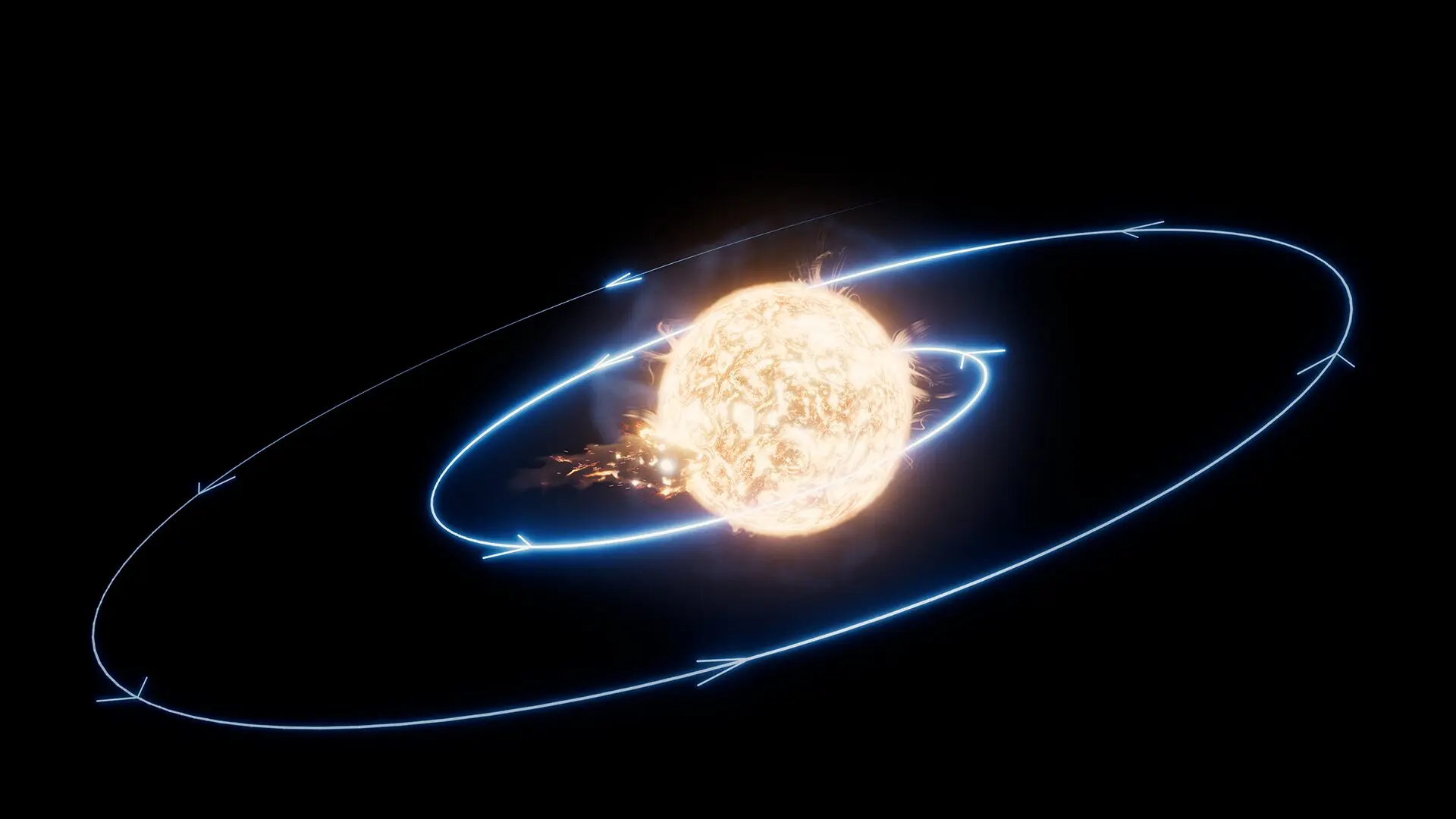
Deep within our Sun, there may lie the ghostly remnants of a world that vanished billions of years ago. A new study suggests that during the dawn of the solar system, the young Sun may have engulfed a rocky super-Earth, leaving behind a chemical signature that continues to influence the star’s internal architecture to this day.
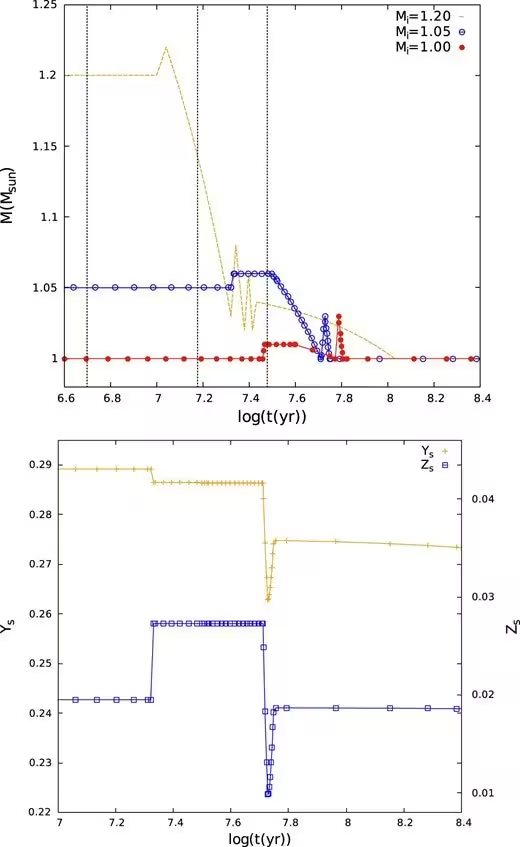
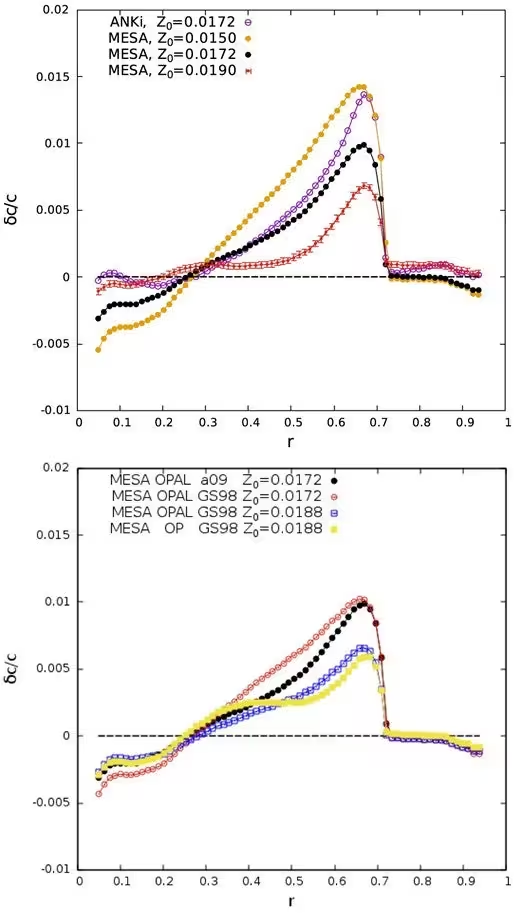
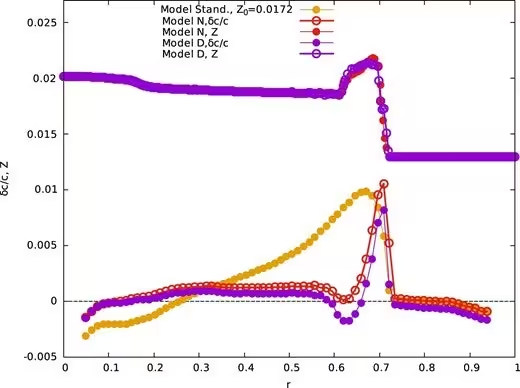
By incorporating the consumption of a massive, rocky planet into solar evolution models, researchers have found a potential solution to long-standing discrepancies in our understanding of the Sun. Standard models have consistently struggled to perfectly align with observed data, particularly regarding the speed of sound beneath the solar convection zone and the curious, extreme depletion of lithium on the solar surface. The new research, published in Monthly Notices of the Royal Astronomical Society and led by Professor Mutlu Yildiz of Ege University, suggests that a swallowed planet could be the missing piece of the puzzle.
Reconciling Solar Anomalies
While scientists have mapped the Sun with high precision using helioseismology—the study of waves traveling through the solar interior—the data frequently clashes with theoretical expectations. The depth of the convection zone and the chemical composition of the solar exterior do not track perfectly with current models. Furthermore, the Sun’s lithium levels are roughly 100 times lower than primordial estimates, implying that surface material must have been dragged into the hotter interior where it was destroyed.
The research team hypothesized that these inconsistencies might share a single origin: the early chemical history of the Sun. By using the MESA stellar-evolution code to simulate the ingestion of planetary material, the team found that adding a super-Earth with roughly 5 to 10 Earth masses creates a chemical layer beneath the convection zone. This layer alters the internal opacity and structure, bringing the simulated Sun into significantly better alignment with actual seismic measurements.
Can a Planet Survive the Dive?
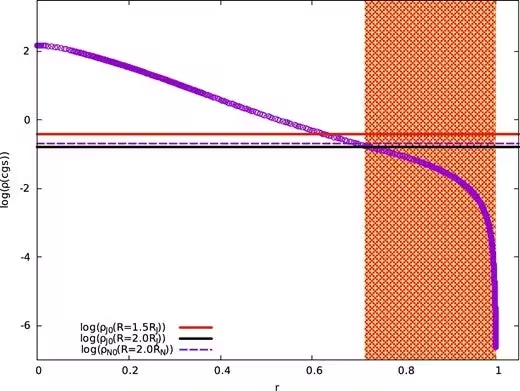
A critical challenge for this hypothesis is determining whether a planet could actually penetrate the Sun’s dense layers without being instantly shredded by heat and drag. The team’s calculations indicate that a compact, rocky super-Earth would be compressed as it descended through the solar envelope. This contraction would reduce its cross-sectional area, limiting the impact of aerodynamic ablation.
While the study does not suggest the planet arrived intact at the core—processes like tidal forces and hydrodynamic instability would inevitably lead to its dissolution—the findings confirm that the planet would not simply evaporate near the surface. Instead, the material would likely settle deep within the star, depositing a metallic “fingerprint” that remains to this day.
A Hidden Piece of Solar History
Though this remains a theoretical model, it highlights a broader trend in astrophysics: many stars may carry the chemical markers of planets they have consumed over eons. The absence of super-Earths in our own solar system, despite their ubiquity around other stars, has long been a subject of speculation. If the hypothesis holds, the missing world is not truly lost; it is simply hidden in plain sight, woven into the very fabric of our Sun.
Future helioseismic data may provide the evidence needed to confirm if such a structural anomaly exists. Until then, the model offers a compelling explanation for why our Sun remains, in some ways, a complex mystery compared to the standard predictions of stellar physics.
Further Reading on Planetary Consumption
- On the formation of super-Earths with implications for the solar system (The Astrophysical Journal, 2016)
- Chemical evidence for planetary ingestion in a quarter of Sun-like stars (Nature Astronomy, 2021)
- Long-term lithium abundance signatures following planetary engulfment (Monthly Notices of the Royal Astronomical Society, 2022)
- Planet engulfment signatures in twin stars (Monthly Notices of the Royal Astronomical Society, 2023)
- At least one in a dozen stars shows evidence of planetary ingestion (Nature, 2024)
This article has been fact checked for accuracy, with information verified against reputable sources. Learn more about us and our editorial process.
Last reviewed on .
Article history
- Latest version
Reference(s)
- <https://academic.oup.com/mnras/article/551/4/stag1527/8787825>.
- Martin, Rebecca G.., et al. “ON THE FORMATION OF SUPER-EARTHS WITH IMPLICATIONS FOR THE SOLAR SYSTEM.” The Astrophysical Journal, vol. 822, no. 2, May 10, 2016, pp. 90 American Astronomical Society, doi: 10.3847/0004-637X/822/2/90. <https://doi.org/10.3847/0004-637X/822/2/90>.
- Spina, Lorenzo., et al. “Chemical evidence for planetary ingestion in a quarter of Sun-like stars.” Nature Astronomy, vol. 5, no. 11, August 30, 2021, pp. 1163-1169. Springer Science and Business Media LLC, doi: 10.1038/s41550-021-01451-8. <https://doi.org/10.1038/s41550-021-01451-8>.
- Sevilla, Jason., et al. “Long-term lithium abundance signatures following planetary engulfment.” Monthly Notices of the Royal Astronomical Society, vol. 516, no. 3, August 29, 2022, pp. 3354-3365. Oxford University Press (OUP), doi: 10.1093/mnras/stac2436. <https://doi.org/10.1093/mnras/stac2436>.
- Behmard, Aida., et al. “Planet engulfment signatures in twin stars.” Monthly Notices of the Royal Astronomical Society, vol. 518, no. 4, December 6, 2022, pp. 5465-5474. Oxford University Press (OUP), doi: 10.1093/mnras/stac3435. <https://doi.org/10.1093/mnras/stac3435>.
- Liu, Fan., et al. “At least one in a dozen stars shows evidence of planetary ingestion.” Nature, vol. 627, no. 8004, March 20, 2024, pp. 501-504. Springer Science and Business Media LLC, doi: 10.1038/s41586-024-07091-y. <https://doi.org/10.1038/s41586-024-07091-y>.
Cite this page:
- Posted by Aisha Ahmed