Ancient Star Knowledge Is Still Alive in South Africa’s Karoo Desert
Long before the SKA telescope, South Africa’s Karoo region held ancient traditions and unique ways of reading the stars that continue to shape local culture.
Long before the colossal radio dishes of the Square Kilometre Array (SKA) and MeerKAT transformed the skyline of South Africa’s Karoo, the region’s inhabitants were already interpreting the cosmos. For generations, local communities have used the heavens to navigate their daily lives, predict environmental shifts, and anchor their cultural narratives.
A recent study published in the Journal of Science Communication offers a deep dive into how these San-descended astronomical traditions have evolved rather than vanished. By working with 52 elders and recognized knowledge holders across seven communities, researcher Anton Binneman found that while some complex cosmological myths have fragmented, a wealth of practical astronomical knowledge remains vibrant and in constant use.
Living Traditions in a Changing World
The research challenges the notion that Indigenous knowledge must be “pure” or static to be considered authentic. Instead, the findings reveal a process of selective memory and adaptation. As languages, religious practices, and social structures in the Karoo have shifted, so too has the way people interact with the night sky.
“Stories are not frozen in time,” Binneman noted. “Language evolves, the way people relate to the sky changes, and our knowledge of the universe changes too.”
Practical observations have shown the most resilience. For instance, the planet Venus is widely recognized as a functional marker, often referred to by the Afrikaans term boer se horlosie (farmer’s clock), signaling the start or end of the workday. Similarly, the zodiacal light is associated with Invaltyd, or the time to begin daily tasks, while lunar cycles remain tethered to rainfall and seasonal predictions.
A New Model for Knowledge Exchange
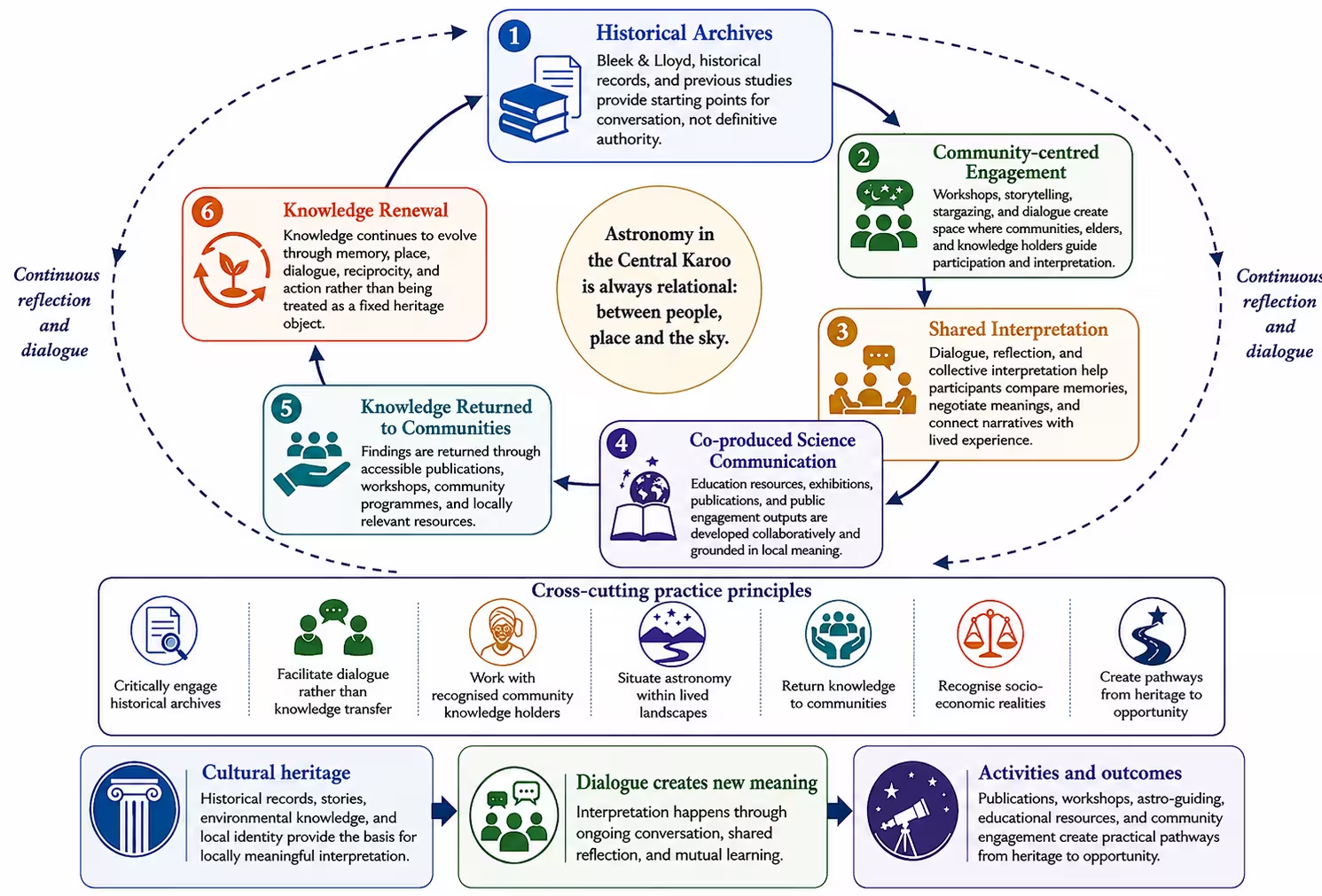
Rather than relying solely on historical records—such as the 19th-century Bleek and Lloyd archive—the study implemented a “Dialogical Knowledge Renewal Model.” This framework moves away from the idea of “recovering” a lost past, favoring a dynamic exchange between historical data, contemporary community insights, and modern scientific discovery.
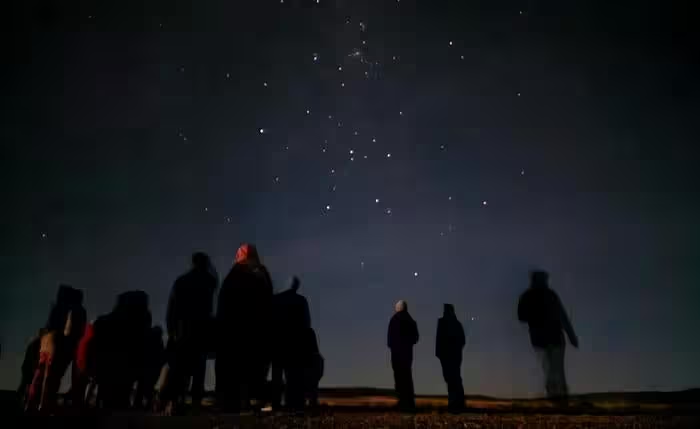
By engaging participants through evening stargazing sessions and informal interviews, the research team found that ancient stories often persist in fragmented ways. The Milky Way, for example, is still widely known as Hemelstraat (heavenly road), even if the specific foundational myth—such as the ancient narrative of a girl casting ashes into the sky to create light—has become less central to contemporary life.
Science as a Partner, Not a Replacement
The integration of modern radio astronomy into the Karoo landscape does not occur in a vacuum. By creating spaces where scientific inquiry and cultural heritage can coexist, the project has fostered new opportunities, including local astro-tourism, specialized guide training, and heritage initiatives. This approach suggests that large-scale science infrastructure can serve as a catalyst for cultural validation rather than just an external imposition.
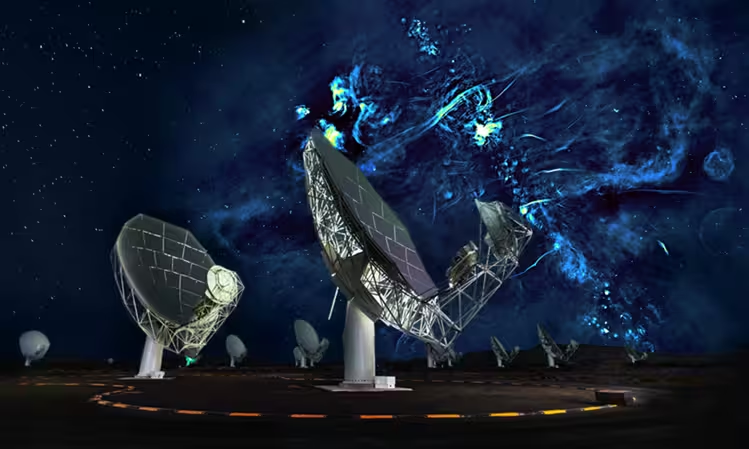
Ultimately, the presence of the MeerKAT and the expanding SKA-Mid facility represents a new layer of observation in a region with a deep, ancestral history of sky-watching. As Binneman emphasizes, the arrival of modern telescopes does not mark the beginning of astronomy in the Karoo, but rather a new chapter in a long-standing human dialogue with the universe.
Further Reading
- Star stories: using indigenous knowledge for stakeholder engagement (Communitas, 2020)
- Elusive Identities: Karoo |Xam Descendants and the Square Kilometre Array (Journal of Southern African Studies, 2019)
- Shared Sky (SKA Observatory, 2024)
This article has been fact checked for accuracy, with information verified against reputable sources. Learn more about us and our editorial process.
Last reviewed on .
Article history
- Latest version
Reference(s)
- “Home - South African Radio Astronomy Observatory - NRF-SARAO.”, March 10, 2013 South African Radio Astronomy Observatory - NRF-SARAO <https://www.sarao.ac.za/>.
- Binneman, Anton. “Star stories: using indigenous knowledge for stakeholder engagement.”, vol. 25, pp. 1-17., doi: 10.18820/24150525/comm.v25.1. <https://www.scielo.org.za/scielo.php?pid=S2415-05252020000100001&script=sci_arttext>.
- Parkington, John., et al. “Elusive Identities: Karoo |Xam Descendants and the Square Kilometre Array.” Journal of Southern African Studies, vol. 45, no. 4, August 12, 2019, pp. 729-747. Informa UK Limited, doi: 10.1080/03057070.2019.1647655. <https://www.tandfonline.com/doi/full/10.1080/03057070.2019.1647655>.
- “Shared Sky | SKAO.” <https://www.skao.int/en/217/shared-sky>.
Cite this page:
- Posted by Aisha Ahmed