New Study Reveals Venus Clouds May Hide Darker Material Than We Ever Imagined
For nearly a century, scientists have puzzled over the mysterious dark patterns in Venus’s clouds. What is the unknown substance absorbing ultraviolet light?
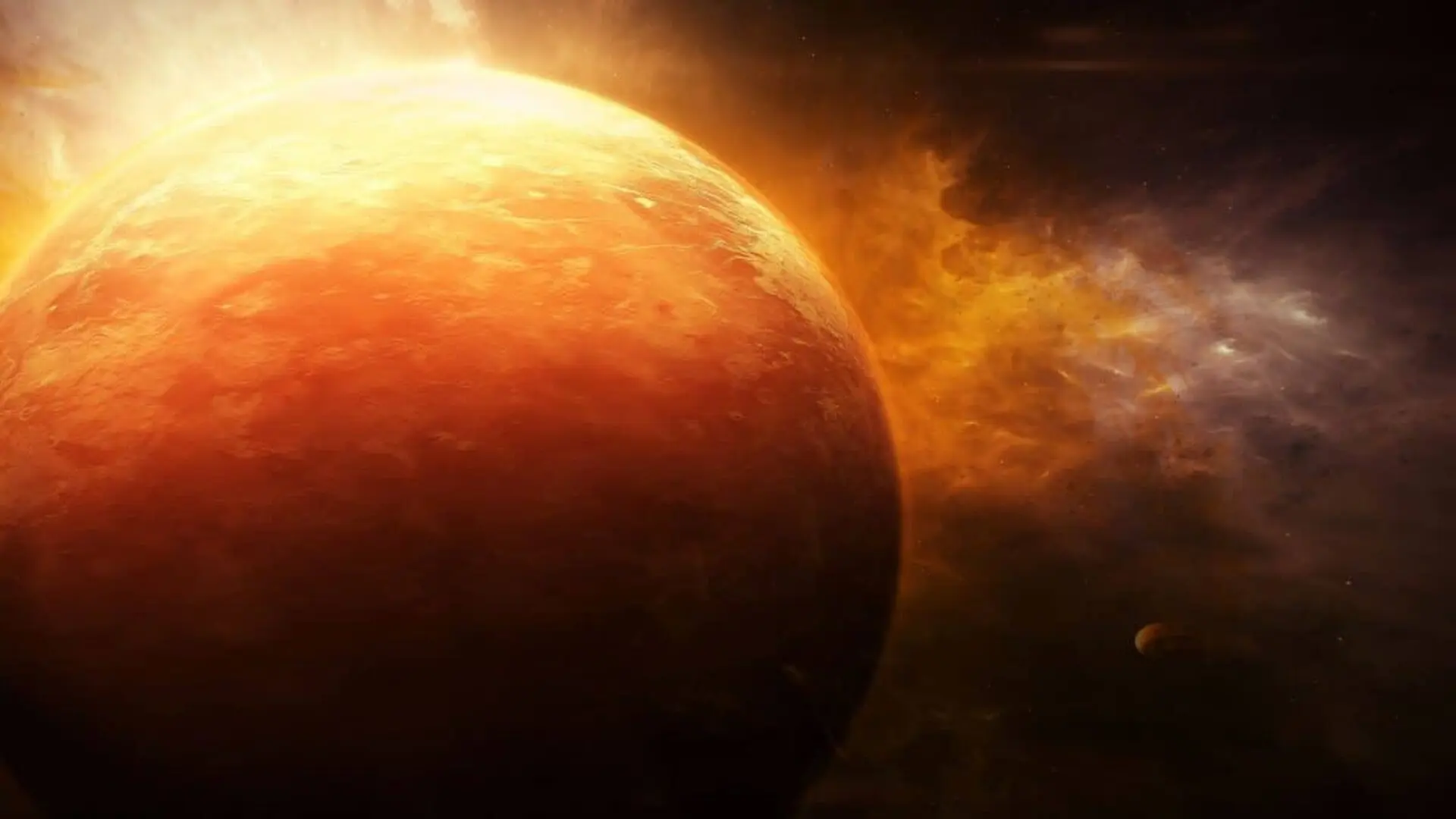
For nearly a century, astronomers have been puzzled by mysterious, dark atmospheric features on Venus that appear in ultraviolet light. A new study published in the journal Astrobiology has moved us closer to solving this riddle by placing rigorous constraints on the physical and chemical properties of the material responsible for these patterns.
Narrowing the Search for the Venusian Absorber
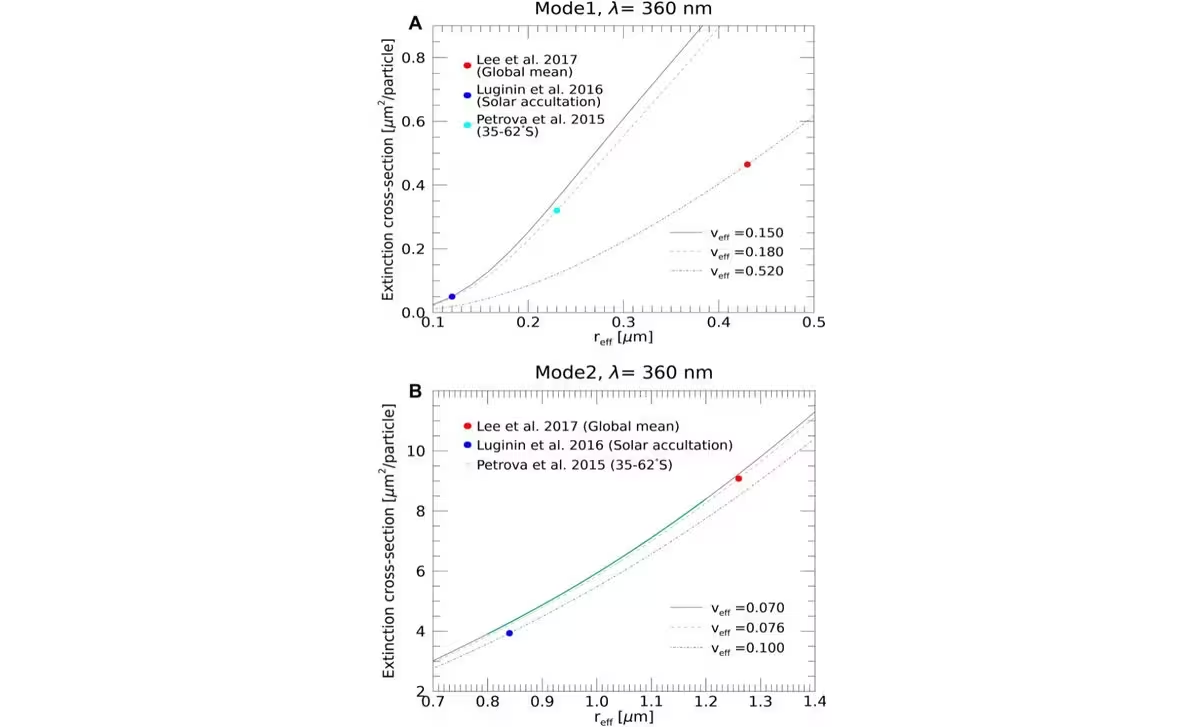
The dark markings in the planet’s upper clouds are not static; they shift through the atmosphere in a rapid, circulation-driven cycle. Observations have long suggested that the mystery substance is not a gas, but rather something embedded within the cloud droplets themselves. By integrating archival data with advanced radiative-transfer modeling, researchers have now calculated the precise levels of ultraviolet and blue light absorption required to mirror the patterns observed by telescopes and interplanetary spacecraft.
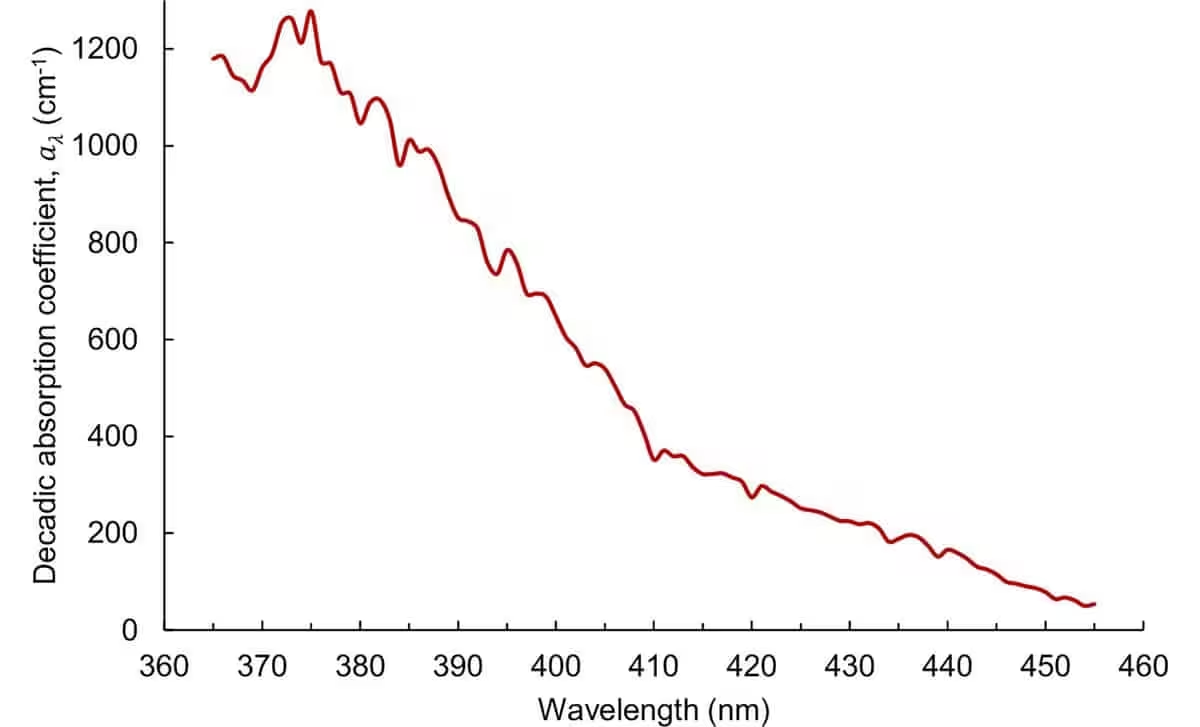
The analysis indicates that the liquid within Venus’s sulfuric acid aerosols must possess an exceptionally high absorption strength, particularly in the 365 to 455 nanometer range. Specifically, the team calculated a decadic absorption coefficient reaching approximately 1,278 cm−1 at 375 nanometers. This suggests that the mystery material is either incredibly efficient at soaking up light or exists in significant concentrations within the droplets.
Lead author Jan Spacek likens the team’s methodology to performing a spectroscopic analysis of cloud samples in a lab. Because Venus’s clouds scatter light so effectively, they often appear bright from afar, masking the dark, concentrated nature of the particles contained within. The researchers point to the behavior of cigarette smoke as a terrestrial analogy: fine particles scatter light to appear white, even though the constituent material is a dark, complex suspension.
Evaluating Potential Candidates
The researchers investigated whether carbon-based organic molecules could account for these observations. While some complex compounds, such as porphyrinoid pigments, exhibit strong light absorption, the study notes that this is not evidence of biological activity. Instead, these molecules were selected as benchmarks for testing whether high-concentration organic matter could explain the observed optical signatures.
The findings indicate that if such pigments were present, they would need to be held at a concentration of roughly 10 grams per liter to match the planet’s observed profile. However, the study also identified a discrepancy: while simple organic compounds reacting in sulfuric acid tend to produce broad, dark mixtures across multiple wavelengths, the observed data from Venus shows a distinct and sharper drop-off in absorption between 365 and 455 nanometers.
Paul B. Rimmer of the University of Cambridge, a co-author on the study, emphasized that the model establishes a challenging set of requirements for any potential candidate, noting that many inorganic materials would struggle to reach the necessary concentrations to replicate the phenomenon. The study leaves open the possibility that a mixture of substances, rather than a single component, may be at play.
Looking ahead, upcoming initiatives like the Morning Star Missions aim to move beyond modeling by deploying technology such as the Autofluorescence Nephelometer. These instruments are designed to probe cloud particles directly for evidence of organic fluorescence. By defining the exact physical and chemical boundaries of the problem, this research provides a clear roadmap for future missions seeking to solve one of the most enduring mysteries of our neighboring world.
This article has been fact checked for accuracy, with information verified against reputable sources. Learn more about us and our editorial process.
Last reviewed on .
Article history
- Latest version
Reference(s)
- Spacek, Jan., et al. “A Model of UV–Blue Absorbance in Bulk Liquid of Venusian Cloud Aerosols Is Consistent with Efficient Organic Absorbers at High Concentrations.” Astrobiology, vol. 26, no. 9, August 25, 2026, pp. 727-739. SAGE Publications, doi: 10.1177/15311074261477502. <https://journals.sagepub.com/doi/10.1177/15311074261477502>.
Cite this page:
- Posted by Aisha Ahmed