Astronomers Discover Ancient Proto-Supercluster 5,000 Times the Mass of the Milky Way
Astronomers have discovered a colossal structure from the early Universe, 5,000 times the mass of the Milky Way, revealing how cosmic giants first assembled.
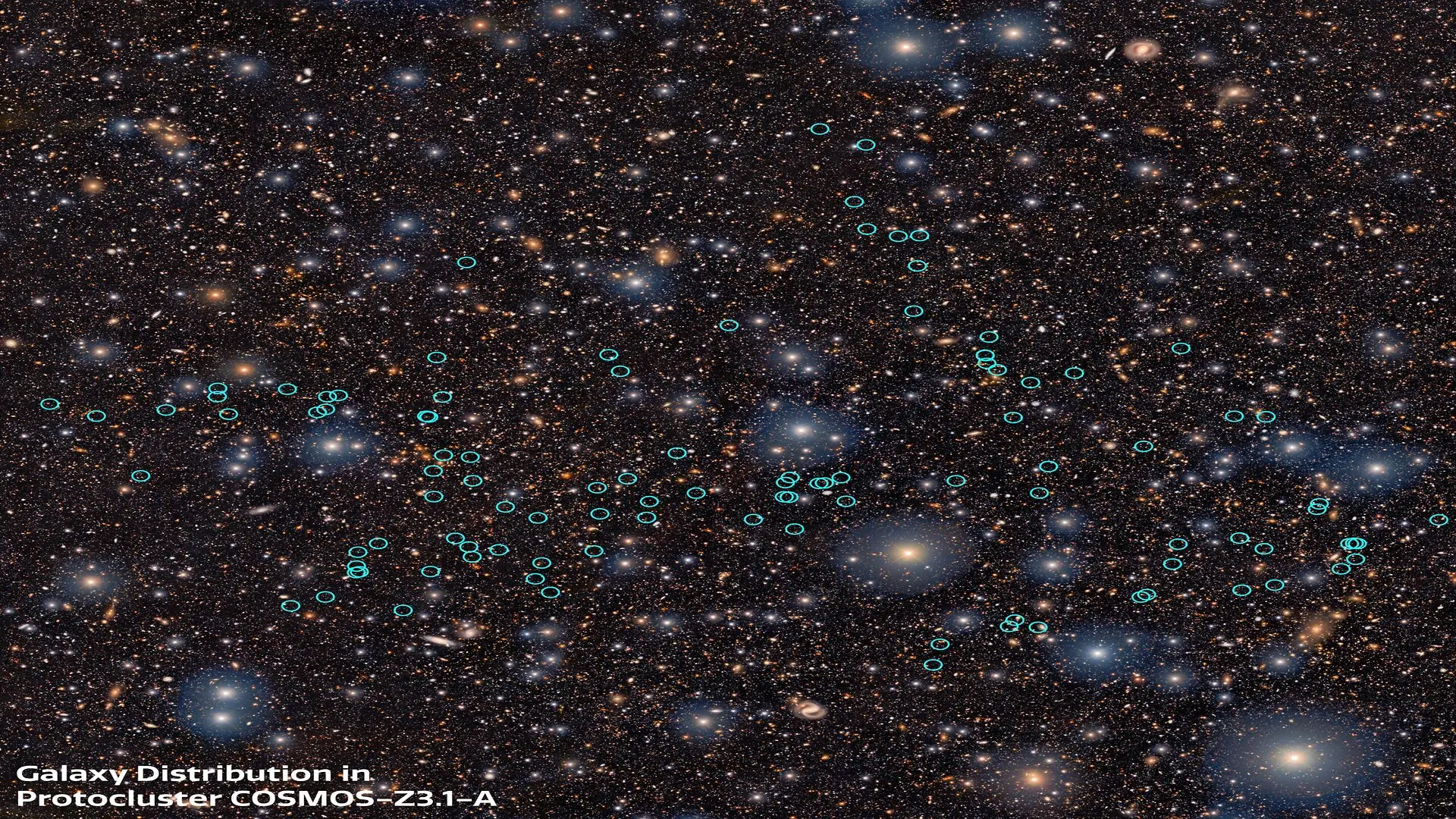
Astronomers have mapped two massive structures dating back to when the universe was just 2.1 billion years old, offering a rare look at the formative stages of the cosmic web. These findings reveal complex, sprawling systems of dense galaxy clumps that are currently coalescing, providing evidence for the hierarchical model of structure formation.
The most prominent of these, dubbed COSMOS-z3.1-A, contains 10 distinct high-density regions connected by long filaments of matter. With an estimated mass roughly 5,000 times that of the Milky Way, researchers have classified it as a proto-supercluster—the most distant and earliest example of its kind ever identified. This gargantuan system is expected to eventually evolve into a galaxy cluster more than twice as massive as the well-known Coma Cluster.
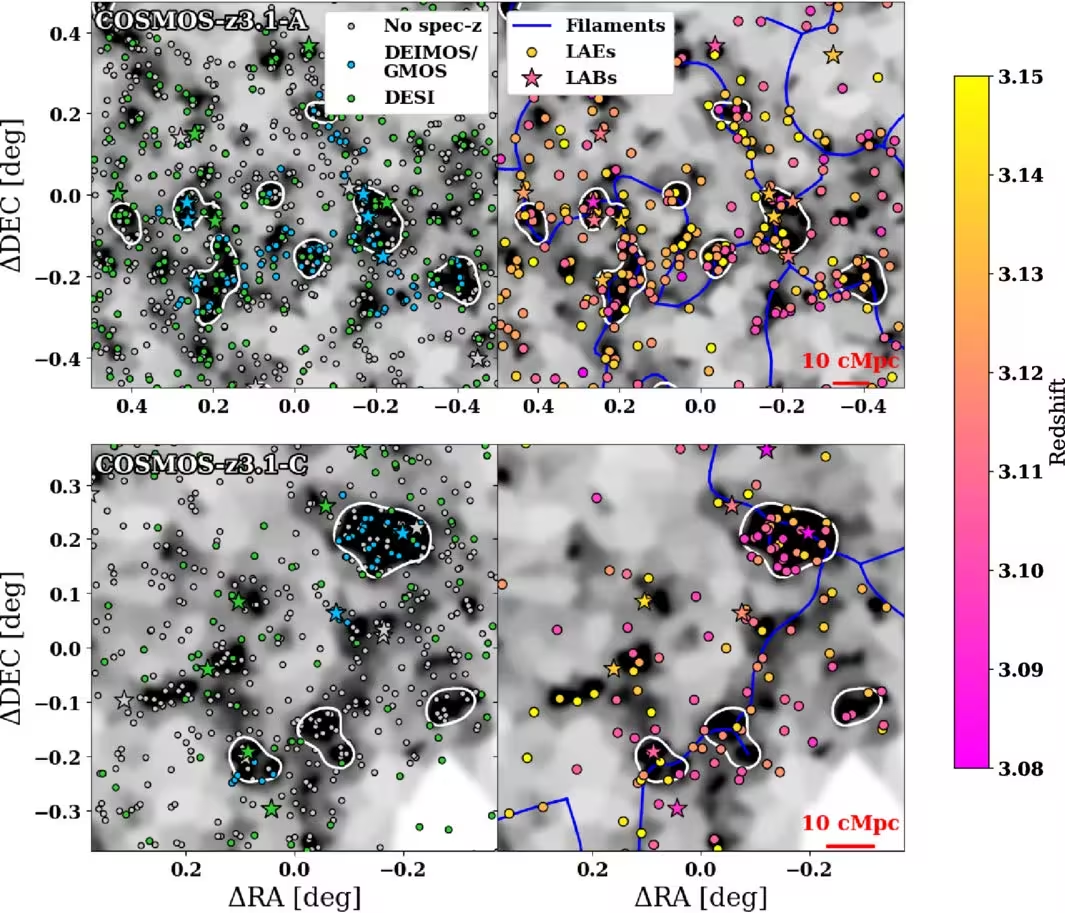
The research, published in The Astrophysical Journal, was led by an international team headed by Vandana Ramakrishnan, then at Purdue University. By utilizing data from the One-hundred-deg² DECam Imaging in Narrowbands (ODIN) survey alongside precise spectroscopic measurements from the Dark Energy Spectroscopic Instrument (DESI) and telescopes in Hawaii and Chile, the team successfully transitioned from two-dimensional sky maps to complex three-dimensional reconstructions.
Mapping the Architecture of the Early Universe
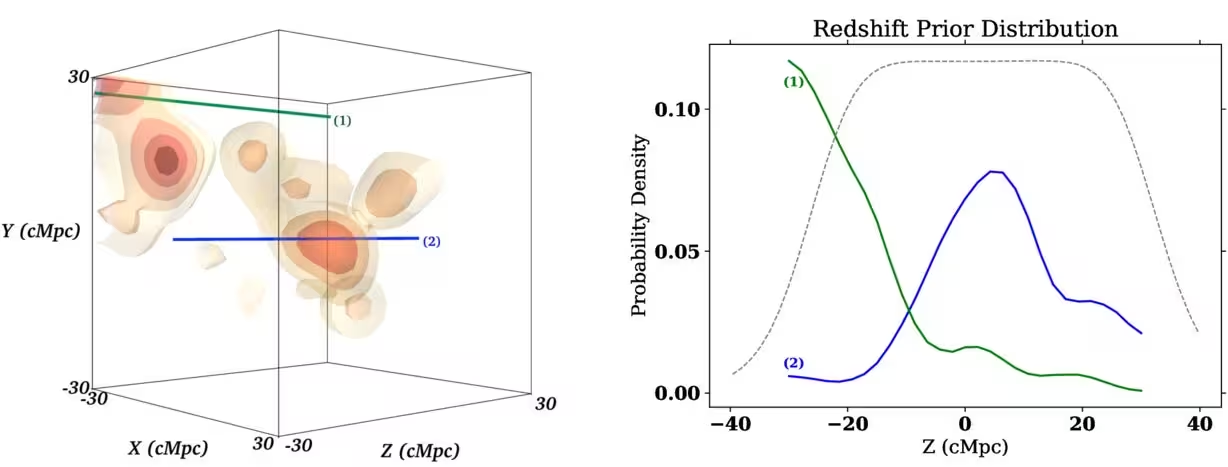
While standard imaging can identify galaxy overdensities, it often fails to account for the true distance between objects along the line of sight. By integrating spectroscopic redshifts with a probabilistic mapping technique, the researchers were able to confirm the three-dimensional positions of hundreds of Lyman-alpha-emitting galaxies. This approach allowed them to visualize how these early structures are fed by the cosmic web, with matter flowing into the center of these growing gravitational wells.
The second structure studied, COSMOS-z3.1-C, also displayed a highly organized, elongated morphology, characterized by four primary density peaks. The architecture observed in both systems aligns with the “bottom-up” theory of cosmic evolution, where smaller concentrations of dark matter and gas merge over time to produce the large-scale structures observed in the modern universe.
The study also yielded insights into the nature of Lyman-alpha blobs—luminous clouds of hydrogen gas. None of the confirmed blobs were found within the most densely packed cores of these clusters, instead appearing in the surrounding filaments and outskirts. This suggests that these intense regions of activity are closely tied to the broader environment of the cosmic web rather than the clusters themselves.
Challenges in Cosmic Archaeology
Identifying such extreme structures is inherently difficult, as their appearance can shift drastically depending on the observer’s vantage point. Some protoclusters may appear compact or fragmented based on their orientation, making wide-field spectroscopic surveys critical for identifying the most massive systems in the early universe.
The discovery of COSMOS-z3.1-A highlights the power of combining deep imaging with large-scale spectroscopic surveys. As new facilities like the Vera C. Rubin Observatory come online, astronomers anticipate finding even more of these “construction sites,” offering a clearer picture of how the most massive entities in existence were assembled billions of years ago.
Additional Research and Context
The progeny of a cosmic titan: a massive multi-component proto-supercluster in formation at z = 2.45 in VUDS: Describes Hyperion, the seven-component proto-supercluster that provides an important comparison for the newly mapped COSMOS-z3.1-A structure. (Astronomy & Astrophysics, 2018)
ODIN: High Clustering Strength of Protoclusters at Cosmic Noon: Examines 150 ODIN protocluster candidates and shows that their clustering is consistent with their evolution into massive present-day galaxy clusters. (The Astrophysical Journal, 2025)
cosmic web in Lyman-alpha emission: Models Lyman-alpha emitters, halos, blobs and filaments to investigate how glowing hydrogen can trace the otherwise faint cosmic web. (Monthly Notices of the Royal Astronomical Society, 2023)
This article has been fact checked for accuracy, with information verified against reputable sources. Learn more about us and our editorial process.
Last reviewed on .
Article history
- Latest version
Reference(s)
- Ramakrishnan, Vandana., et al. “ODIN: Characterizing the Three-dimensional Structure of Two Protocluster Complexes at z = 3.1.” The Astrophysical Journal, vol. 1008, no. 2, September 8, 2026, pp. 220 American Astronomical Society, doi: 10.3847/1538-4357/ae8091. <https://iopscience.iop.org/article/10.3847/1538-4357/ae8091>.
- “Purdue University - Indiana’s Land Grant University.” Purdue University <https://www.google.com/goto?url=CAESTwHrOzAVlCOhvtfc57yxiW7XIFtfCdII4kVmictfWZPDLAAu4yFfbwgmmiVMVH8CLQl3XYABst21DVmCbMy39VF6uklMxlEOrfwHgnw8b8k>.
- Cucciati, O.., et al. “The progeny of a cosmic titan: a massive multi-component proto-supercluster in formation at z = 2.45 in VUDS.” Astronomy & Astrophysics, vol. 619, November 6, 2018, pp. A49 EDP Sciences, doi: 10.1051/0004-6361/201833655. <https://doi.org/10.1051/0004-6361/201833655>.
- Ramakrishnan, Vandana., et al. “ODIN: High Clustering Strength of Protoclusters at Cosmic Noon.” The Astrophysical Journal, vol. 982, no. 2, March 20, 2025, pp. 74 American Astronomical Society, doi: 10.3847/1538-4357/adb624. <https://doi.org/10.3847/1538-4357/adb624>.
- <https://academic.oup.com/mnras/article/523/4/5248/7199176>.
Cite this page:
- Posted by Aisha Ahmed