Scientists Create Bizarre Ice That Stays Solid at 2,000 Degrees Celsius
Scientists have recreated extreme conditions to discover a mysterious new state of water that may exist deep within the interiors of distant planets.
Researchers have successfully engineered a paradoxical form of ice that remains solid even at temperatures exceeding 2,000°C. By subjecting water to crushing forces that mimic the extreme conditions found deep within the icy giants of our solar system, scientists have uncovered a material state that challenges our traditional understanding of planetary interiors.
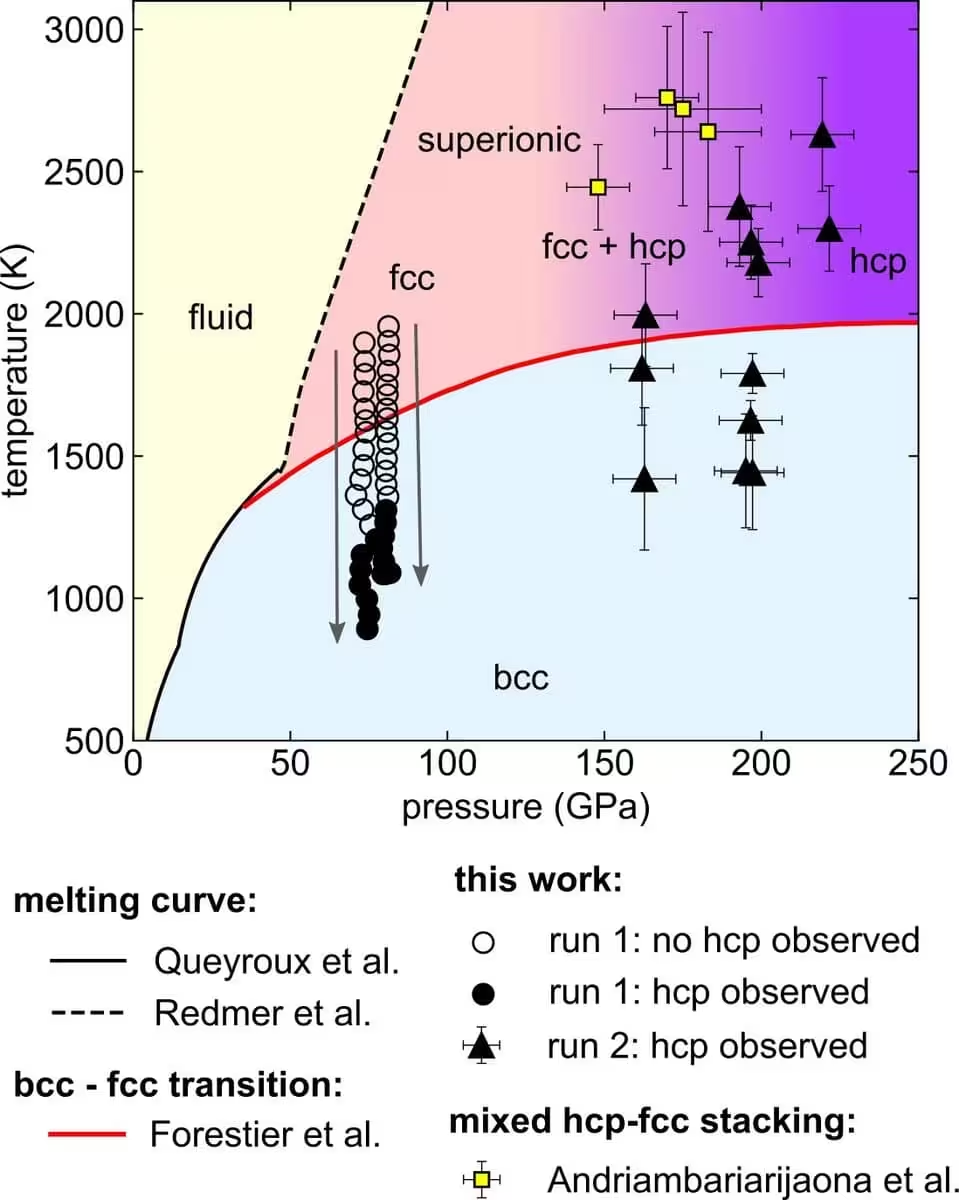
To reach these conditions, a team utilized a diamond-anvil cell, which squeezed a minuscule droplet of water between two diamonds under pressures reaching 219 gigapascals. When subjected to intense laser heating, the water transitioned into a state known as superionic ice. Unlike the rigid, structured ice found in a kitchen freezer, this exotic material maintains a solid lattice of oxygen atoms while allowing hydrogen nuclei to drift freely through the framework, effectively creating a solid that can conduct electricity.
A New Phase of Matter Under Extreme Stress
The experimental results, recently detailed in Physical Review Letters, demonstrate that water can adopt a hexagonal close-packed (hcp) crystal structure at temperatures as high as 2,630 kelvins (approximately 2,357°C). While the concept of superionic water has been theorized for decades, and initial experimental evidence began to emerge in 2018 and 2019, this latest work provides a deeper look into the atomic shifts that define its behavior.
Deciphering the Depths of Neptune and Uranus
Led by Alexis Forestier of the French Alternative Energies and Atomic Energy Commission, the research team used X-ray diffraction at the European Synchrotron Radiation Facility to observe the sample as it reached a width of just 12 micrometers. The transition to the hcp structure was found to be a gradual, multi-step process rather than an instantaneous change, with layers of atoms rearranging as the pressure and thermal energy shifted the material’s properties.
These findings hold significant implications for planetary science, particularly concerning the internal dynamics of Uranus and Neptune. These giants possess strangely tilted, complex magnetic fields that current models struggle to fully explain. Scientists have long hypothesized that deep-seated, conductive layers of water could generate these fields. The discovery that superionic ice exhibits high electrical conductivity provides a compelling, evidence-based mechanism for how these magnetic environments might be sustained.
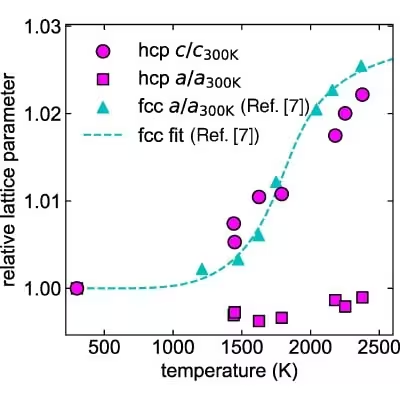
The research also noted an expansion phenomenon near 1,700 kelvins (1,427°C), which the team links to the onset of the superionic state. This directional expansion suggests that hydrogen atoms may be following specific pathways through the crystal lattice. As researchers refine their models of these planetary interiors, this high-temperature ice serves as a vital key to unlocking the mysteries of the outer solar system.
This article has been fact checked for accuracy, with information verified against reputable sources. Learn more about us and our editorial process.
Last reviewed on .
Article history
- Latest version
Reference(s)
- Forestier, Alexis., et al. “Observation of Hexagonal Close-Packed Water Ice at Conditions in Ice Giant Planetary Interiors.” Physical Review Letters, vol. 137, no. 11, September 9, 2026 American Physical Society (APS), doi: 10.1103/sdrk-3m4t. <https://journals.aps.org/prl/accepted/10.1103/sdrk-3m4t>.
- Millot, Marius. “Experimental evidence for superionic water ice using shock compression - Nature Physics.”, vol. 14, no. 3, pp. 297-302. Nature, doi: 10.1038/s41567-017-0017-4. <https://www.nature.com/articles/s41567-017-0017-4>.
- Millot, Marius. “Nanosecond X-ray diffraction of shock-compressed superionic water ice - Nature.”, vol. 569, no. 7755, pp. 251-255. Nature, doi: 10.1038/s41586-019-1114-6. <https://www.nature.com/articles/s41586-019-1114-6>.
- <https://www.researchgate.net/profile/Alexis-Forestier>.
Cite this page:
- Posted by Aisha Ahmed