Fornax Pair of Ghost Galaxies Appears Almost Dark‑Matter‑Free Hinting at Violent Origins
Astronomers detect rare dark-matter-free galaxies in Fornax Cluster hinting at unusual cosmic collisions

A new study of two faint, sprawling galaxies on the fringe of the Fornax Cluster suggests they may contain almost no dark matter, a result that could upend current ideas about galaxy assembly. The research, posted on the arXiv preprint server, focuses on the ultra‑diffuse systems FCC 224 and FCC 240, whose strange dynamics may reveal a violent birth scenario.
Fornax Ultra‑Diffuse Galaxies Appear Almost Dark‑Matter‑Free
Ultra‑diffuse galaxies (UDGs) are as large as the Milky Way but host only a fraction of its stars. While many UDGs are thought to be “failed” galaxies dominated by dark matter, a handful seem to lack this invisible component. The two Fornax objects, FCC 224 and FCC 240, fall into that rare category. Spectroscopic data obtained with the MUSE instrument on the Very Large Telescope show that both the stellar bodies and their globular clusters move very slowly, indicating that the gravitational pull inside the half‑light radius is supplied almost entirely by the visible stars. Consequently, the dynamical masses derived for these regions are nearly identical to the measured stellar masses, far below the values typical for ordinary dwarf galaxies. Such low velocity dispersions place these systems among the most unusual galactic structures known.
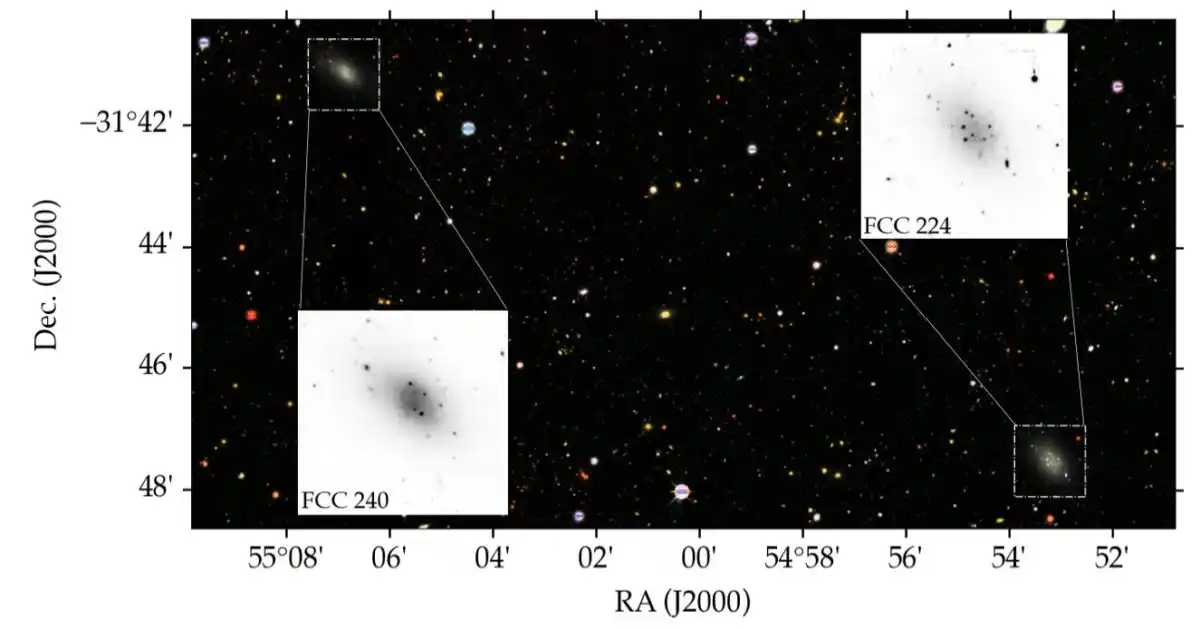
Credit: Maria Luisa Buzzo
Signs of a Catastrophic Collision
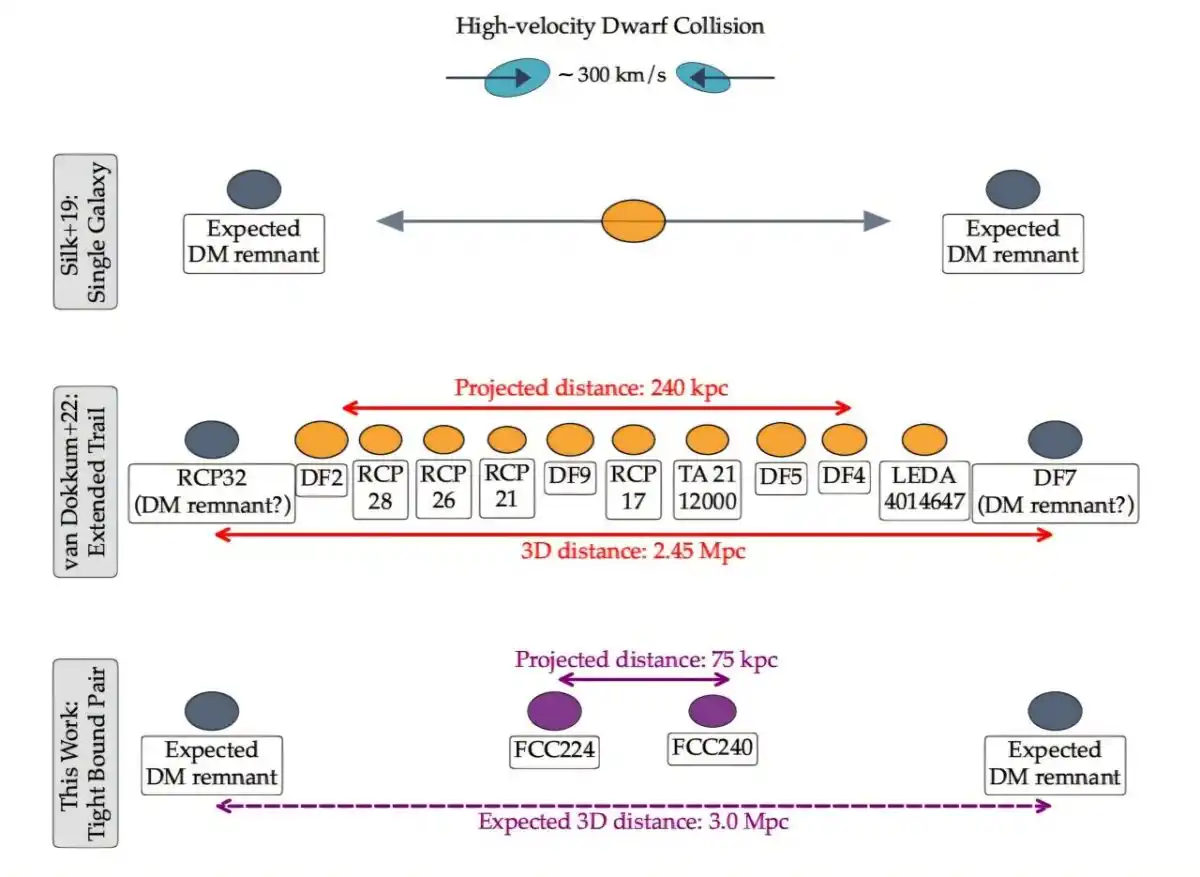
Both galaxies also host unusually bright globular clusters whose luminosities echo those found in the previously identified dark‑matter‑deficient systems DF2 and DF4. The clusters share the same age—about ten billion years—and metallicity as the surrounding stellar populations, suggesting a common formation history. The authors argue that these characteristics fit a “bullet‑dwarf” collision model, in which two dwarf galaxies smash together at high speed, stripping away most of their dark matter and igniting a brief, intense burst of star formation that creates both the diffuse galaxy and its massive clusters.
“Taken together, these results suggest that FCC 224 and FCC 240 may have formed in a high‑velocity collision similar to the event proposed for DF2 and DF4,” the researchers conclude.
How These Twins Differ From DF2 and DF4
Unlike DF2 and DF4, which are separated by roughly 240 kiloparsecs and belong to an extended stream of debris, FCC 224 and FCC 240 lie only about 75 kiloparsecs apart and are approaching each other at a modest 16 kilometers per second. This tighter configuration hints at a long‑lived gravitational partnership rather than a scattered collection of fragments. Nevertheless, the authors propose that both pairs could have emerged from similarly energetic impacts, with variations in orbital geometry producing either a sprawling chain of remnants or a compact binary system. The discovery therefore suggests that dark‑matter‑deficient galaxies might represent a broader class of collision‑driven objects.
Where to Look for Missing Dark Matter
The investigators estimate that any dark‑matter remnants left over from the original impact could be located roughly three megaparsecs away along the projected collision axis. Identifying such fragments would provide a natural test for the bullet‑dwarf hypothesis and might uncover additional ejected halos. Further deep observations will be required to decide whether FCC 224 and FCC 240 formed as a coupled pair or as independent products of a single violent event. The full dataset, released on the arXiv preprint server, offers some of the strongest evidence to date that high‑speed dwarf collisions can sculpt galaxies in unexpected ways.
This article has been fact checked for accuracy, with information verified against reputable sources. Learn more about us and our editorial process.
Last reviewed on .
Article history
- Latest version
Reference(s)
- Buzzo, Maria. “Dark matter-deficient twins: FCC 224 and FCC 240 as possible analogues of NGC 1052-DF2 and DF4.” arXiv.org <https://arxiv.org/abs/2605.24099>.
Cite this page:
- Posted by Aisha Ahmed