Microscopic Cracks in Martian Salt Crystals Could Harbor Secret Life Habitats
Tiny salt fractures on Mars could act as microscopic havens, trapping liquid water and potentially providing a protected environment for microbial life.
Microscopic fissures within Martian salt crystals may offer a temporary sanctuary for microbial life, according to new research published in the journal Icarus. The findings suggest that the extreme temperature fluctuations characteristic of the Red Planet could periodically create protected pockets of liquid water, shielding potential organisms from the harsh surface environment.
Thermal Stress as a Potential Life-Support System
The quest for extraterrestrial life on Mars has been long hindered by a fundamental disparity: the necessary conditions for biology—liquid water, heat, and radiation shielding—rarely coincide in time and space. A research team led by Anna Bognar of ELTE Eötvös Loránd University and the Konkoly Observatory proposes that common minerals might bridge this gap.
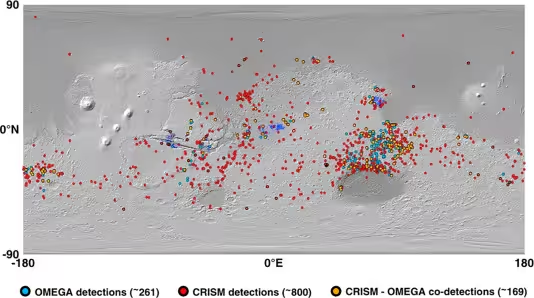
By analyzing the behavior of halite—a mineral compositionally similar to common table salt—the team modeled how these crystals respond to the intense thermal cycle of the Martian surface, where temperatures can swing by as much as 150 degrees Celsius within a single day. This rapid thermal expansion and contraction cause the crystals to shrink and shift by up to 1.6%, creating tiny, internal fractures within the mineral structure.
Capturing Moisture in a Barren Landscape
The mechanism relies on a process known as deliquescence. During the freezing Martian nights, as surface temperatures plummet to roughly -80 degrees Celsius, hygroscopic salts draw moisture directly from the thin atmosphere. This vapor condenses into concentrated brine within the microscopic cracks formed by the daily thermal cycles.
As the sun rises and temperatures climb, the salt crystals expand, potentially sealing these fractures and locking the brine inside. This trapped liquid remains protected from the rapid evaporation that characterizes the exposed Martian surface. Researchers believe these interior chambers could maintain a liquid state for several hours, providing a window of habitability. Furthermore, the mineral structure itself acts as a natural filter, blocking lethal ultraviolet radiation while permitting enough light for potential photosynthetic processes.
Biological Precedents and Future Exploration
The concept of “salt-dwelling” life is not purely speculative. In Earth’s Atacama Desert, cyanobacteria are known to thrive within the pores of halite rocks, harvesting atmospheric moisture that the soil cannot retain. While the Martian environment is undeniably more hostile—defined by lower atmospheric pressure and higher radiation—the terrestrial model proves that mineral-based niches can sustain life in extreme aridity.
However, the researchers caution that this model remains a theoretical possibility rather than proof of current life. The presence of toxic perchlorates within Martian salts, combined with the penetration of high-energy cosmic rays, presents significant hurdles for any potential organism. Despite these challenges, the Icarus study highlights a critical new focus for future planetary missions: moving beyond the search for surface-level water to investigate the hidden, microscopic habitats embedded within Martian geology.
This article has been fact checked for accuracy, with information verified against reputable sources. Learn more about us and our editorial process.
Last reviewed on .
Article history
- Latest version
Reference(s)
- Bognar, Anna., et al. “Current water trapping micro-habitats on the surface of Mars.” Icarus, vol. 460, December 1, 2026, pp. 117273 Elsevier BV, doi: 10.1016/j.icarus.2026.117273. <https://www.sciencedirect.com/science/article/pii/S0019103526003398?via%3Dihub>.
Cite this page:
- Posted by Aisha Ahmed