Powerful New Simulation Reveals How The First Stars Shaped Our Universe’s Smallest Galaxies
New MEGATRON simulations reveal how ancient stellar explosions shaped the iron patterns found in today’s dwarf galaxies, linking the universe’s first stars.
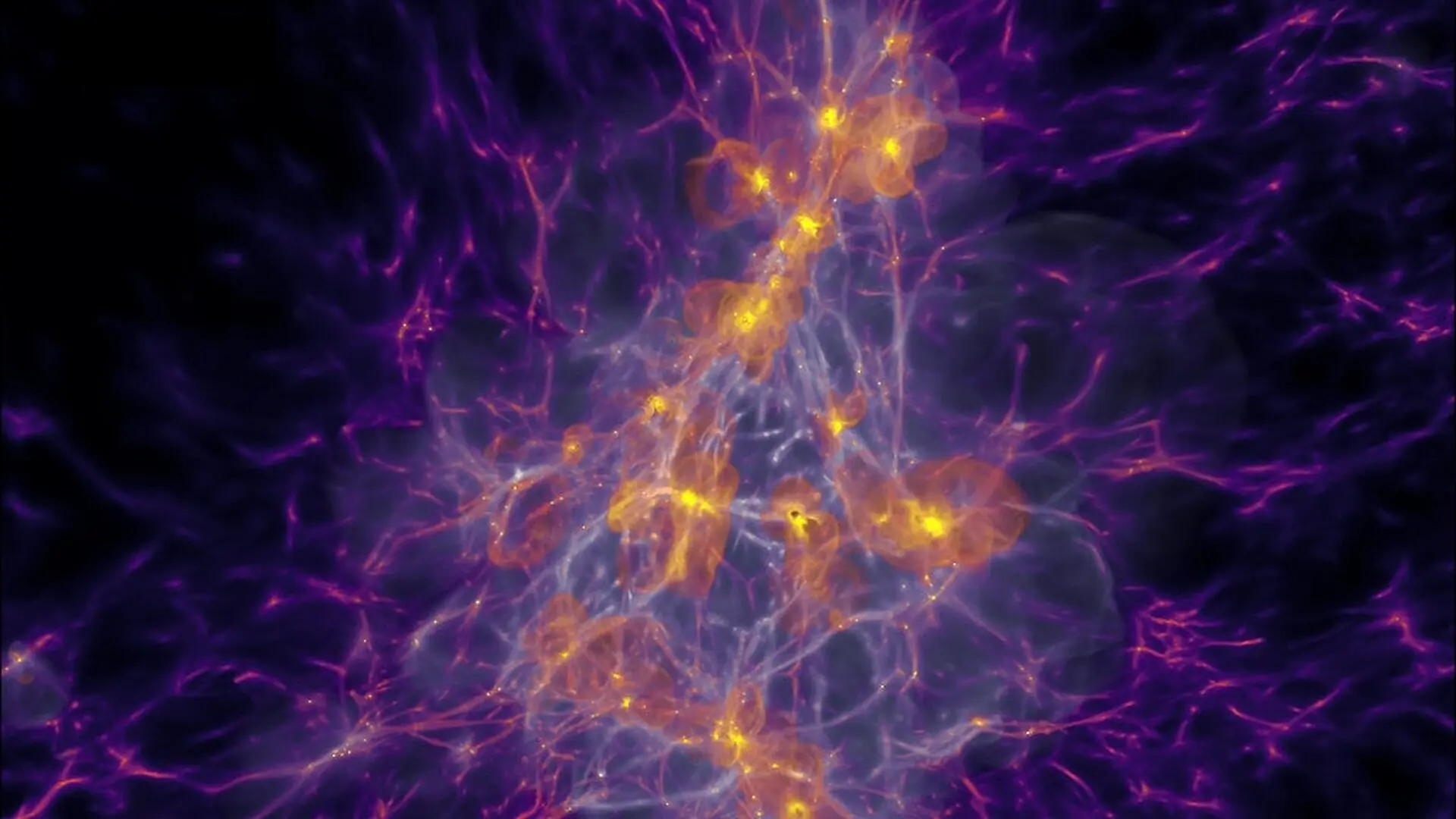
A new suite of sophisticated computer simulations, known as MEGATRON, is providing fresh insights into a long-standing cosmic mystery: why many of the universe’s tiniest galaxies exhibit a curiously uniform concentration of iron, regardless of their total stellar mass. These findings suggest that the chemical signatures of the very first generation of stars may still be echoing in the dwarf galaxies we observe today.
The research, published in a series of four papers in The Open Journal of Astrophysics, was led by scientists at the University of Bath in collaboration with teams from the University of Chicago and the Institut d’Astrophysique de Paris. By modeling the complex interplay between gas, radiation, and chemical evolution in the early universe, the project offers a bridge between observations of distant, ancient galaxies and the study of local “fossil” stars.
Bridging Ancient Stars and Modern Telescopes
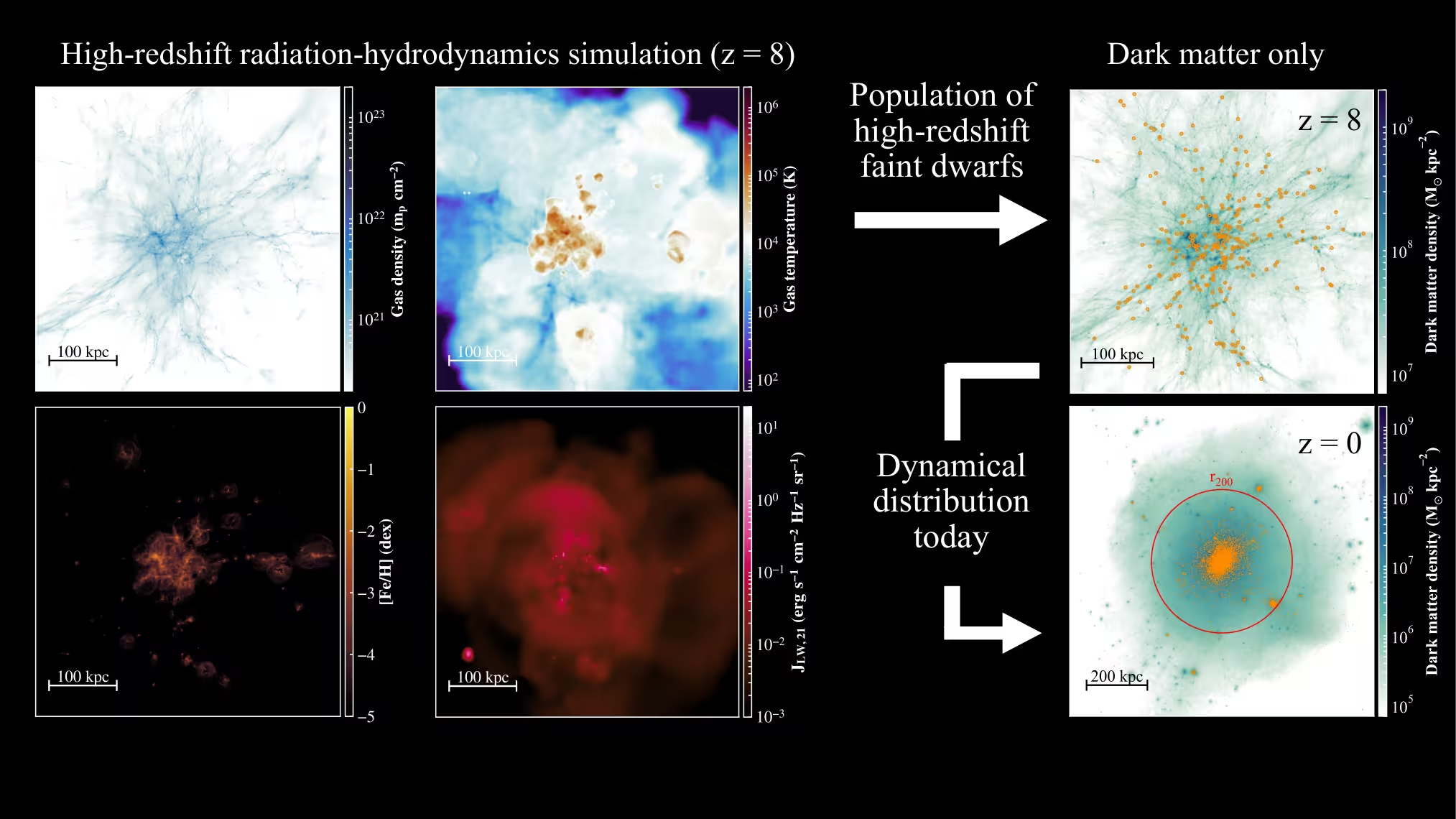
Astronomers currently use two primary methods to probe the dawn of the cosmos. Advanced observatories like the James Webb Space Telescope capture the light from the most distant, primeval galaxies, while “stellar archaeology” allows researchers to analyze the chemical makeup of ancient stars within our own celestial neighborhood. "The James Webb Space Telescope gives us a direct glimpse of the infant cosmos, while stellar archaeology allows us to study the relics of those earliest times in our own Galactic neighbourhood,“ explains Martin Rey, a physicist at the University of Bath and lead contributor to the project. ”MEGATRON provides a physical bridge between the two."
The challenge lies in reconciling the different chemical indicators favored by each approach. While distant observations often focus on oxygen levels in glowing gas, nearby stellar studies rely on iron measurements. The MEGATRON simulations reconcile these discrepancies by tracking how gravity, gas flow, radiation, and chemical changes occurred over the first billion years of cosmic history.
The Origins of the Iron Plateau
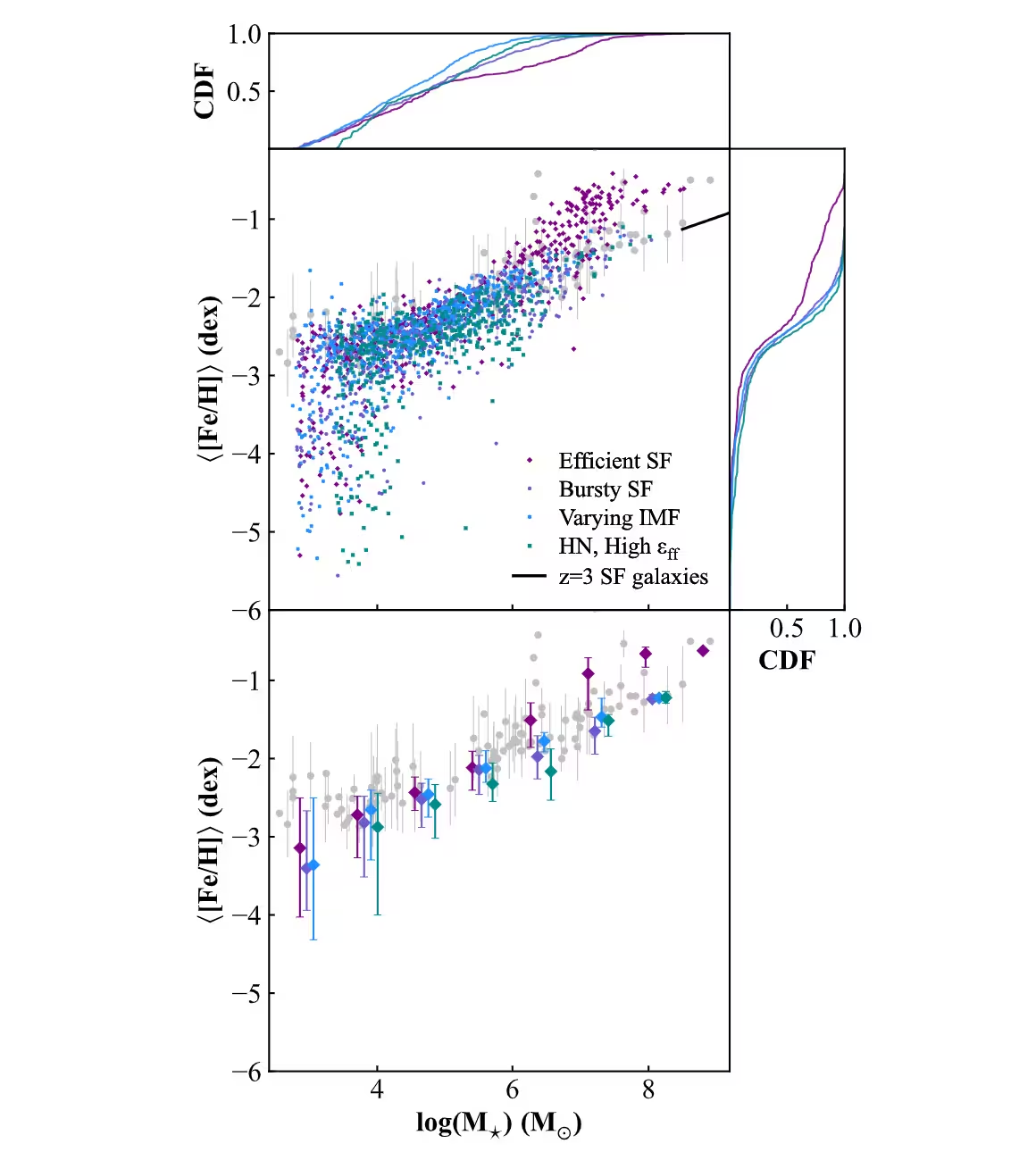
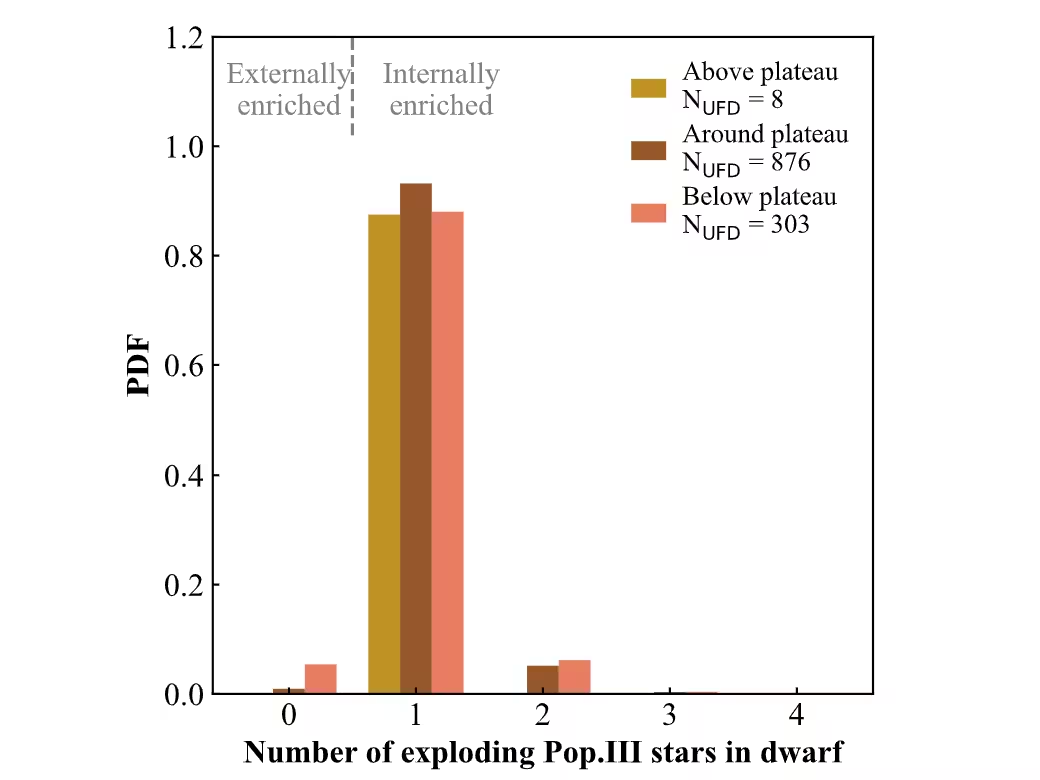
The simulations reveal a consistent trend: in galaxies with fewer than 100,000 solar masses of stars, the iron-to-hydrogen ratio flattens into a distinct “plateau.” The team posits that this phenomenon is driven by pair-instability supernovae—cataclysmic explosions of exceptionally massive, first-generation stars. These events would have forcefully ejected iron-rich material into the surrounding environment.
Radiation played a crucial role in this process by suppressing early star formation. By breaking down molecular hydrogen—a vital cooling agent for gas—the intense radiation from early stars delayed the collapse of subsequent gas clouds. This allowed dark matter structures to grow larger and more stable, eventually enabling them to retain the iron ejected by these massive, ancient explosions. As a result, subsequent generations of stars formed from this enriched gas, locking that signature into the galaxy’s long-term chemical profile.
Future Directions and Limitations
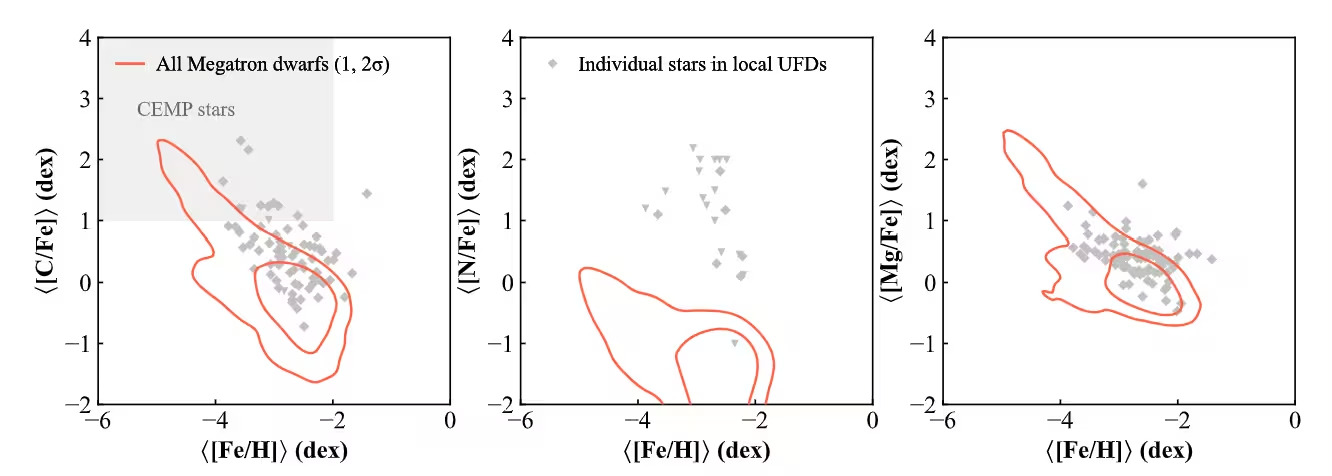
While the models successfully replicate the observed iron plateau, the researchers caution that their work is not without limitations. Certain chemical markers, such as nitrogen, were underrepresented in the simulations, indicating that the full history of early chemical enrichment remains complex. Additionally, the model’s accuracy depends heavily on theoretical assumptions regarding the nature and properties of the very first stars, which remain difficult to observe directly.
Looking ahead, the team expects to refine these predictions as more observational data becomes available. The simulation predicts a small population of galaxies with extremely low iron levels, a hypothesis that future deep-space surveys could confirm. By distinguishing between different models of early star formation, these findings aim to turn the faint, metallic whispers of dwarf galaxies into a clearer picture of how the first stars transformed the universe.
Essential Reading for Early Galaxy Research
- MEGATRON: Disentangling Physical Processes and Observational Bias in the Multi-Phase ISM of High-Redshift Galaxies — The Open Journal of Astrophysics, 2026
- The Impact of Star Formation and Feedback Recipes on the Stellar Mass and Interstellar Medium of High-Redshift Galaxies — The Open Journal of Astrophysics, 2026
- The First Stars: Formation, Properties, and Impact — Annual Review of Astronomy and Astrophysics, 2023
- The Faintest Dwarf Galaxies — Annual Review of Astronomy and Astrophysics, 2019
This article has been fact checked for accuracy, with information verified against reputable sources. Learn more about us and our editorial process.
Last reviewed on .
Article history
- Latest version
Reference(s)
- Rey, Martin. “MEGATRON: how the first stars can create an iron metallicity plateau in the smallest dwarf galaxies.”, vol. 9, September 30, 2026, doi: 10.33232/001c.169605. <https://astro.theoj.org/article/169605-megatron-how-the-first-stars-can-create-an-iron-metallicity-plateau-in-the-smallest-dwarf-galaxies>.
- “University of Bath.”, October 20, 2026 <https://www.bath.ac.uk/>.
- “The University of Chicago.” <https://www.uchicago.edu/>.
- <https://www.iap.fr/?langue=en>.
- Choustikov, Nicholas. “MEGATRON: Disentangling Physical Processes and Observational Bias in the Multi-Phase ISM of High-Redshift Galaxies.”, vol. 9, February 23, 2026, doi: 10.33232/001c.158199. <https://astro.theoj.org/article/158199-megatron-disentangling-physical-processes-and-observational-bias-in-the-multi-phase-ism-of-high-redshift-galaxies>.
- Katz, Harley. “The Impact of Star Formation and Feedback Recipes on the Stellar Mass and Interstellar Medium of High-Redshift Galaxies.”, vol. 9, February 2, 2026, doi: 10.33232/001c.156097. <https://astro.theoj.org/article/156097-the-impact-of-star-formation-and-feedback-recipes-on-the-stellar-mass-and-interstellar-medium-of-high-redshift-galaxies>.
- Klessen, Ralf S.., et al. “The First Stars: Formation, Properties, and Impact.” Annual Review of Astronomy and Astrophysics, vol. 61, no. 1, August 18, 2023, pp. 65-130. Annual Reviews, doi: 10.1146/annurev-astro-071221-053453. <https://www.annualreviews.org/content/journals/10.1146/annurev-astro-071221-053453>.
- Simon, Joshua D.. “The Faintest Dwarf Galaxies.” Annual Review of Astronomy and Astrophysics, vol. 57, no. 1, August 18, 2019, pp. 375-415. Annual Reviews, doi: 10.1146/annurev-astro-091918-104453. <https://www.annualreviews.org/content/journals/10.1146/annurev-astro-091918-104453>.
Cite this page:
- Posted by Aisha Ahmed