Scientists Propose Turning The Moon Into A Massive Gravitational Wave Detector
Scientists are using lunar lasers and binary pulsars to transform familiar astronomical systems into powerful detectors for ancient gravitational waves.
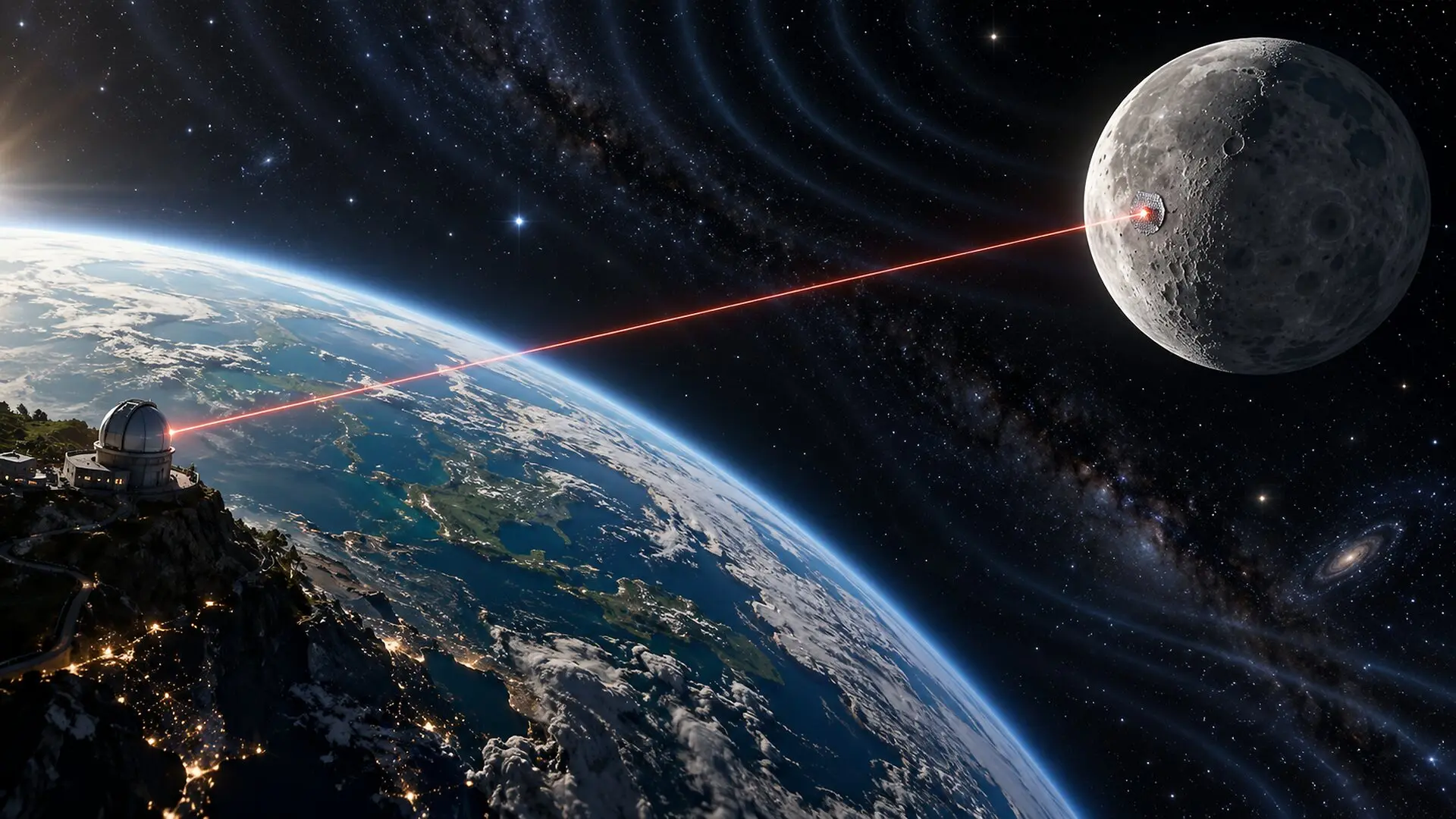
For billions of years, the Moon has traced a steady path around Earth. Now, physicists suggest this familiar celestial dance could serve as a vast, natural detector for the most elusive ripples in the fabric of space-time: gravitational waves.
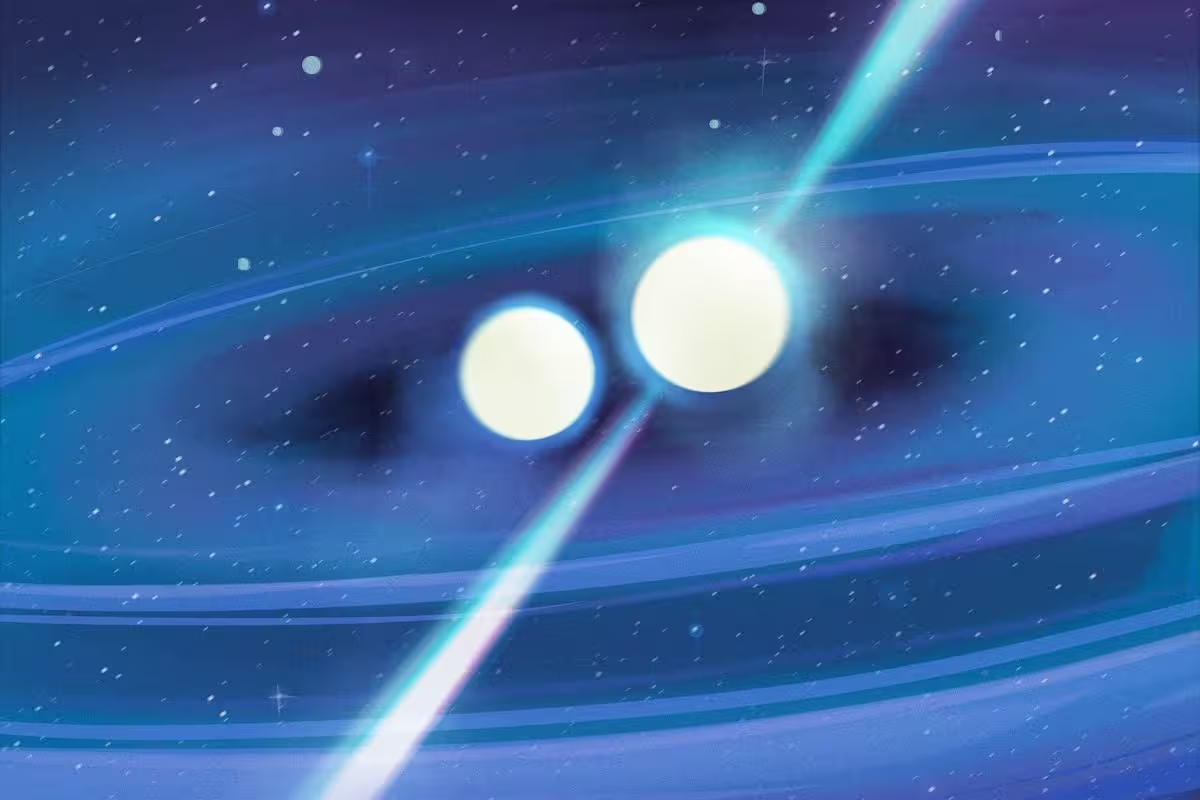
By leveraging decades of high-precision laser-ranging data, researchers have proposed a way to transform the Earth-Moon system—along with artificial satellites and distant binary pulsars—into an observatory capable of probing a frequency band that has remained frustratingly out of reach for current technology.
The study, led by Diego Blas of the Universitat Autònoma de Barcelona and the Institut de Física d’Altes Energies, and Alexander C. Jenkins of University College London, details how these gravitational waves could leave subtle imprints on orbital motions. Their findings are published in Physical Review Letters.
Filling the Microhertz Void
Since the first direct detection of gravitational waves in 2015, astronomers have been able to “listen” to the universe across different frequencies. Ground-based detectors like LIGO and Virgo excel at identifying high-frequency signals, such as the violent collisions of stellar-mass black holes. Conversely, pulsar timing arrays monitor the rhythmic pulses of neutron stars to capture lower-frequency waves. Future space-based missions, such as the Laser Interferometer Space Antenna (LISA), will target the millihertz range.
However, a significant observational gap persists in the microhertz region. Detecting waves at these frequencies with a man-made instrument would typically require an interferometer with arms spanning vast distances, far beyond current engineering capabilities. Blas and Jenkins suggest that nature has already provided the solution by populating the cosmos with massive, orbiting systems that span the necessary scale.
Orbital Resonance as a Sensor
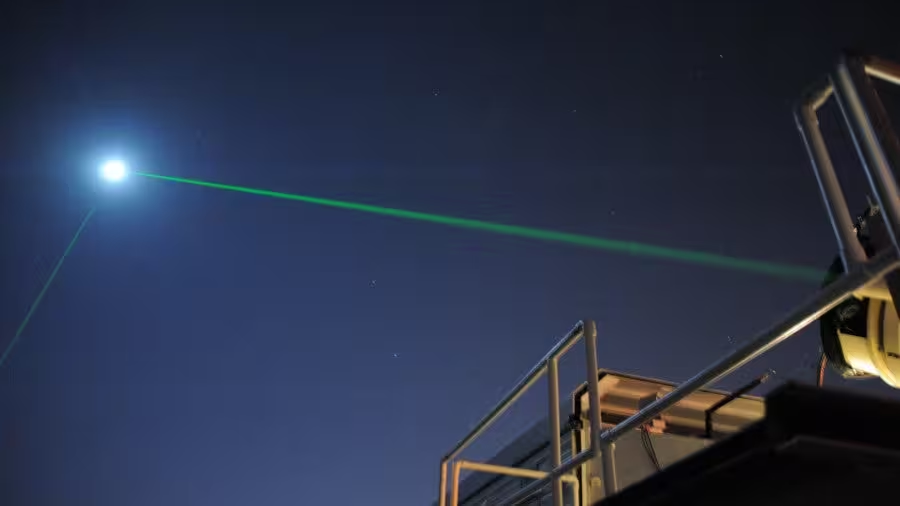
When gravitational waves wash over a binary system, they introduce minute perturbations in the orbital path of the objects. In the case of the Moon, which is monitored by laser pulses bounced off retroreflectors left during the Apollo missions, these disturbances would manifest as tiny fluctuations in the Earth-Moon distance. With millimeter-scale precision and decades of historical data, scientists are in a unique position to look for these signals.
The research team points to the concept of resonance as the key to detection. If a gravitational wave oscillates at a frequency corresponding to an integer multiple of the Moon’s orbital period, its impact on the orbit would accumulate over time rather than canceling itself out. By analyzing this long-term data, researchers hope to identify the signatures of a stochastic gravitational-wave background—a constant hum of waves from numerous, unresolved sources throughout the universe.
Broadening the Horizon with Satellites and Pulsars
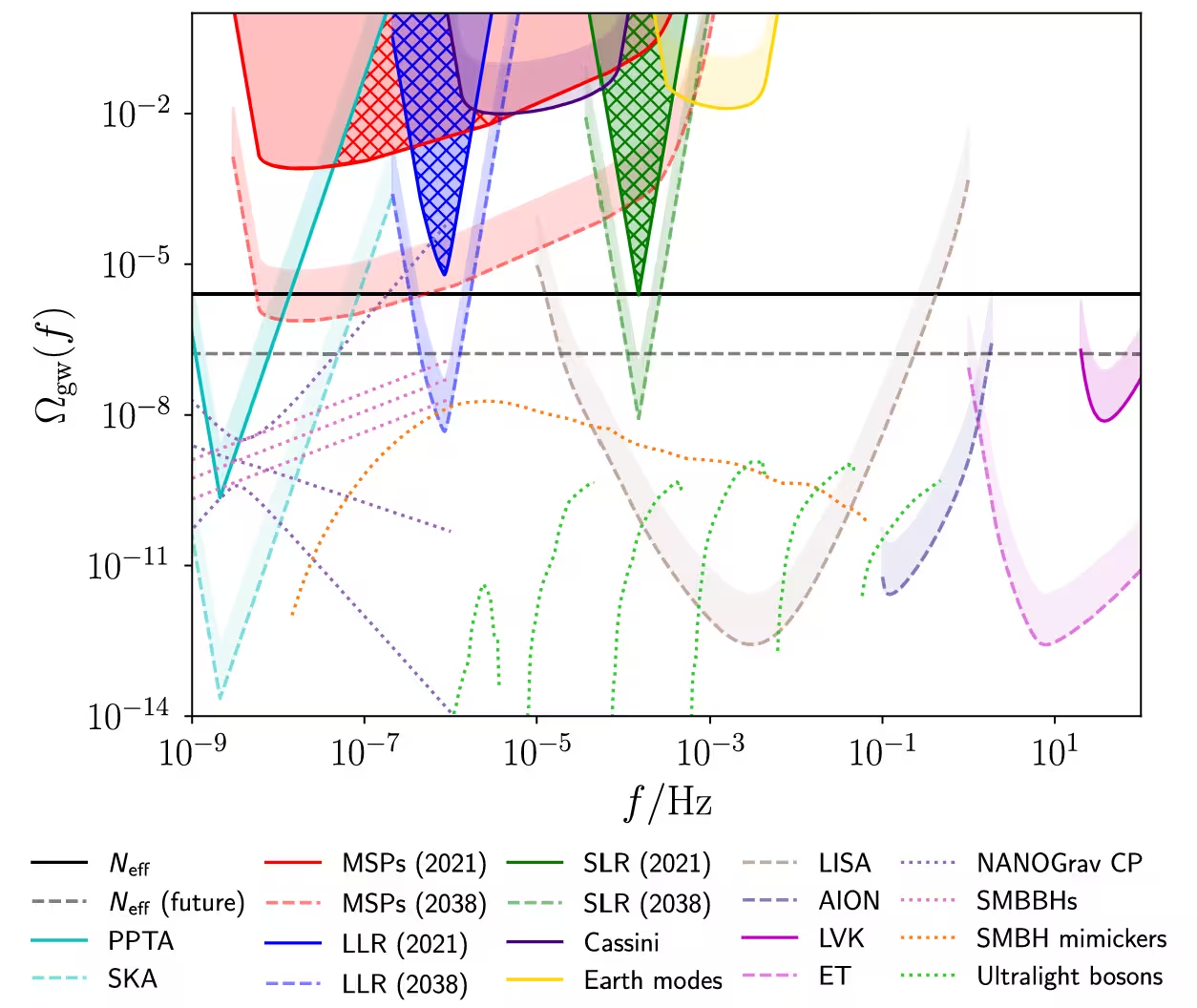
The approach is not limited to the Moon. Artificial satellites like LAGEOS-1, which have been tracked for years, offer a window into even higher frequencies, around 0.15 millihertz. When combined with the data from hundreds of binary pulsars—nature’s most stable clocks—researchers can effectively construct a network of sensors spanning from 6 nanohertz to 0.2 millihertz.
This multi-pronged strategy provides a way to study cosmic history without the need for a multibillion-dollar mission. One primary target for this research is the gravitational-wave background generated by first-order phase transitions in the early universe. According to many theories beyond the Standard Model, the young universe underwent violent, bubble-forming transitions that should have produced a distinct gravitational echo. Some of these predicted signals peak precisely in the microhertz band.
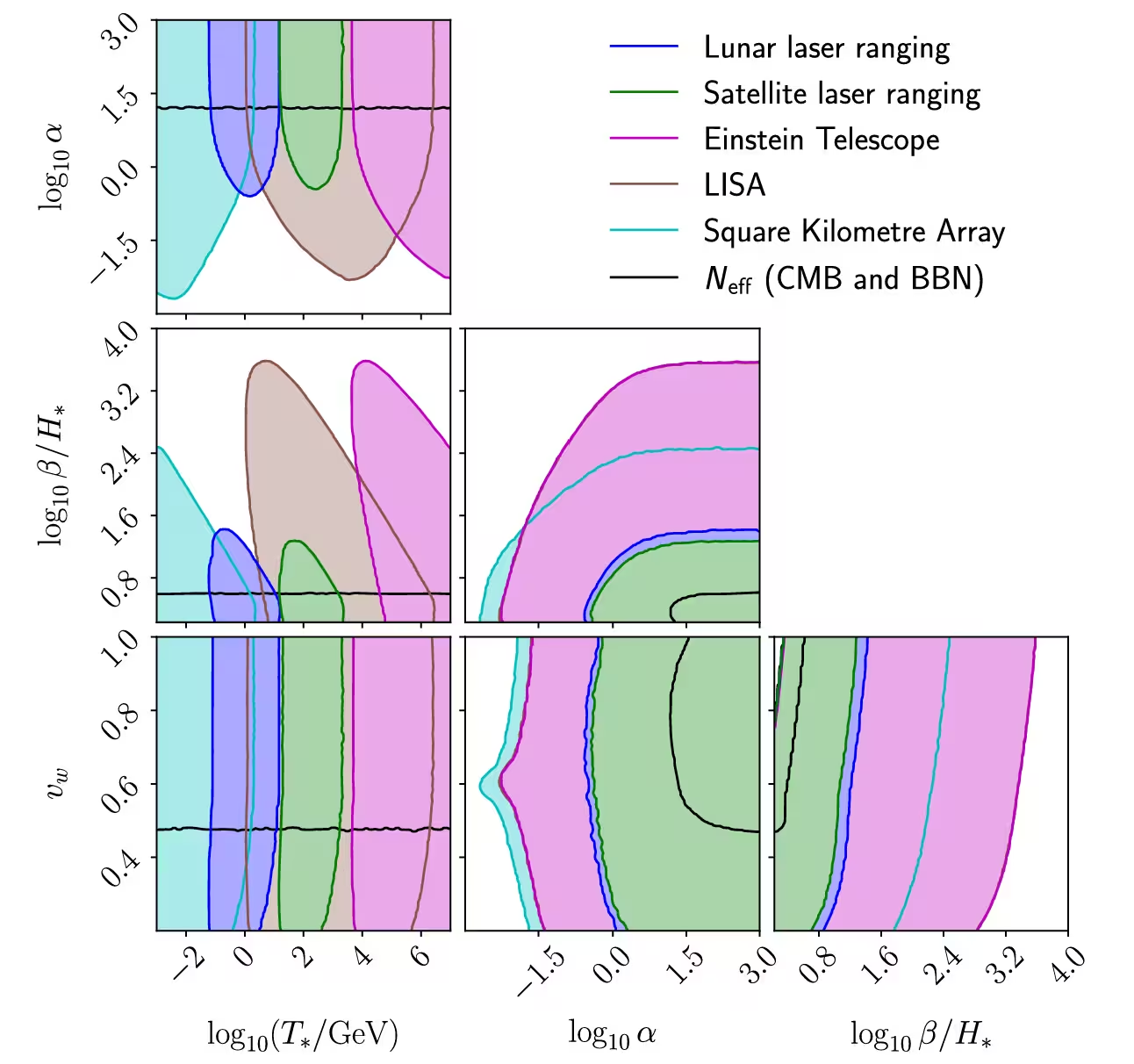
By treating the solar system and beyond as an astronomical-scale observatory, researchers are opening a new chapter in gravitational-wave science. This methodology promises to complement existing experiments, providing a deeper understanding of the physical processes that shaped the cosmos during its earliest, most energetic moments.
Key References and Further Reading
- Detecting stochastic gravitational waves with binary resonance(Physical Review D, 2022)
- Lunar laser ranging: a continuing legacy of the apollo program(Science, 1994)
- The Laser Interferometer Space Antenna: Unveiling the Millihertz Gravitational Wave Sky(Bulletin of the American Astronomical Society, 2019)
- Gravitational wave research using pulsar timing arrays(National Science Review, 2017)
- Gravitational waves from a first-order electroweak phase transition: a brief review(Philosophical Transactions of the Royal Society A, 2018)
This article has been fact checked for accuracy, with information verified against reputable sources. Learn more about us and our editorial process.
Last reviewed on .
Article history
- Latest version
Reference(s)
- Blas, Diego., et al. “Bridging the
- Blas, Diego., et al. “Detecting stochastic gravitational waves with binary resonance.” Physical Review D, vol. 105, no. 6, March 11, 2022 American Physical Society (APS), doi: 10.1103/PhysRevD.105.064021. <https://doi.org/10.1103/PhysRevD.105.064021>.
- Dickey, J. O.., et al. “Lunar Laser Ranging: A Continuing Legacy of the Apollo Program.” Science, vol. 265, no. 5171, July 22, 1994, pp. 482-490. American Association for the Advancement of Science (AAAS), doi: 10.1126/science.265.5171.482. <https://doi.org/10.1126/science.265.5171.482>.
- Baker, John. “The Laser Interferometer Space Antenna: Unveiling the Millihertz Gravitational Wave Sky.” arXiv.org <https://arxiv.org/abs/1907.06482>.
- <https://academic.oup.com/nsr/article/4/5/707/4566535>.
- Weir, David J.. “Gravitational waves from a first-order electroweak phase transition: a brief review.” Philosophical Transactions of the Royal Society A: Mathematical, Physical and Engineering Sciences, vol. 376, no. 2114, January 22, 2018, pp. 20170126 The Royal Society, doi: 10.1098/rsta.2017.0126. <https://doi.org/10.1098/rsta.2017.0126>.
Cite this page:
- Posted by Aisha Ahmed