JWST Uncovers Three Actively Growing Black Holes in a 1-Billion-Year-Old Galaxy
JWST spots three active black holes in one distant galaxy, revealing a rare view of early massive black‑hole system formation.
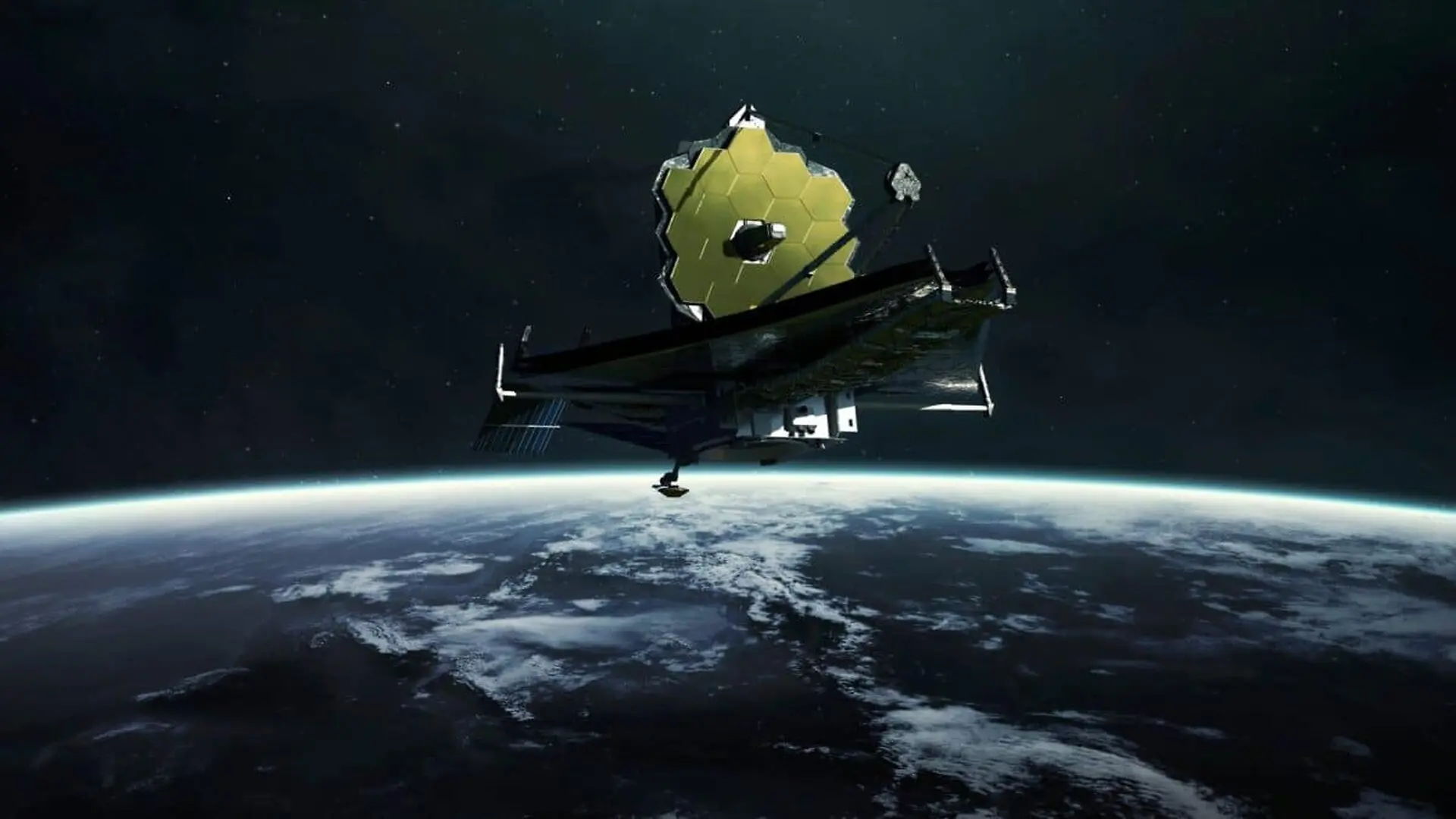
Using the James Webb Space Telescope, astronomers have identified three massive black holes that are actively pulling in gas within a single galaxy observed at redshift z = 5.0167. The galaxy, known as J0148‑4214, dates to roughly 1.2 billion years after the Big Bang, offering a rare glimpse of multiple heavyweight black holes co‑existing at such an early epoch.
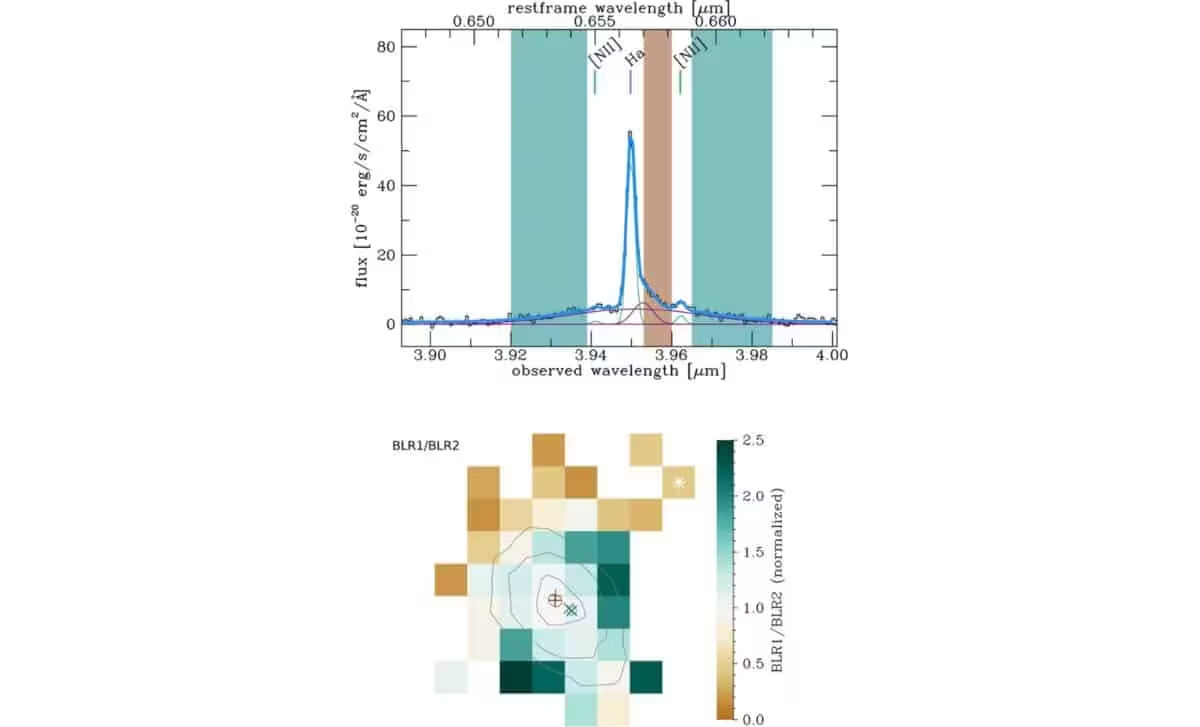
The discovery was made possible by JWST’s NIRSpec integral‑field spectrograph, which separated the broad hydrogen‑alpha emission originating from distinct regions of the galaxy. By analysing these emissions, the team could infer both the masses and the spatial distribution of the three black holes, shedding light on the twin mechanisms—gas accretion and mergers—that are thought to drive black‑hole growth.
Three Separate Broad‑Line Regions Signal Independent Accretion
Broad‑line regions (BLRs) identified through Hα emission reveal rapidly moving gas that typically surrounds an actively feeding black hole. While broad hydrogen lines can sometimes be produced by supernovae, shocks, or stellar winds, the researchers cross‑checked additional spectral signatures before concluding that black‑hole accretion was the most plausible source.
A key diagnostic comes from the contrast between the broadened Hα lines—showing widths of 430 to 2,920 km s⁻¹—and the narrow forbidden [O III] doublet, which lacks comparable broadening. This mismatch, according to Übler et al., points strongly toward genuine BLRs around accreting black holes.
Two of the BLRs sit near the galaxy’s core, with spectro‑astrometric measurements indicating a projected separation of 190 ± 40 parsecs (about 620 light‑years). The third BLR is offset by roughly 1.7 kiloparsecs (≈5,500 light‑years) from the central region.
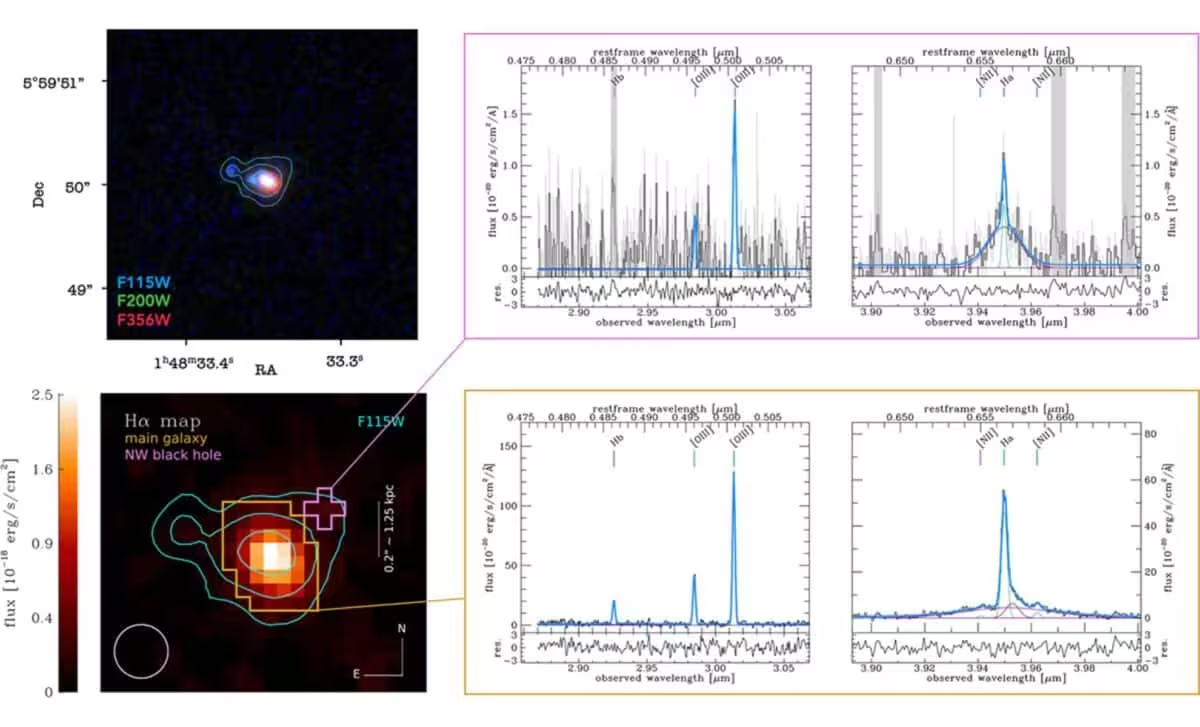
Mass estimates derived from single‑epoch virial relations place the primary black hole at log(M•/M☉) = 7.9 ± 0.4, the secondary at 5.8 ± 0.5, and the off‑nuclear object at 6.3 ± 0.5. In plain terms, these correspond to roughly 80 million, 0.6 million, and 2 million solar masses, respectively.
The host galaxy’s stellar mass is approximated at 1.3 billion M☉, meaning the black holes together constitute a substantial portion of the galaxy’s total mass, as highlighted by co‑author Giovanni Mazzolari.
A Glimpse of Early Merger‑Driven Black Hole Evolution
The spatial arrangement suggests a system poised for future mergers. The two central black holes, separated by only a few hundred light‑years, could coalesce within an estimated 700 million years based on simple dynamical‑friction calculations. The more distant black hole might eventually migrate inward, potentially joining another merger event.
Alternative scenarios for the peripheral object include a prior three‑body interaction or a gravitational recoil following an earlier merger, which would imply that a displaced black hole can retain an accretion disk and a detectable BLR after a violent dynamical episode.
These observations add a crucial data point to ongoing efforts to decipher how massive black holes attained their size in the early universe. While continuous gas accretion is widely regarded as the dominant growth channel over cosmic time, merger events may play an outsized role for certain mass ranges and epochs.
The J0148‑4214 system therefore serves as concrete evidence that multiple massive black holes could have been commonplace in the first billion years after the Big Bang. Coupled with other recent detections of distant black‑hole pairs, the finding underscores JWST’s capability to resolve and characterize potential progenitors of future massive‑black‑hole mergers.
This article has been fact checked for accuracy, with information verified against reputable sources. Learn more about us and our editorial process.
Last reviewed on .
Article history
- Latest version
Reference(s)
- “Mazzolari, Giovanni | Max Planck Institute for extraterrestrial Physics.” <https://www.mpe.mpg.de/personnel/143201>.
Cite this page:
- Posted by Aisha Ahmed