Chinese Researchers Achieve 1 Gbps Laser Downlink From 36,000 Km Using 2 Watt Beam
A 2‑W laser achieved a 36,000 km satellite downlink using a novel signal technique that vastly outperforms previous results.

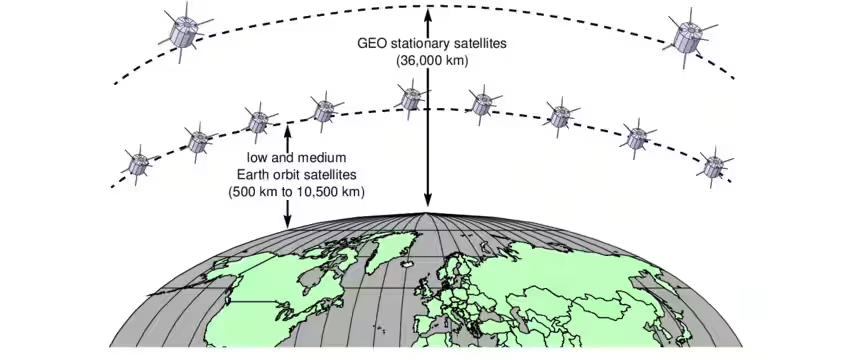
A laser transmitted from a geostationary platform must traverse roughly 36,000 km before reaching the surface, only to encounter a turbulent layer of atmosphere that can disperse and blur its beam.
Scientists in China have demonstrated a hybrid approach that merges two complementary mitigation strategies, allowing a ground‑based receiver to extract data from a signal that would otherwise be lost.
The experiment achieved a downlink speed of 1 gigabit per second using a laser source rated at merely 2 watts. The South China Morning Post reported on 17 June 2025 that the measured data rate was about five times higher than that of SpaceX’s Starlink service.
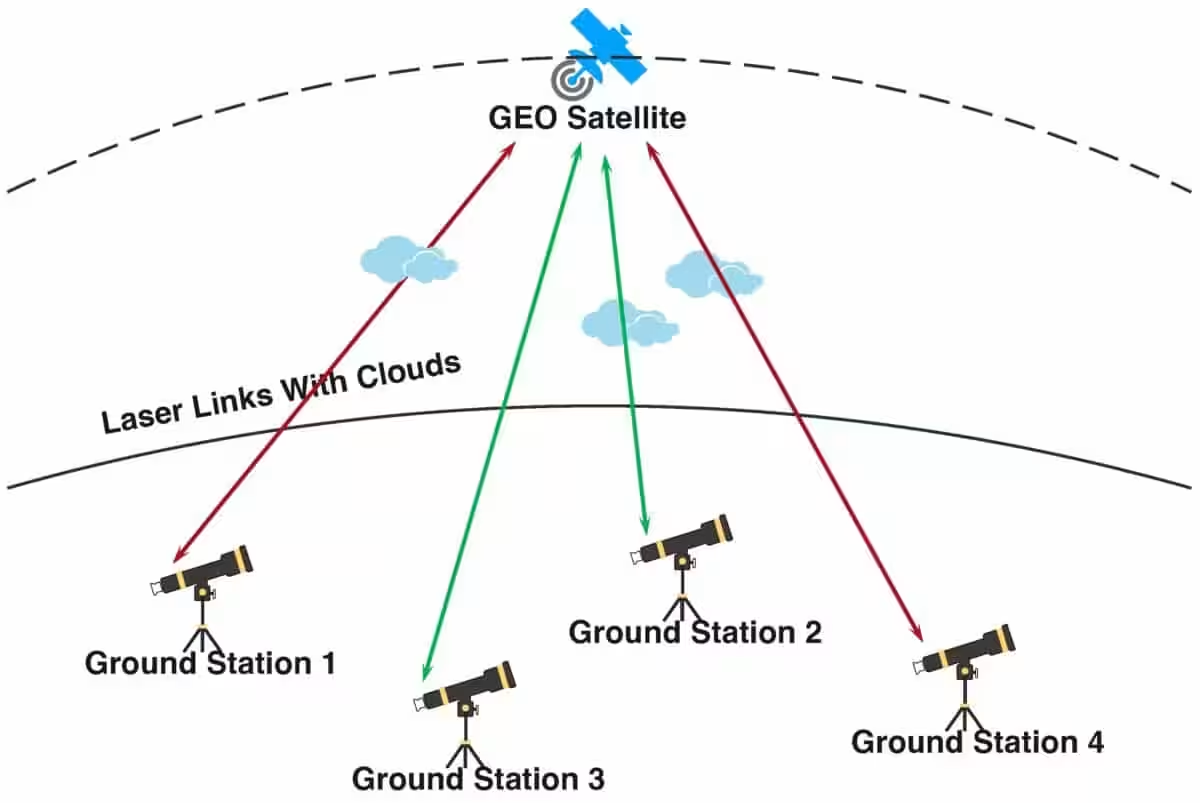
Atmospheric Turbulence Scrambles Space‑Based Laser Links
As the beam reaches the lower atmosphere, random variations in temperature and density scatter the photons, producing faint, diffuse spots that can span several hundred metres on the ground.
Traditional solutions fall into two camps. Adaptive optics (AO) seeks to reverse wavefront distortions, while mode‑diversity reception (MDR) attempts to salvage usable information from light that has already been scattered.
Under conditions of strong turbulence, each technique alone proved inadequate. The Chinese team therefore devised a sequential system: AO first reduces the bulk of the distortion, after which MDR captures the residual scattered component.
Synergistic Receiver Improves Usable Signal to Over 90 %
Record‑Setting 1‑Gbps Downlink Demonstrated
With the enhanced receiver in place, the team recorded a sustained 1 Gbps optical downlink despite the modest 2‑watt laser, illustrating that a carefully engineered ground station can compensate for severe atmospheric effects.
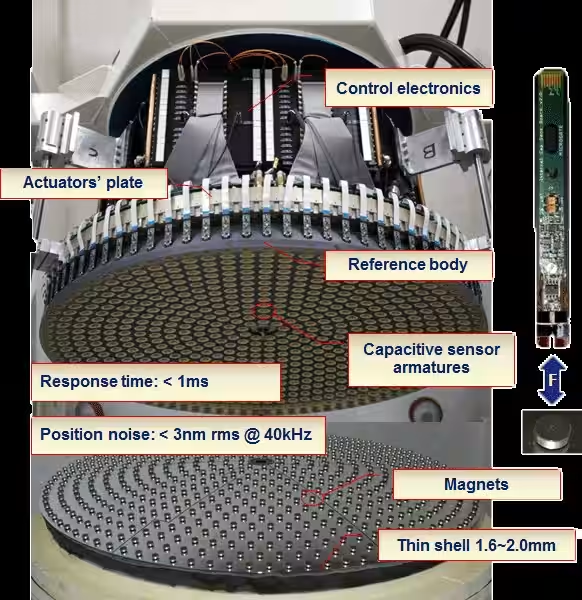
According to the study authors, the technique “effectively prevents communication quality degradation caused by extremely low signal power.”
Clarifying the Starlink Benchmark
The cited “five‑times‑Starlink” figure refers solely to the measured transmission speed and does not imply a head‑to‑head test under identical conditions. Starlink satellites operate in low Earth orbit, a few hundred kilometres above the planet, whereas the Chinese laser originated from a geostationary orbit exceeding 36,000 km in altitude.
The investigation specifically addressed the challenge of guiding a laser beam through turbulent skies to a terrestrial receiver, rather than evaluating competing consumer satellite services.
By integrating adaptive optics with mode‑diversity reception, the researchers have shown that high‑capacity optical links from geostationary platforms are feasible even with low‑power transmitters, opening new possibilities for space‑to‑ground communications.
This article has been fact checked for accuracy, with information verified against reputable sources. Learn more about us and our editorial process.
Last reviewed on .
Article history
- Latest version
Reference(s)
- Chen, Stephen. “Chinese satellite achieves 5 times Starlink speed with 2-watt laser from 36,000km orbit.”, June 17, 2025 South China Morning Post <https://www.scmp.com/news/china/science/article/3314087/chinese-satellite-achieves-five-times-starlink-speed-2-watt-laser-36000km-orbit>.
Cite this page:
- Posted by Aisha Ahmed