New Math Formula Calculates Exact Size Needed For Advanced Drug Libraries
A novel energy pixel model uses initial screening data to predict how many compounds a targeted library needs, replacing expensive physical controls with calculations.
Scientists have developed a mathematical method to calculate the exact size required for specialized chemical libraries used in drug discovery, addressing a persistent bottleneck in machine learning models. The approach tackles a core challenge in modern pharmaceutical research, where finding initial molecular hits is routine, but training predictive models to guide subsequent chemical modifications remains difficult.
DNA-encoded libraries allow researchers to screen billions of compounds simultaneously by attaching unique DNA barcodes to small molecules, washing them over a target protein, and sequencing the survivors. However, machine learning models tasked with predicting how single-atom changes alter binding affinity require specific training data. They need dense sampling of the chemical neighborhood surrounding a hit and an adequate number of genuinely tight binders within that space. Traditional random libraries fail to provide either requirement because they spread too few compounds across vast chemical space, forcing algorithms to extrapolate beyond the data they have seen.
How Energy Pixels Map Protein Interactions
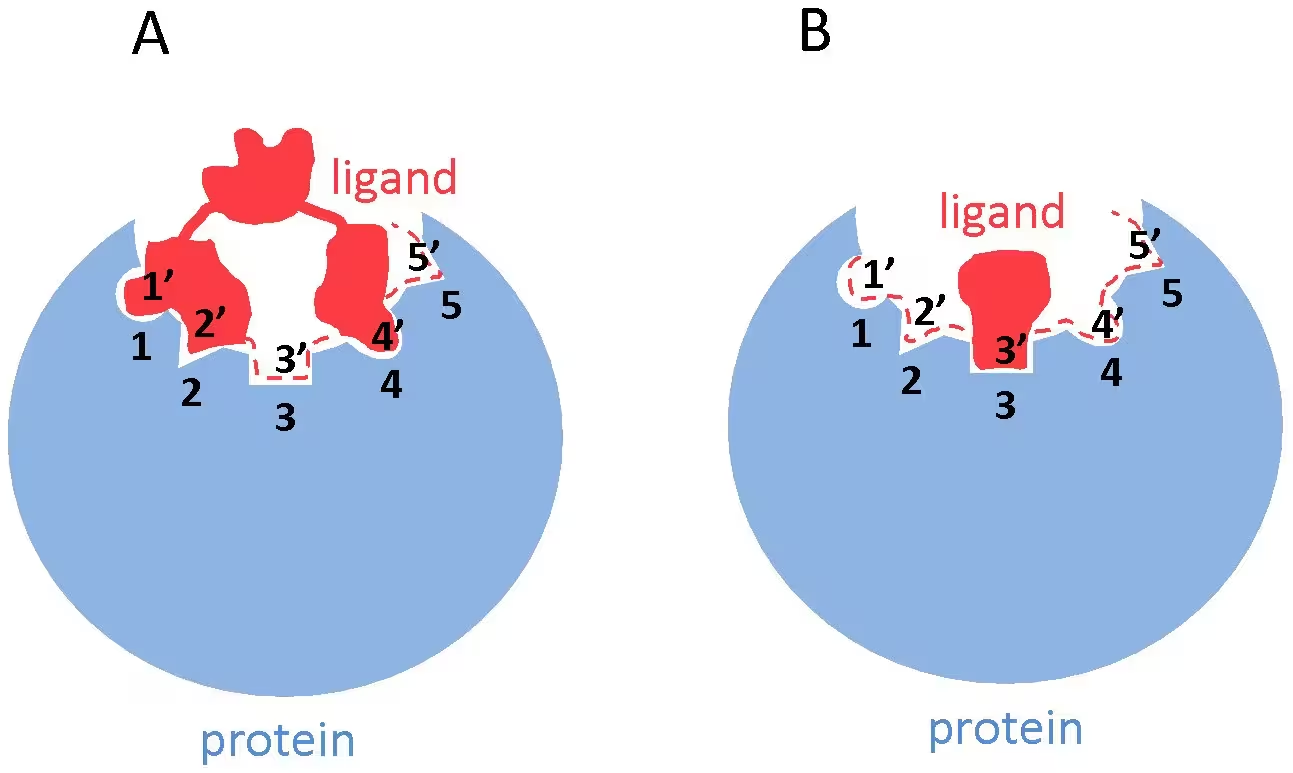
To determine how complex a targeted second-generation library must be, researchers Boris P. Belotserkovskii and R. Edward Watts of Insitro Inc. formulated a model treating binding interactions as a sum of smaller, independent components. In a paper available on the arXiv preprint server, the authors model the binding pocket of a target protein as a collection of spots called pixels, while viewing visiting ligands as carrying matching antipixels. Each pixel-antipixel pairing contributes a specific amount of free energy to the overall molecular interaction.
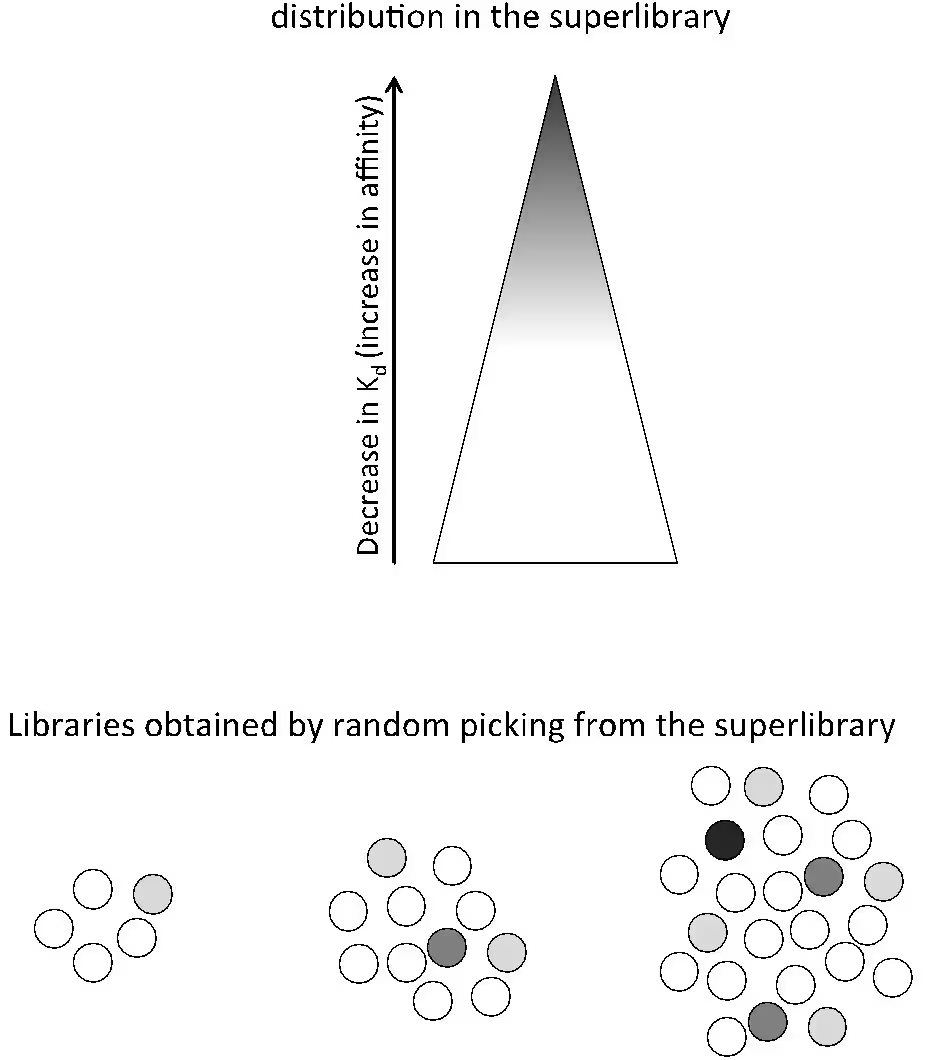
By analyzing the spread of binding affinities measured in an initial naïve library, the team bypasses the need to map out abstract chemical space from scratch. They introduce the concept of a superlibrary, representing nearly all compounds that a given chemical reaction scheme could theoretically produce. A standard naïve library acts as a small random sample of this broader superlibrary. The authors demonstrate that the affinity distribution of the initial library can predict the behavior of a focused second-generation library built around promising hits.
Calculating Library Complexity Without Physical Controls
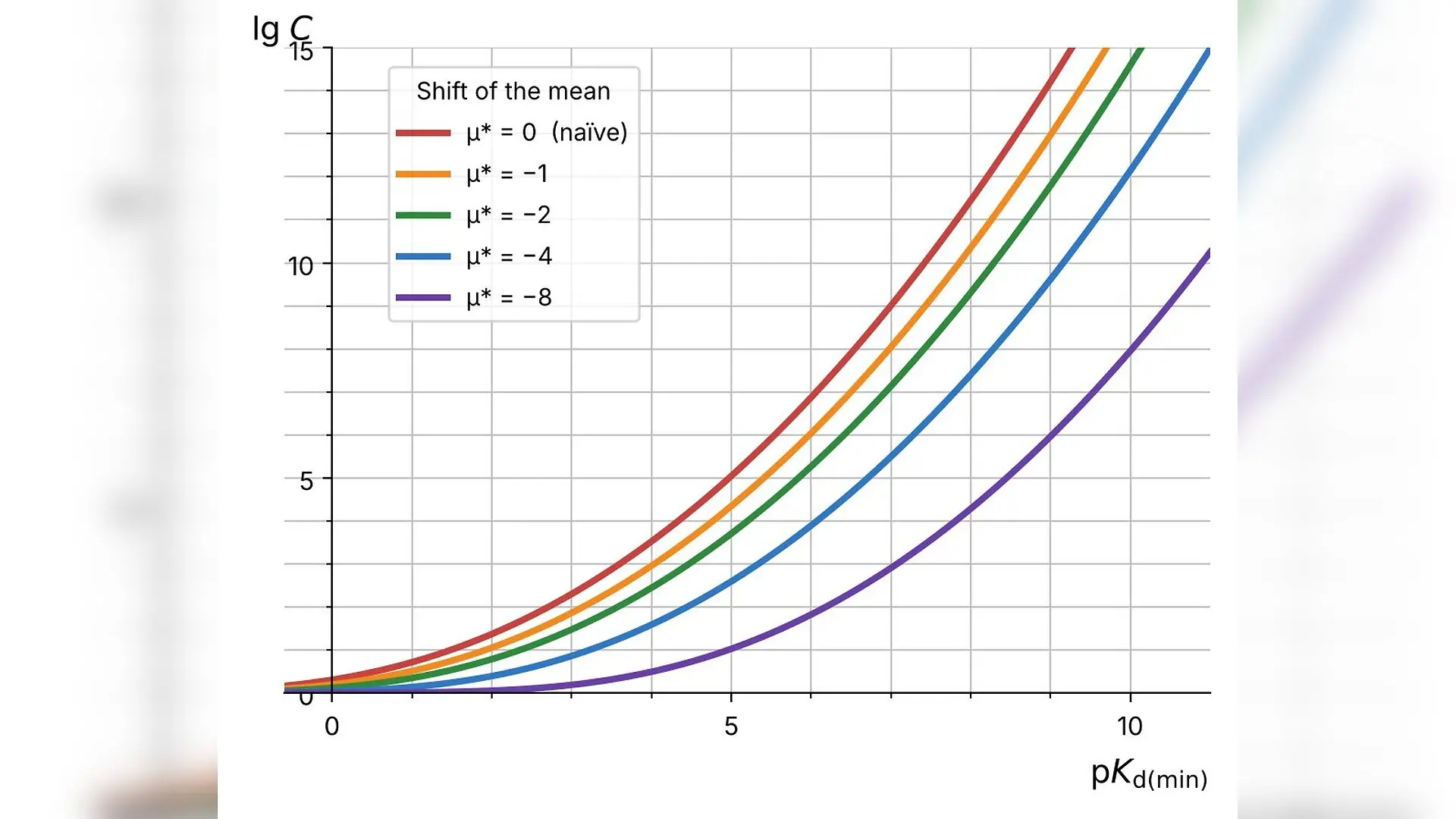
The mathematical framework translates the number of tight binders a model needs into a concrete library size. By modeling binding energies through a Gaussian distribution, the researchers derived equations that link library complexity directly to desired target dissociation constants and distribution shifts. This approach allows scientists to compute the expected yield of a randomly designed second-generation library strictly on paper.
This calculated yield serves as a baseline for measuring the true value added by advanced library design strategies like active learning or machine learning. Ordinarily, evaluating whether a sophisticated design algorithm actually improved a library requires synthesizing and screening a massive random control library, incurring substantial financial costs. The new method replaces that physical control with a computational baseline derived entirely from initial screening data.
Core Assumptions and Underlying Limitations
The reliability of the estimation tool rests on specific assumptions, most notably the principle of additivity. The pixel model assumes that total binding energy equals the sum of independent pixel contributions, a foundational concept shared by many molecular fingerprinting and graph neural network models. When chemical features interact cooperatively, altering the shape of the distribution rather than just shifting its mean, the simple predictive shift becomes less accurate.
Furthermore, because researchers observe only the detectable tail of a binding energy distribution, fitting parameters for the entire distribution involves extrapolation. Deeper and more accurate high-throughput measurements of equilibrium dissociation constants remain essential for parameterizing the model. Despite these constraints, the quantitative framework provides drug discovery teams with a clear roadmap to size their libraries accurately for high-resolution machine learning models.
The study was posted to the arXiv preprint server on November 12, 2026.
This article has been fact checked for accuracy, with information verified against reputable sources. Learn more about us and our editorial process.
Last reviewed on .
Article history
- Latest version
Reference(s)
- Belotserkovskii, Boris. “Using an energy pixels approach to estimate the size a 2nd Generation DEL must be to train a high-resolution binding model.” arXiv.org <http://arxiv.org/abs/2611.17121v1>.
Cite this page:
- Posted by Hassan Raza