Hidden Population of Fast-Fading Supernovae Discovered Inside Ancient Galaxy Cluster Cores
A large-scale archival survey isolates 242 rapidly dimming stellar explosions, offering new clues about white dwarf physics and cosmic distance measurements.
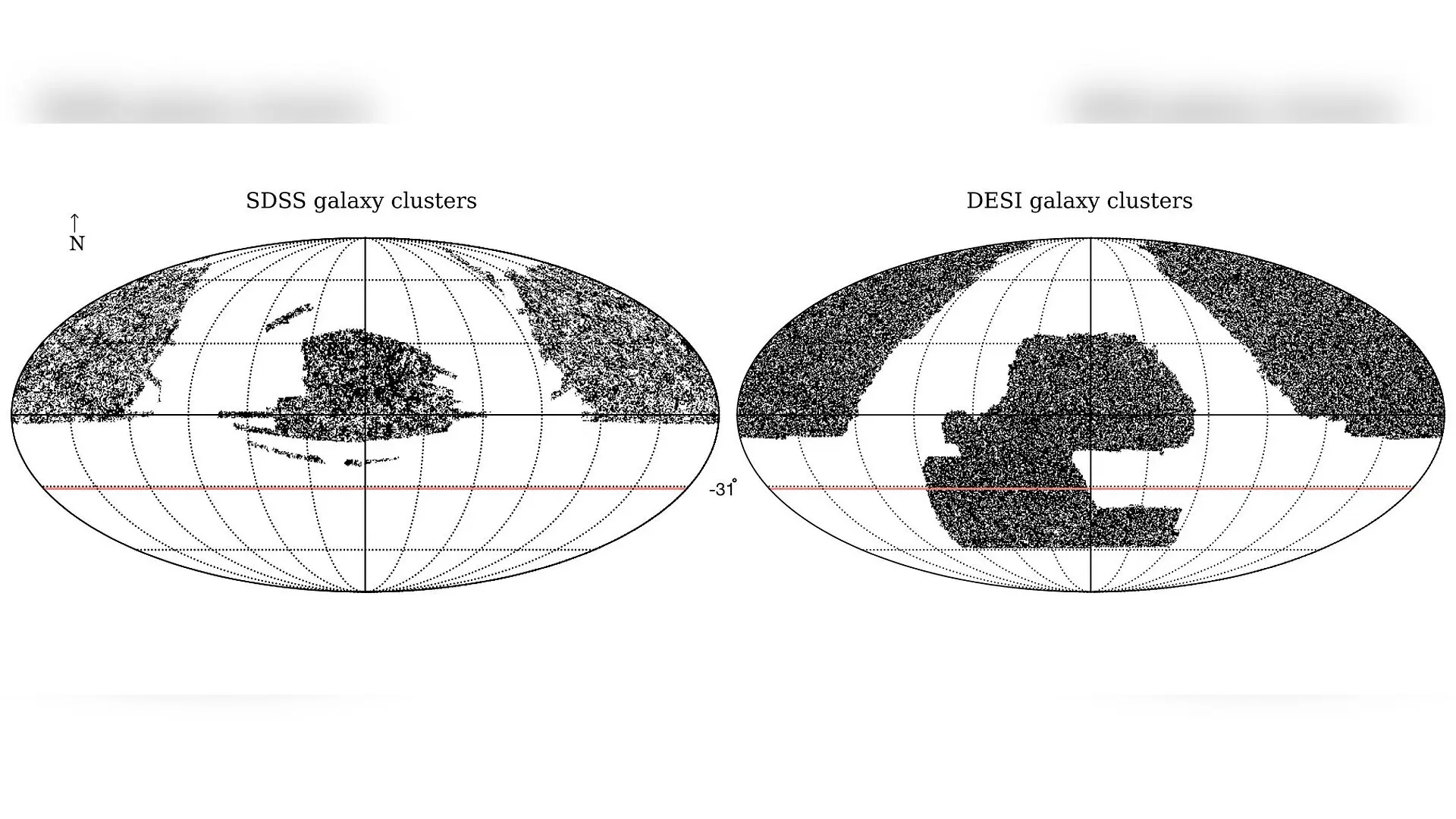
A massive population of fast-fading stellar explosions hidden deep within ancient galaxy clusters is challenging how astronomers measure cosmic distances across the universe. By analyzing archival data from a wide-field survey, researchers have isolated 242 unusual Type Ia supernovae (stellar explosions involving white dwarf stars) packed tightly inside the dense cores of galaxy clusters.
These dying stars decline in brightness much faster than typical counterparts found in ordinary space. The findings, published in a preprint on arXiv, suggest that the local environment of a galaxy cluster drastically shapes the life cycles and physics of these crucial cosmic yardsticks.
Unlocking the Oldest Stellar Populations
Type Ia supernovae are essential tools in modern astronomy because their predictable peak brightness allows scientists to gauge vast cosmic distances and measure the accelerated expansion of the universe. However, researchers have long debated whether the physical traits of these explosions depend on the age and environment of their host stars. Galaxy cluster cores provide a pristine laboratory to study this question because they consist almost entirely of old, quiet stars with very little active star formation.
Led by a team of astronomers utilizing archival data from the Zwicky Transient Facility (a wide-field robotic survey operating at Palomar Observatory), the study sifted through nearly 90,000 light-curve alerts. By cross-referencing these transients with two major galaxy cluster catalogs derived from the Sloan Digital Sky Survey and the Dark Energy Spectroscopic Instrument, the authors identified nearly 5,000 likely supernova candidates across a redshift range up to 0.2.
When the team focused specifically on the innermost core regions, defined as the central half of the cluster radius, they uncovered a distinct subpopulation of 242 fast-declining supernovae. Statistical tests revealed that the light curve stretch distribution in these core regions differs from outer-core regions and standard field populations with a significance exceeding four sigma.
What Drives These Rapidly Fading Explosions?
The rate at which a Type Ia supernova dims is characterized by a parameter called stretch, where lower stretch values indicate faster fading. In the innermost cluster cores, the mean low-stretch value reached minus 1.95 for the lower redshift slice, which is significantly more negative than values typically observed in ordinary field galaxies. The researchers attribute this pattern to the advanced age of the stellar populations residing in the cluster centers.
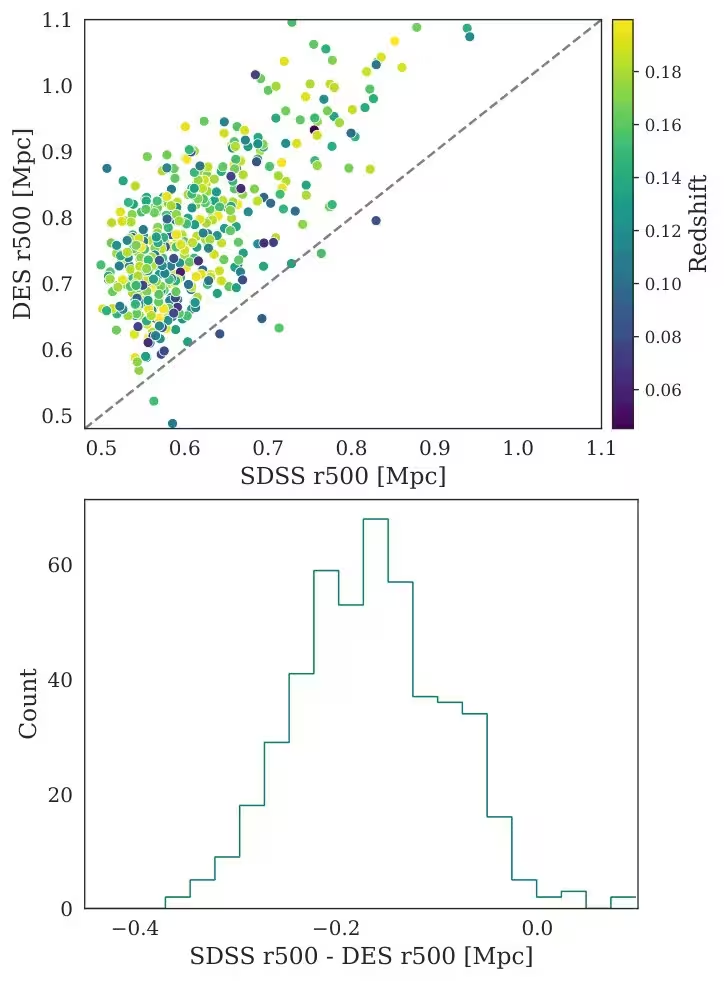
According to the prevailing two-population model of stellar explosions, fast-declining supernovae are tied exclusively to older progenitor environments. Because galaxy cluster cores suppressed star formation billions of years ago, younger and slower-evolving explosive channels are largely filtered out. This leaves behind a dominant signal from delayed progenitor systems.
Exploring Sub-Chandrasekhar Mass Systems
Connecting these observations to explosion mechanisms points toward specific physical models. Based on empirical scaling relations between light curve stretch and ejected mass, the authors estimate that the core cluster supernovae possess an average ejecta mass of approximately 0.92 solar masses. This low mass strongly points toward sub-Chandrasekhar mass explosions rather than traditional white dwarf detonations that approach the theoretical Chandrasekhar mass limit.
Within double degenerate binary systems, where two white dwarfs orbit each other and eventually merge, these events likely proceed through a double detonation scenario. In this mechanism, an initial ignition of a surface helium shell triggers a shock wave that compresses the core and prompts a secondary explosion.
Intriguingly, while the stretch properties varied dramatically between the core and outer regions, the color distribution of the supernovae remained completely uniform. The authors note that the intense, hot plasma of the intracluster medium efficiently destroys cosmic dust grains through thermal sputtering. This leaves very little dust in the cluster cores, resulting in minimal extrinsic reddening for explosions occurring there.
Implications for Precision Cosmology
Isolating this unique population of core cluster supernovae carries important implications for precision cosmology, particularly concerning the Hubble tension, the persistent disagreement over the exact expansion rate of the universe. Recent studies suggest that standardizing supernova brightness may require more complex, population-dependent corrections rather than a simple linear formula. By confirming that cluster environments harbor distinct explosion physics, future surveys utilizing next-generation facilities like the Vera Rubin Observatory will be able to refine these distance indicators and test whether supernova properties evolve across cosmic time.
The study was posted to the arXiv preprint server on November 12, 2026.
This article has been fact checked for accuracy, with information verified against reputable sources. Learn more about us and our editorial process.
Last reviewed on .
Article history
- Latest version
Reference(s)
- Eranhalodi, A.. “Characterising a population of fast-declining SNe Ia in galaxy cluster cores.” arXiv.org <http://arxiv.org/abs/2611.17242v1>.
Cite this page:
- Posted by Nida Rehman