New Algorithm Tackles Millions of Overlapping Space Gravitational Waves
A high-performance C++ computing tool successfully processes over 130,000 source parameters to untangle crowded signals for the upcoming LISA observatory.
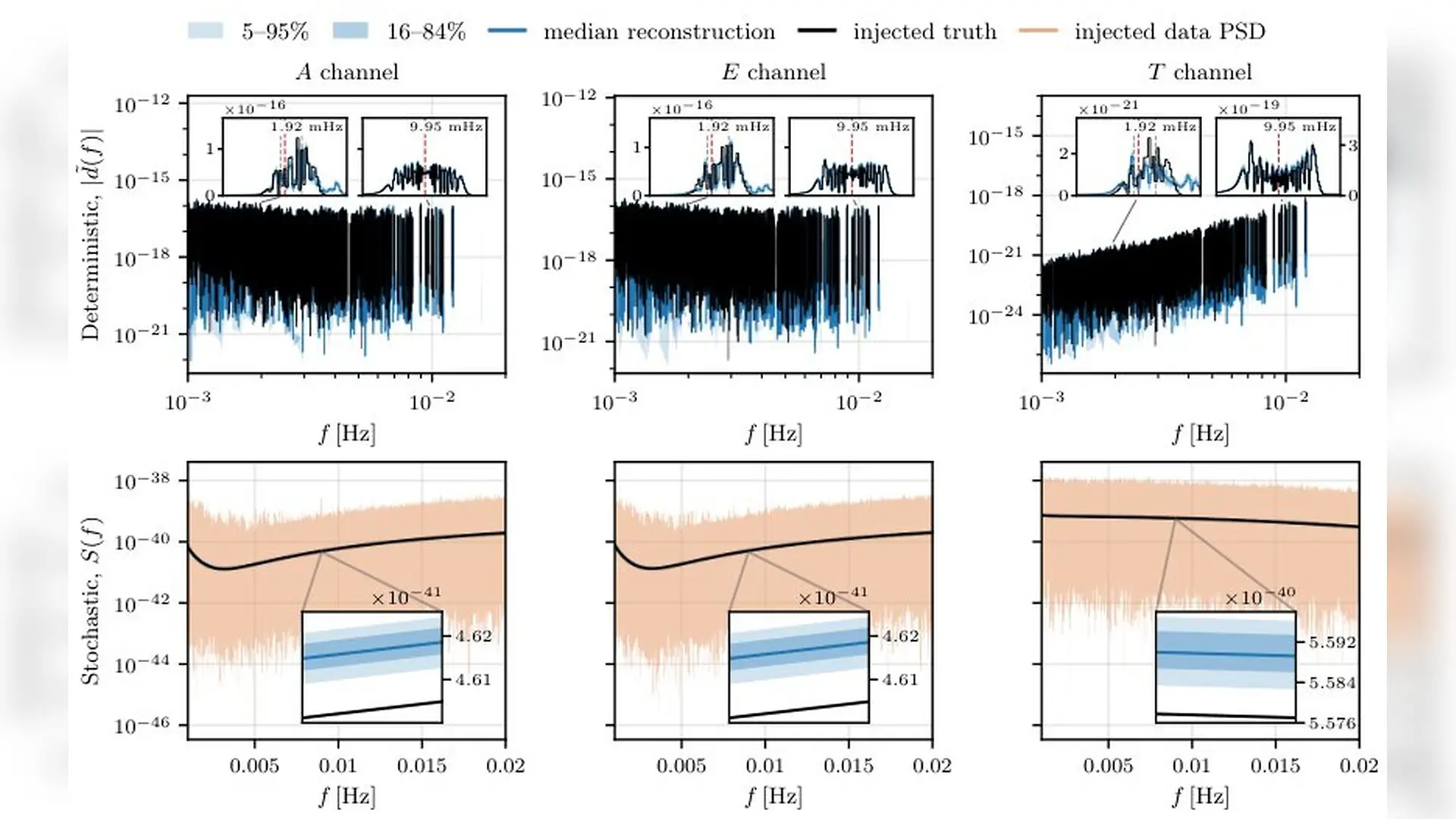
A new high-performance computing algorithm could help scientists untangle millions of overlapping gravitational wave signals expected to flood the upcoming Laser Interferometer Space Antenna (LISA) space mission. The tool, called samsara++, is designed to simultaneously solve the complex data jigsaw puzzle presented by thousands of compact binary star systems in our Milky Way.
How Will LISA Hear the Milky Way White Dwarf Population?
Set to launch in the 2030s, the Laser Interferometer Space Antenna will operate as a space-based gravitational wave observatory with arms stretching 2.5 million kilometers across interplanetary space. Unlike ground-based detectors such as LIGO, which primarily catch fleeting transient signals from colliding black holes and neutron stars, LISA will face a perpetually crowded sky. The authors report the new findings are available on the arXiv preprint server.
Population synthesis studies indicate that the most numerous sources in LISA’s frequency band will be roughly 10 million double white dwarf binary systems scattered throughout our galaxy. Between 1,000 and 10,000 of these individual pairs will emit continuous gravitational waves loud enough to be resolved directly, while the rest blend together into an incoherent background roar below a few millihertz. Because these signals overlap continuously in both time and frequency, researchers must perform a massive global fit analysis to separate individual sources, stochastic foregrounds, and instrumental noise.
Why Is Global Fit Inference So Computationally Demanding?
Traditional Bayesian data analysis struggles with trans-dimensional problems where the exact number of sources is unknown and must be treated as an active parameter. The research team, consisting of Lorenzo Valbusa Dall’Armi, Gabriele Astorino, Riccardo Buscicchio, Angelo Ricciardone, and Walter Del Pozzo, built their new sampler to replace older methods that require extensive memory allocations or rely heavily on Python limitations.
By writing the framework in C++ and CUDA, the team utilized graphics processing units to execute batched parallel calculations and shared-memory threading. They introduced specialized dynamic array structures that eliminate redundant memory allocations whenever stellar sources are added or removed during Markov chain Monte Carlo iterations. This design cuts memory overhead by three orders of magnitude and reduces the computational complexity of removing a binary source from an operations-heavy step down to a near-instantaneous index swap.
What Did the Stress Tests Reveal About the Algorithm?
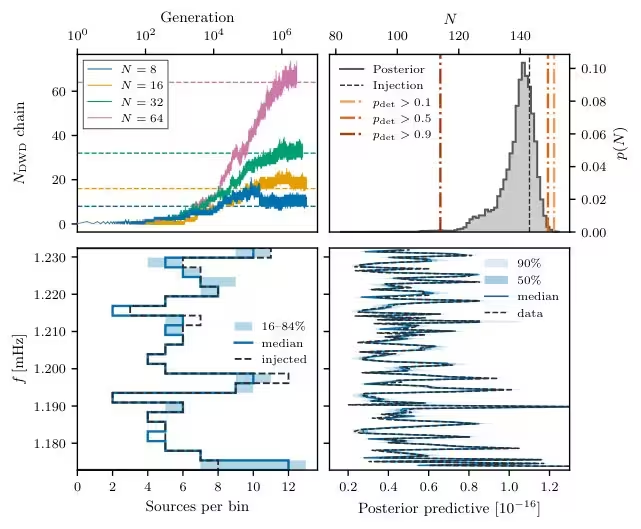
The investigators tested their sampler using simulated one-year LISA data streams containing thousands of synthetic double white dwarf binaries alongside stationary Gaussian instrumental noise. In a targeted benchmark involving 16,435 injected binaries, which created a staggering parameter space of 131,480 dimensions at the true population size, the system completed 15 million iterations in approximately 16 hours using only 3 gigabytes of RAM.
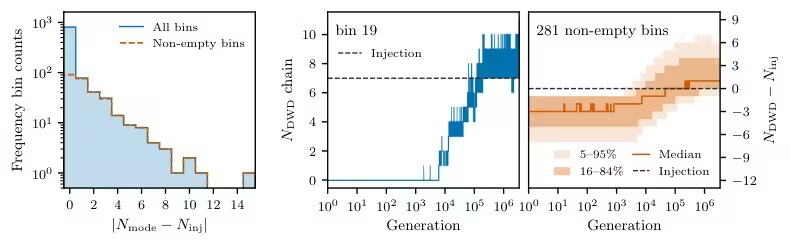
The benchmarking results demonstrate that continuous-time birth-death sampling is computationally feasible for massive galactic populations. The authors emphasize that their algorithm successfully recovered the injected number of sources starting from completely empty initial states without needing prior astrophysical hints. While minor upward offsets appeared in the reconstructed instrument noise spectral density due to incomplete separation of overlapping signals, the overall signal reconstruction matched the simulated data within close credible intervals.
What Steps Come Next for Space-Based Gravitational Wave Astronomy?
The research group aims to expand their sampler to tackle an even wider array of astrophysical phenomena in future simulations. Planned expansions involve incorporating massive black hole binaries, extreme mass ratio inspirals, and the total unresolved galactic foreground into a unified global fitting architecture for upcoming data challenges.
The study was posted to the arXiv preprint server on November 12, 2026.
This article has been fact checked for accuracy, with information verified against reputable sources. Learn more about us and our editorial process.
Last reviewed on .
Article history
- Latest version
Reference(s)
- Dall'Armi, Lorenzo. “Global Fit Inference for LISA with samsara++.” arXiv.org <http://arxiv.org/abs/2611.17266v1>.
Cite this page:
- Posted by Karan Das