Watch asteroid 152637 (1997 NC1) zip past Earth at its closest in 400 years this June
A massive near‑Earth asteroid will swing by at a record‑close range in June, offering scientists a unique chance to probe its composition and trajectory.

The asteroid designated 152637 (1997 NC1) will swing past Earth on 27 June 2026, reaching a distance that has not been witnessed in more than four centuries. Coordinated observations from ground‑based telescopes and radar installations, including efforts led by the Virtual Telescope Project, are tracking the encounter at roughly 0.01715 AU (about 2.56 million km). While the flyby poses no impact threat, it offers scientists a valuable chance to sharpen the orbital data for this sizable near‑Earth object. The next similarly close passage is projected for 28 June 2133.
A Millennial‑Scale Close Encounter
At approximately six and a half lunar distances, the asteroid will make its closest approach since the early 1600s, a rarity driven by long‑term gravitational interactions. Classified as an Aten‑type body, it spends part of its orbit interior to Earth’s path while intersecting our planet’s orbital plane. Size estimates range from about 900 m to 1.5 km, depending on assumptions about surface reflectivity, but the object remains well outside any collision scenario for the foreseeable future.
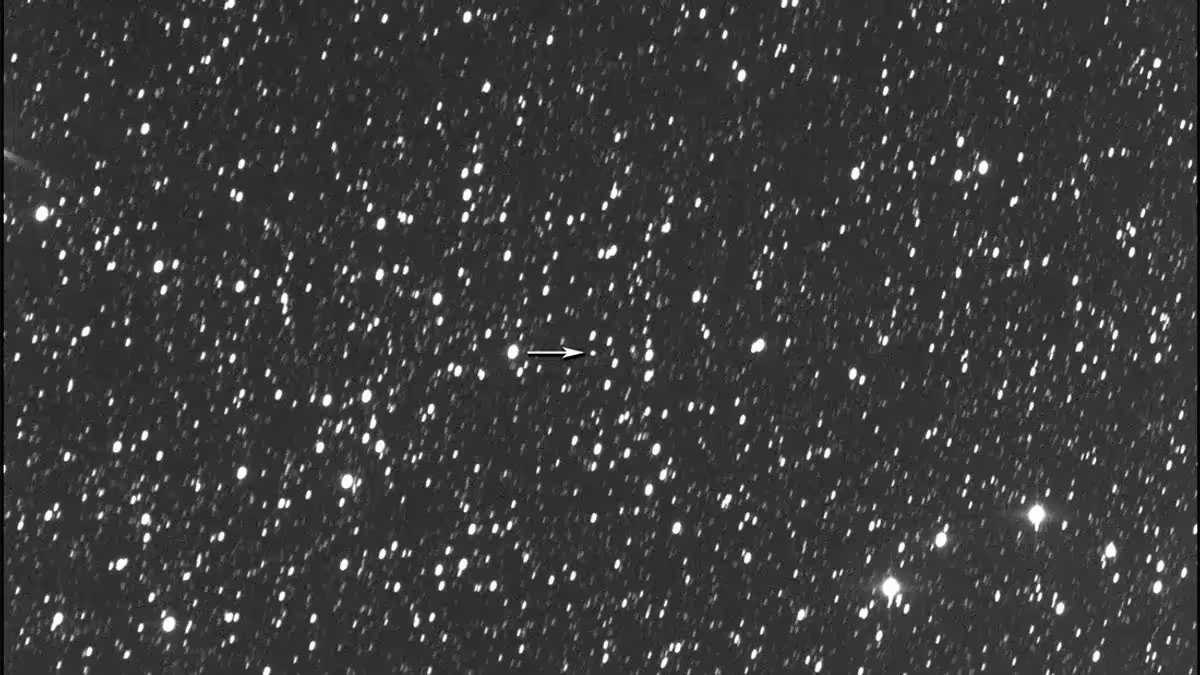
Credit: Virtual Telescope Project
Coordinated Observation Campaigns
Astronomers are deploying a mix of optical telescopes and radar facilities to refine the asteroid’s physical characteristics. The Virtual Telescope Project has scheduled live imaging sessions as the object nears its closest point, providing both scientific data and public outreach. Complementary radar tracking from installations such as the Goldstone Solar System Radar aims to resolve lingering uncertainties about size, spin state, and surface composition.
“Visible light from the sun reflects off the surface of the rocks. The more reflective, or shiny, the object is (a feature called albedo), the more light it will reflect.”
“Darker objects reflect little sunlight, so to a telescope from millions of miles away, a large dark asteroid can appear the same as a small, light one.”
These quotations underscore why brightness alone cannot determine an asteroid’s dimensions; variations in surface albedo can mask true size, making radar measurements essential for accurate modeling.
Radar Insights Expected from the 2026 Flyby
By transmitting radio pulses toward 152637 (1997 NC1) and analyzing the echoes, researchers anticipate a high‑resolution shape reconstruction, tighter constraints on its diameter, and a clearer picture of its rotation rate. The data will also reveal surface roughness and any structural anomalies, information that feeds directly into long‑term orbital forecasts, especially for bodies affected by subtle forces such as the Yarkovsky effect.
Although the asteroid is labeled “potentially hazardous” due to its orbital proximity, none of the current dynamical models predict an impact within the next century. The upcoming observations will serve as a benchmark, allowing scientists to compare past radar‑based predictions with the new measurements and refine planetary‑defense catalogs accordingly.
How Amateur Astronomers Can See the Asteroid
At its brightest, the asteroid is expected to reach magnitude 10, a level reachable with modest telescopes under dark skies. Northern observers will have the earliest window as the object approaches, while southern sky enthusiasts will see better conditions during its retreat. Moonlight may reduce contrast at certain times, so planning around lunar phases will improve visibility.
The slow apparent motion across the sky will allow tracking over several nights, enabling coordinated efforts between professional facilities and hobbyist groups. Live streams and imaging sessions are slated for 26–27 June, offering the public an opportunity to follow the event in real time.
A Benchmark for Centuries of Orbital Evolution
The 2026 pass represents a data point anchored in a trajectory shaped by centuries of planetary perturbations. Each close approach provides a test for predictive models, helping astronomers gauge how small bodies migrate within the inner Solar System. The forthcoming 2133 encounter will extend this observational record, linking generations of measurements.
Combining optical and radar observations during this flyby will reduce uncertainties surrounding the asteroid’s size, composition, and spin, thereby strengthening the overall framework used to monitor near‑Earth objects. The event exemplifies how collaborative, multi‑method science advances both public engagement and technical precision in planetary astronomy.
This article has been fact checked for accuracy, with information verified against reputable sources. Learn more about us and our editorial process.
Last reviewed on .
Article history
- Latest version
Cite this page:
- Posted by Aisha Ahmed