Ultra-puffy super-Neptune discovered around a tiny red dwarf – the lightest of its kind
A newly discovered exoplanet 383 light-years away has an unusually low density, shedding light on how some worlds evolve in extreme conditions
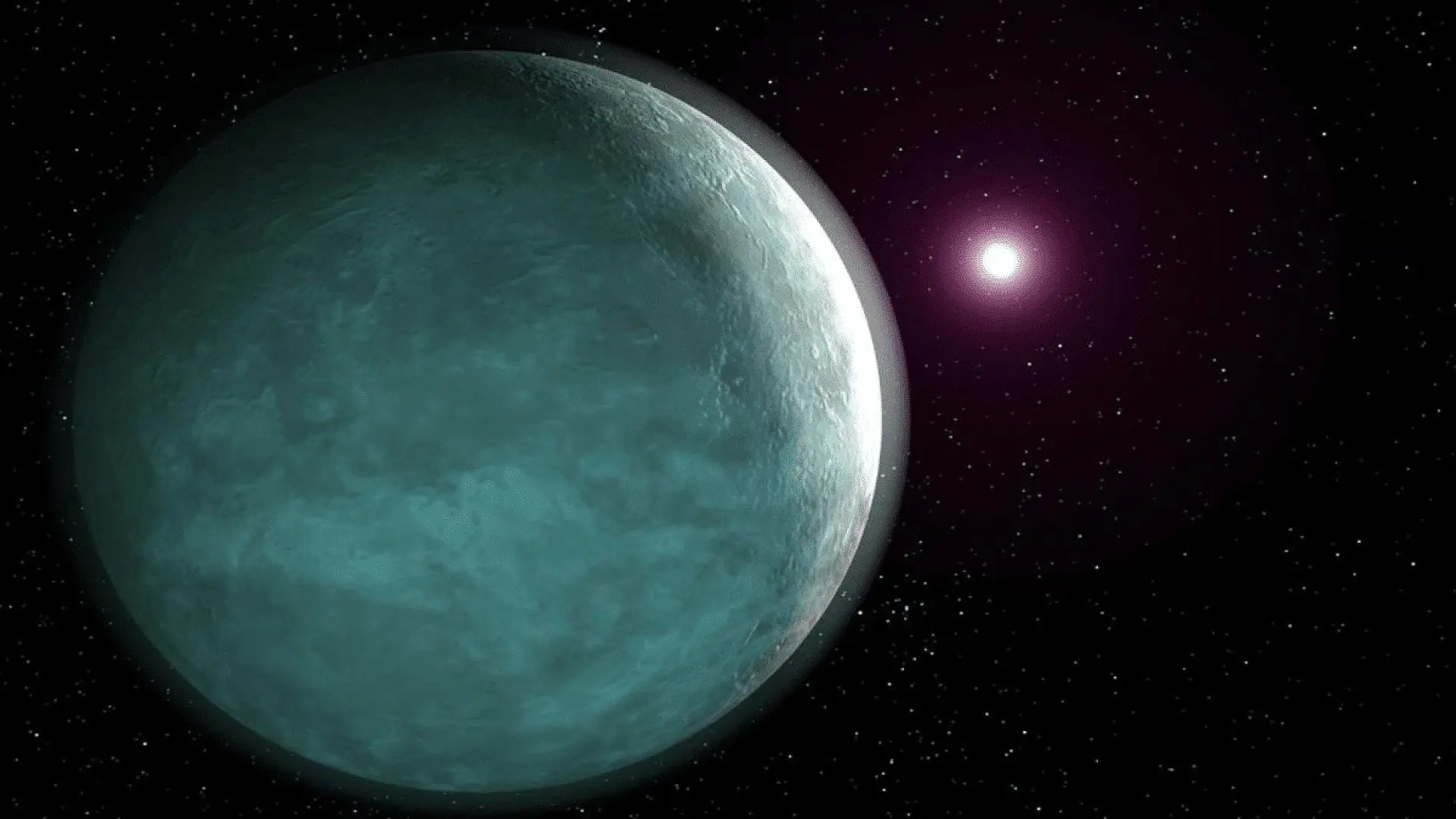
A newly identified exoplanet orbiting a modest red dwarf has been measured as one of the most inflated bodies known around this type of star. The planet, labeled TOI-1883 b, shows a bulk density of roughly 0.4 g cm⁻³, far lighter than many models predicted for an object of its dimensions. This finding sheds light on a scarcely explored class of planets and may help clarify how some worlds endure in orbital zones that are otherwise largely empty.
A Massive World Around a Small Red Dwarf
The system lies about 383 light‑years from our planet, with its host star TOI‑1883 classified as an M‑dwarf possessing roughly half the Sun’s mass and radius. The planet was first flagged in 2024, revealing a rapid 4.5‑day orbital period. Early transit data indicated a radius exceeding five times that of Earth, yet its mass remained uncertain, leaving its true nature ambiguous.
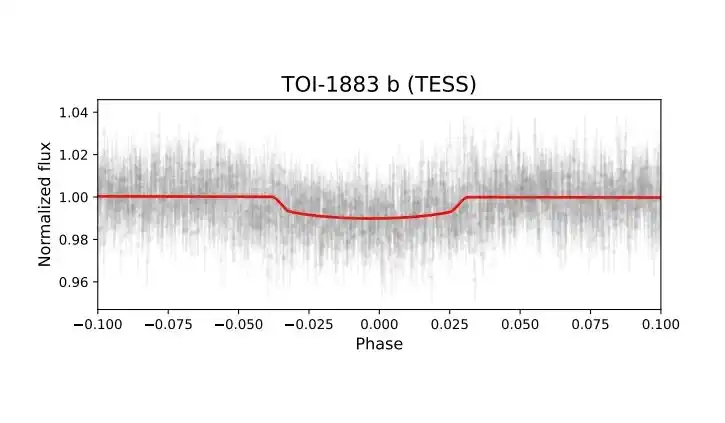
To resolve this, a collaboration led by Izuru Fukuda at the University of Tokyo obtained precise radial‑velocity measurements with the InfraRed Doppler (IRD) spectrograph on the Subaru Telescope. Complementary transit monitoring was carried out with the multi‑band MuSCAT instruments. By merging the spectroscopic and photometric datasets, the team derived a planetary mass and uncovered an unexpected characteristic: despite its large size, the planet is remarkably light, placing it in the “super‑Neptune” category—larger than Neptune but well below Jupiter’s mass.
Credit: arXiv (2026). DOI: 10.48550/arxiv.2606.06868
Measurements Reveal an Ultra‑Low Density
The preprint on arXiv reports a planetary mass of about 13.7 Earth masses and a radius of roughly 5.65 Earth radii. These values correspond to a mean density near 0.4 g cm⁻³, making TOI‑1883 b the lowest‑density super‑Neptune identified around an M‑dwarf to date.
The authors describe their methodology:
“After TOI-1883 b was validated as a bona fide planet, we attempted to determine its mass through RV [radial velocity] observations using the IRD instrument mounted on the Subaru Telescope. (…) Furthermore, we carried out transit observations with the MuSCAT series and examined potential transit timing variations (TTVs) that could arise from gravitational perturbations induced by an additional outer planet,” the researchers explained.
Such a sparse density implies a thick gaseous envelope surrounding a relatively small core, a hallmark of “puffy” planets whose atmospheres are inflated far beyond what their mass alone would suggest. The extreme nature of TOI‑1883 b adds a valuable data point to ongoing debates about how these bloated worlds form and persist.
A Rare Inhabitant of the Neptunian Desert
What makes TOI‑1883 b especially intriguing is its position within the so‑called Neptunian desert—a region of orbital parameter space where planets between super‑Earth and Jupiter sizes are conspicuously scarce despite being easy to detect. The planet resides in a sub‑region termed the Neptunian ridge, defined by periods from roughly 3.2 to 5.7 days. Its 4.506‑day orbit places it squarely in this niche.
Because objects in this zone are uncommon, each new discovery provides critical insight into the physical mechanisms that sculpt planetary systems. The combination of a short orbital period, large radius, and exceptionally low density makes TOI‑1883 b a prime laboratory for testing theories of atmospheric loss, migration, and formation.
Researchers note that unraveling why planets are sparse in this sector could illuminate how stellar radiation strips atmospheres, how inward migration reshapes system architecture, and how diverse birth environments imprint on final planetary characteristics.
Hints of a Complex Evolutionary Path
The team proposes that TOI‑1883 b likely originated farther out in its protoplanetary disk before moving inward via disk‑driven migration. Interactions with the surrounding gas would have gradually altered its orbit, delivering the planet to its present close‑in location.
Once settled, the intense radiation from its host star would have initiated photoevaporation, a process in which high‑energy ultraviolet photons erode the outer layers of the atmosphere over long timescales. This gradual stripping could explain the planet’s survival in the Neptunian desert while retaining a highly expanded envelope.
The host star’s composition also appears to play a role. Spectroscopic analysis shows that TOI‑1883 has a metallicity notably higher than the Sun’s. The authors suggest that this enriched environment may have curtailed runaway gas accretion, preventing the planet from ballooning into a full‑scale gas giant and leaving it in a transitional, highly inflated state.
Future Prospects for Atmospheric Characterisation
Given its bloated atmosphere and low bulk density, TOI‑1883 b is an attractive target for detailed spectroscopic studies with upcoming observatories. High‑resolution observations could uncover the chemical makeup of its envelope, quantify atmospheric loss, and discriminate among competing evolutionary models.
The authors stress that additional high‑precision radial‑velocity data will refine the planet’s mass and search for any additional companions that might influence its orbit. Confirming the current scenario would establish TOI‑1883 b as a benchmark case for understanding planetary migration, atmospheric dynamics, and survival in extreme exoplanetary environments, marking it as one of the most compelling discoveries of the year.
This article has been fact checked for accuracy, with information verified against reputable sources. Learn more about us and our editorial process.
Last reviewed on .
Article history
- Latest version
Reference(s)
- Fukuda, Izuru. “The mass of TOI-1883 b: A low density super-Neptune in the ridge regime transiting an early-M dwarf.” arXiv.org <https://arxiv.org/abs/2606.06868>.
Cite this page:
- Posted by Aisha Ahmed