Neptune’s Mysterious Moon May Be A Rare Survivor Of The Solar System’s Early Chaos
Astronomy
Neptune’s Mysterious Moon May Be A Rare Survivor Of The Solar System’s Early Chaos
Neptune’s satellite Nereid might represent the sole remaining primordial moon, offering clues about the planet’s turbulent formative years through its frozen, highly irregular trajectory.
By Aisha Ahmed
Published:
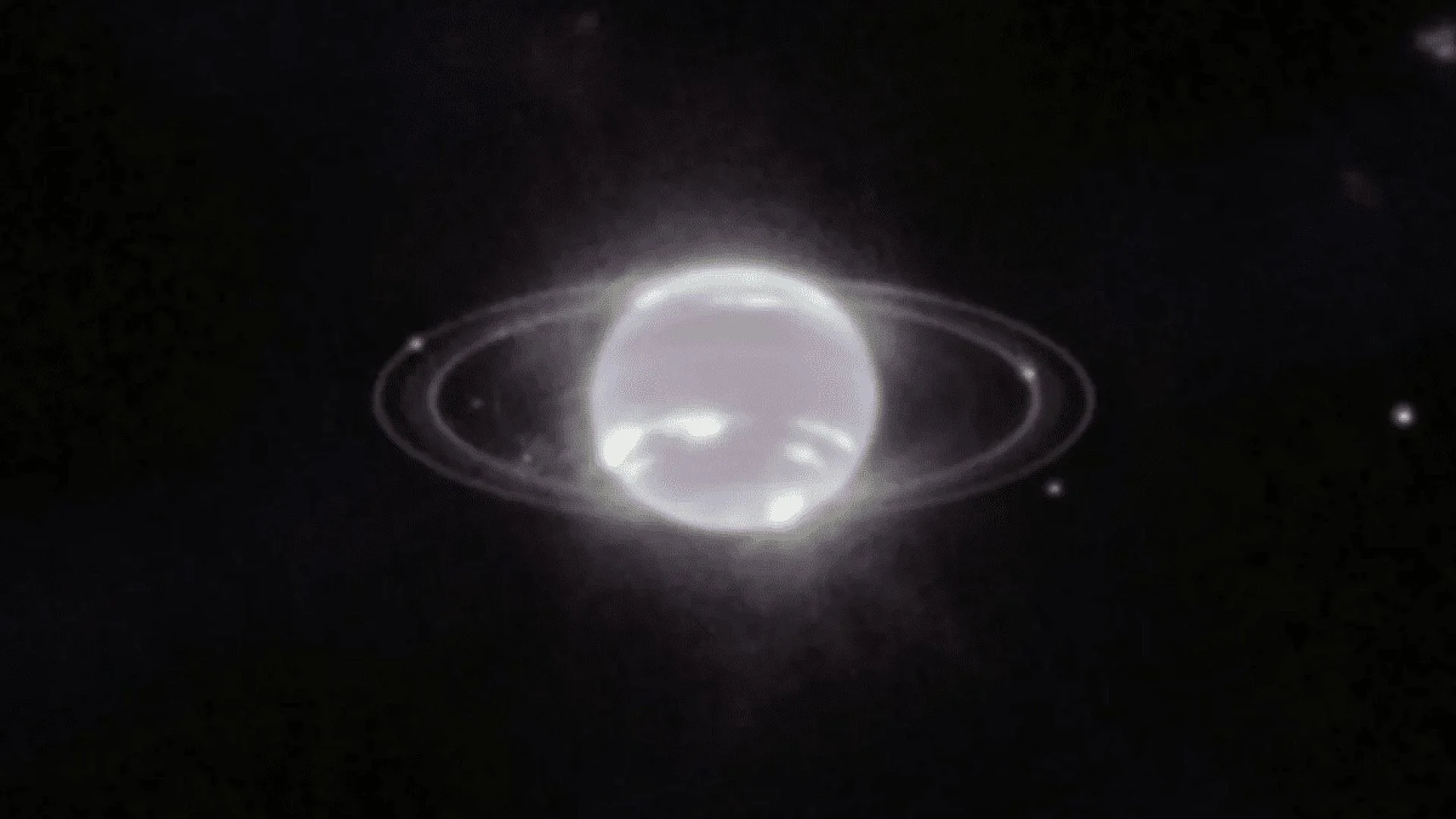
A groundbreaking study published in the esteemed journal Science Advances has shed new light on the mysterious past of Neptune’s moon, Nereid. This enigmatic satellite has endured for billions of years, defying the odds of cosmic upheaval that ravaged Neptune’s original moon system. Using the cutting-edge James Webb Space Telescope, researchers from the prestigious California Institute of Technology have made a compelling case for Nereid’s ancient origins, tied intimately to Neptune itself, rather than a wandering origin in the distant Kuiper Belt.
Nereid’s Unconventional Orbit Holds Clues to Its Ancient Past
Unlike Neptune’s largest moon, Triton, which invaded from the outer reaches of the solar system and disrupted the planet’s original satellites, Nereid has maintained a peculiar yet stable orbit. Its path around Neptune is highly elliptical, bringing it as close as 1 million miles (1.4 million kilometers) and as far as 6 million miles (9.6 million kilometers) from the planet. The Webb telescope observations indicate that Nereid is composed largely of ice, inconsistent with objects from the Kuiper Belt, suggesting it was part of Neptune’s system from the beginning.A Glimpse into Neptune’s Turbulent Past
Study author Matthew Belyakov of Caltech shared his insights with AP News in an email, stating, “We don’t have all that much evidence left around Neptune — the system doesn’t have very many moons left. But the latest observations strongly rule out that Nereid wandered by like so many others and got ensnared by planetary gravity.”The Extreme Orbit of Nereid: A Key to Survival
The extreme eccentricity of Nereid’s orbit may have shielded it from collisions that destroyed Neptune’s other original moons, allowing it to survive the chaos triggered by Triton’s capture. This remarkable discovery provides a rare window into the dynamics of Neptune’s original moon system, offering insights that cannot be gleaned from planets with less chaotic histories.
A Historical Perspective: Kuiper’s Early Insight
Nereid was discovered in 1949 by Dutch astronomer Gerard Kuiper, who remarked at the time, “There is some reason to hope that this object may become a clue to the unusual cosmogonic problem presented by the Neptune system, and as such is of more than routine interest.” The recent Webb observations confirm that Kuiper’s early instincts were correct: Nereid is indeed a key to understanding the formation and evolution of Neptune’s moons.The Road Ahead: Future Exploration Opportunities
Despite the significance of these discoveries, Neptune’s system remains largely unvisited. Only NASA’s Voyager 2, which flew by the planet in 1989, has directly explored Neptune. A dedicated mission to the planet could confirm the origins of Nereid and the other moons, revealing more about their compositions, orbital dynamics, and the history of Neptune’s original satellite system.Unraveling the Story of Nereid
Until such a mission is launched, the Webb Space Telescope observations represent the best evidence that Nereid survived a cosmic upheaval that destroyed or displaced Neptune’s other original moons. Scientists anticipate that further study will continue to unravel the story of this icy, resilient world orbiting the solar system’s most distant planet.Fact Checked
This article has been fact checked for accuracy, with information verified against reputable sources. Learn more about us and our editorial process.
Last reviewed on .
Article history
- Latest version
Reference(s)
- Dunn, Marcia. “Neptune's mysterious moon Nereid may be an original companion.”, May 20, 2026 AP News <https://apnews.com/article/neptune-moon-nereid-nasa-webb-telescope-f546a59d7b7d10a2efcfb3a27aa89c43>.
Cite this page:
- Posted by Aisha Ahmed
End of the article