Psyche Mission Captures Never-Before-Seen Images of Mars During Flyby
During its Mars flyby, Psyche captured breathtaking images while simultaneously receiving a vital velocity increase to propel it toward its destination—a metal-rich asteroid.
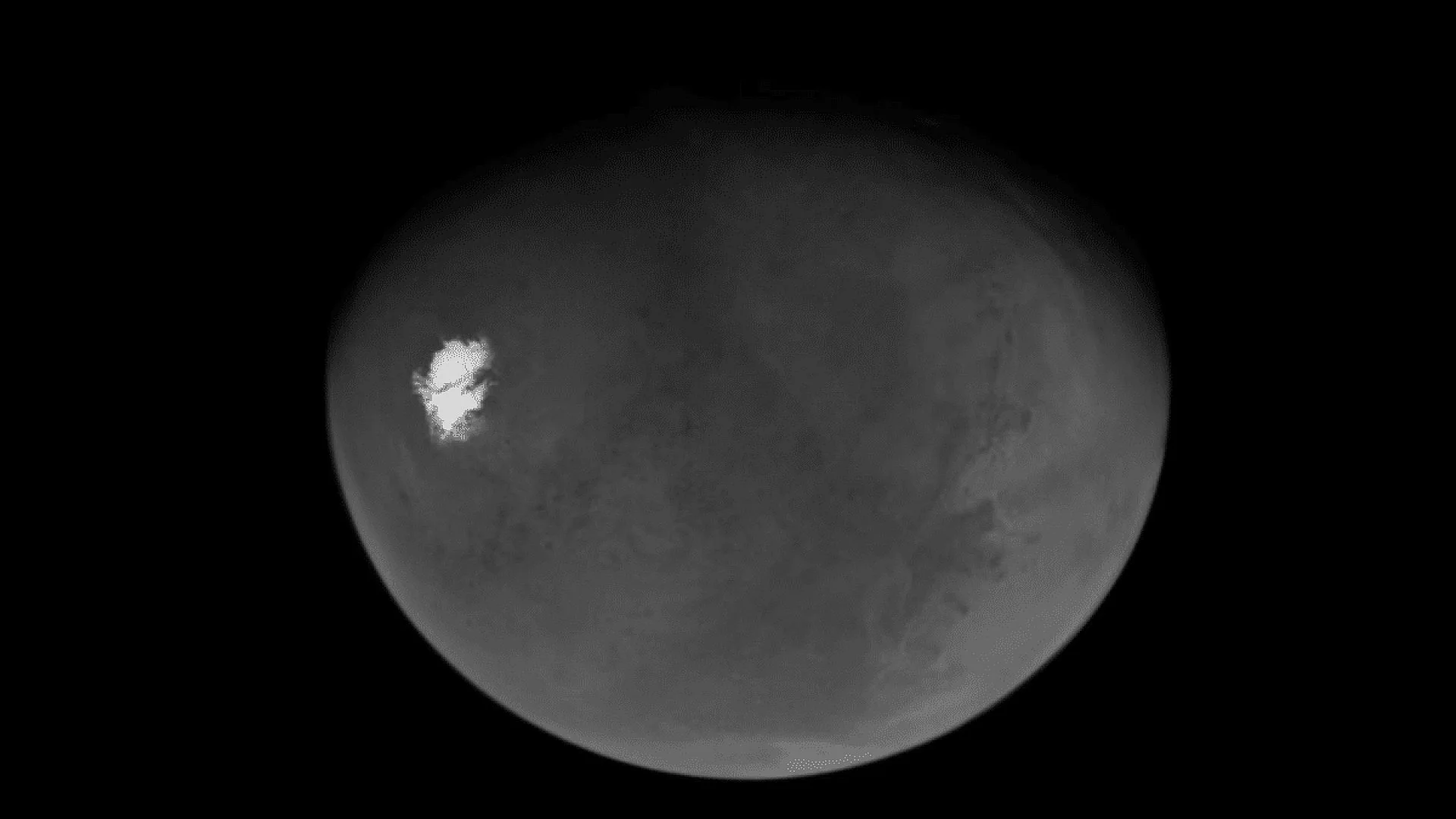
The Psyche mission made history on May 15, 2026, as it completed a precise flyby of Mars, capturing breathtaking images while gaining a critical speed boost toward its ultimate destination: the metal-rich asteroid 16 Psyche. According to NASA, this maneuver not only increased the spacecraft’s velocity by 1,000 mph (1,600 kph) but also slightly altered its trajectory to align with the asteroid belt, marking a milestone in humanity’s quest to explore rare metallic bodies in our solar system.
A Gravity-Assisted Leap Toward the Asteroid Belt
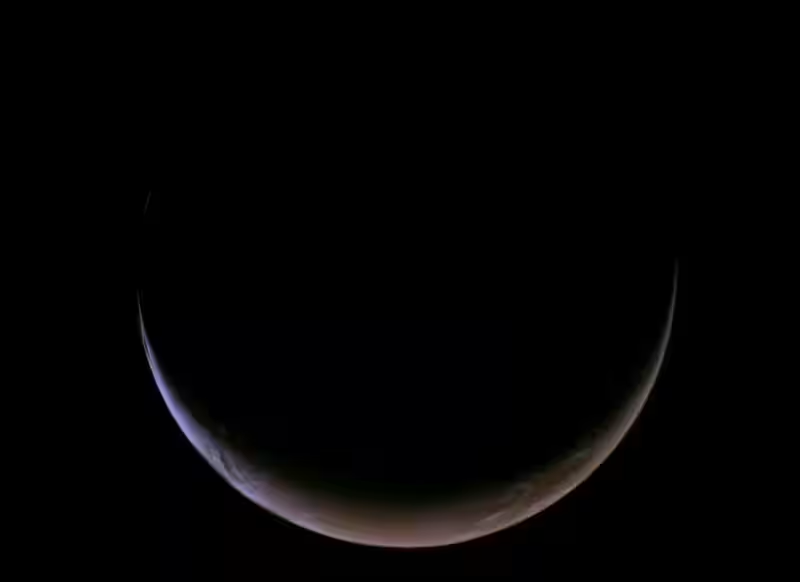
The flyby of Mars was a textbook example of a gravity-assist maneuver. By approaching the planet within 2,800 miles (4,500 kilometers) of its surface, Psyche tapped into Mars’ gravitational pull, using it as a cosmic slingshot to accelerate its journey. Traveling at 12,333 mph (19,848 kph), the spacecraft not only gained speed but also adjusted its orbital path by roughly 1 degree, a subtle but essential change to match the tilted orbit of 16 Psyche. This precise navigation ensures Psyche remains on track for its 2029 arrival.
Credit: NASA/ JPL-Caltech/ ASU.
NASA explains that flybys like this one are far more than speed boosts, they are strategic course corrections. Because 16 Psyche’s orbit is slightly inclined relative to the plane of the solar system, a small adjustment during a planetary encounter is the most efficient way to position a spacecraft for its long-term mission. The technique saves both fuel and time, proving once again that orbital mechanics can be leveraged to remarkable effect.
The Visual Odyssey: Mars Like You’ve Never Seen
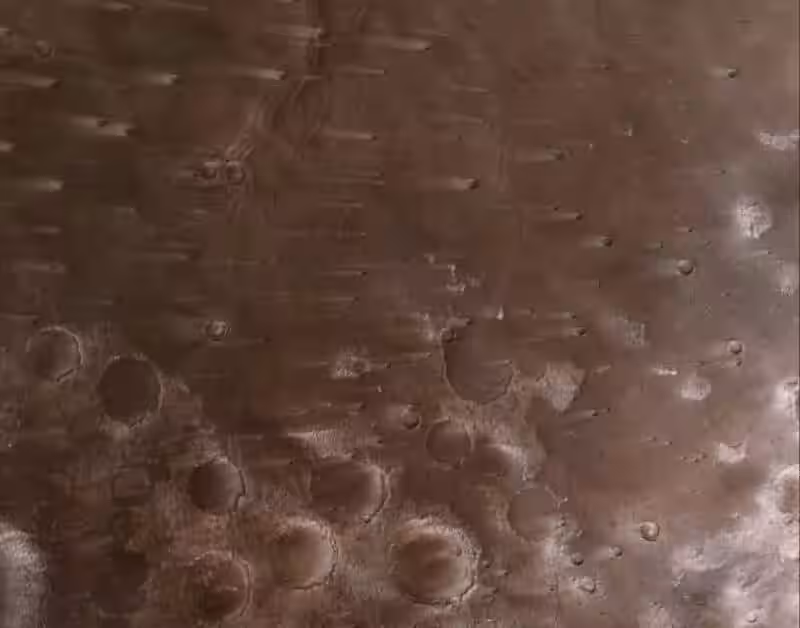
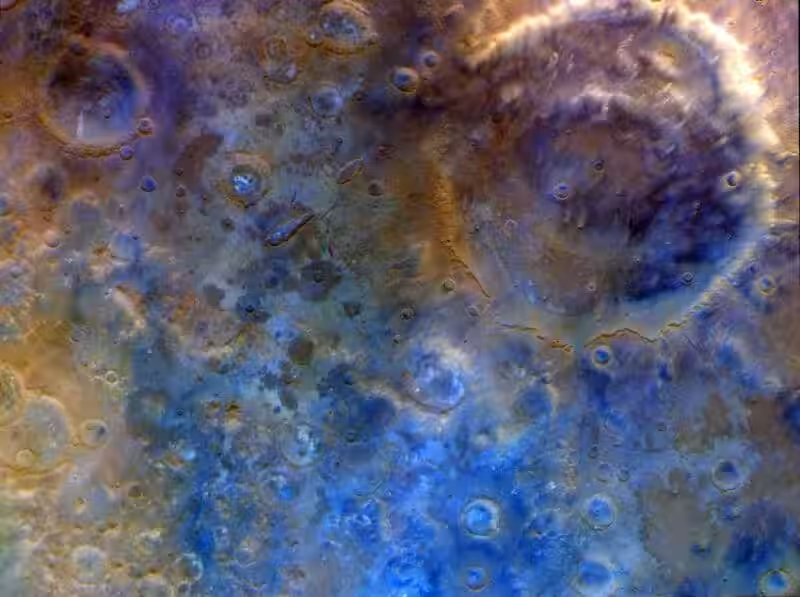
Images captured by Psyche reveal Mars in stages of illumination, starting with a crescent view as the spacecraft approached and evolving into a fully lit view as it sped past. These images offer not only spectacular visuals but also valuable data on the planet’s atmosphere and surface characteristics. Early photos from May 3, 2026, show Mars from 3 million miles (4.8 million km) away, gradually increasing in clarity as Psyche closed in. The perspective highlights the precision of the spacecraft’s trajectory and the skillful planning of mission engineers.
Credit: NASA/ JPL-Caltech/ ASU.
Observers note that capturing images during such a high-speed flyby, covering nearly 20,000 kilometers per hour, is no small feat. Each photograph requires exact timing, sophisticated instruments, and careful calibration to counter the motion blur that comes with such velocity. The results provide both a visual feast and scientific insight into planetary proximity operations.
Targeting the Rare Metal Asteroid Psyche
The ultimate objective of the Psyche mission is the 16 Psyche asteroid, a celestial body unique in the solar system for its rich concentration of nickel, iron, and other metals. Scientists believe it may be the exposed core of an early protoplanet, offering a window into planetary formation processes that occurred over 4 billion years ago. By studying this metallic world up close, the mission will provide unprecedented data about the building blocks of planets, the dynamics of the asteroid belt, and the history of solar system evolution.
Credit: NASA/ JPL-Caltech/ ASU.
The journey to 16 Psyche requires careful navigation. Its orbit is skewed slightly relative to the plane of the solar system, meaning the spacecraft cannot travel in a straight line. Each flyby, including this recent Mars encounter, is designed to make incremental course corrections and velocity adjustments, ensuring a precise rendezvous with the asteroid in 2029.
What Psyche’s Mars Flyby Signifies
This flyby represents more than a technical achievement, it demonstrates how human ingenuity leverages planetary physics to reach previously unreachable destinations. By combining gravity assists, trajectory adjustments, and high-speed imaging, the Psyche mission illustrates the delicate balance between engineering, astronomy, and exploration strategy.
NASA’s announcement of the flyby images confirms the mission remains on schedule, with each maneuver reinforcing confidence in the spacecraft’s systems and trajectory. These developments excite both the scientific community and space enthusiasts, as Psyche continues its journey to a world that could rewrite our understanding of planetary cores and the early solar system.
As the spacecraft speeds toward its final destination, each captured image and measured adjustment becomes part of a story that will extend humanity’s reach into the metallic heart of the solar system.
This article has been fact checked for accuracy, with information verified against reputable sources. Learn more about us and our editorial process.
Last reviewed on .
Article history
- Latest version
Reference(s)
- Alanis, Rafael. “NASA’s Psyche Mission Images Mars’ Huygens Crater - NASA Science.”, May 19, 2026 NASA <https://science.nasa.gov/photojournal/nasas-psyche-mission-images-mars-huygens-crater/>.
Cite this page:
- Posted by Aisha Ahmed