11 Billion-Year-Old Collision May Explain Milky Way’s Spin-Up Mystery
A colossal galactic merger might have warped the Milky Way’s stellar disk around 11 billion years ago, triggering a burst of star formation that continues to influence the galaxy’s evolution.
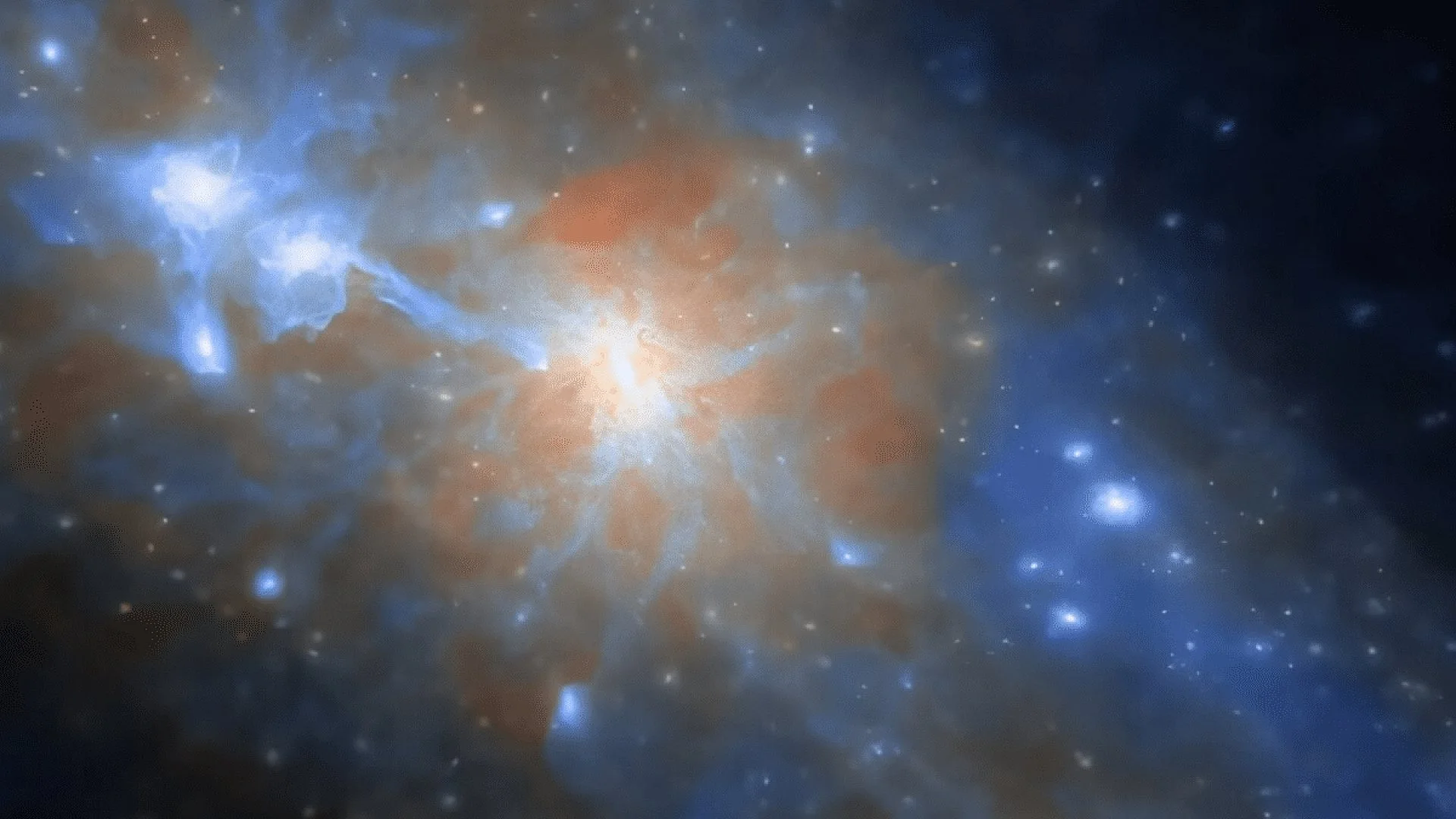
The Milky Way’s history is a complex tapestry of violent mergers and intense starbursts, with a cosmic smash-up that occurred around 11 billion years ago potentially reshaping the galaxy’s rotating stellar disk. This ancient collision sent shockwaves through the galaxy, triggering the formation of new stars and leaving lasting imprints on its structure, as revealed by recent simulations and star cluster observations.
The Milky Way’s Disk: A Story of Spin-Up and Destruction
The Milky Way’s disk is a sprawling, pancake-shaped system of stars, including our sun, rotating at over 220 kilometers per second. For decades, astronomers have sought to determine when this coherent rotation first emerged, a phenomenon known as the galaxy’s spin-up. However, the Milky Way’s history is far from peaceful, with evidence suggesting a violent collision with a smaller galaxy early in its life.
Data from the Gaia mission revealed a population of stars with unusual motions, pointing to a massive merger event that scientists have dubbed the Gaia, Sausage, Enceladus (GSE) merger. This collision disrupted the Milky Way’s disk and likely erased much of its early structure, meaning the spin-up observed today reflects a recovery rather than the disk’s initial formation.
Simulating Galactic Collisions: A Window into the Past
Researchers at the Institute of Cosmos Sciences of the University of Barcelona (ICCUB) and the Institute of Space Studies of Catalonia (IEEC) used Auriga simulations to model the Milky Way and explore how disks form under varying conditions. These simulations revealed that stellar disks often emerge earlier than previously believed but can be partially or completely destroyed by major mergers.
Starbursts and Galactic Fireworks: The Legacy of the GSE Merger
The study finds a direct link between the GSE merger and intense bursts of star formation in the early Milky Way. “Models of the Gaia–Sausage–Enceladus merger predict that a galactic firework should have followed the impact, raising star formation and fostering the formation of globular clusters,” explains co-author Chervin F. P. Laporte of the French National Centre for Scientific Research (CNRS). The violent compression of gas during the collision likely triggered these starbursts, leading to the sudden proliferation of star clusters that astronomers observe today.
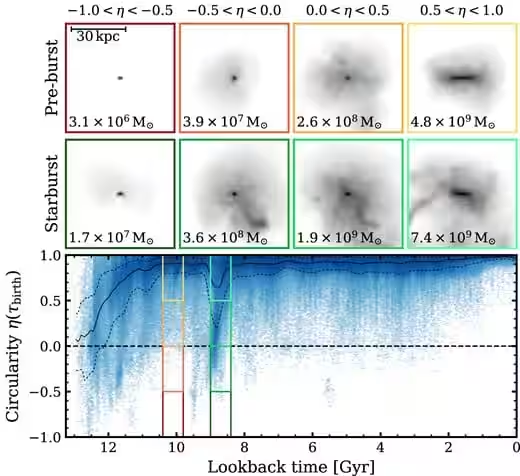
Credit: Monthly Notices of the Royal Astronomical Society.
Reconstructing the Milky Way’s History: A Dance of Destruction and Creation
Lead author Matthew D. A. Orkney, a researcher at ICCUB and IEEC, adds, “This research highlights the important relationship between galactic structure and ancient collisions, which must be understood in unison in order to understand the history of our galaxy.” By studying the aftermath of such events, astronomers can infer not only when key mergers occurred but also how galaxies like the Milky Way rebuild themselves over billions of years.
Observing Distant Galaxies for Clues: A Window into the Past
Although humans cannot travel back in time to witness the Milky Way’s youth, astronomers can study analogous galaxies in the distant universe. Data from the James Webb Space Telescope (JWST) and the Atacama Large Millimeter/submillimeter Array (ALMA) allow researchers to observe star-forming galaxies as they existed billions of years ago, offering valuable insights into how early collisions shaped their disks and star populations.
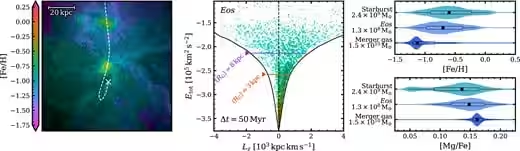
Credit: Monthly Notices of the Royal Astronomical Society.
Linking Simulations and Observations: A New Era of Galactic Research
By combining high-resolution simulations with observational data on star clusters, the study published in the Monthly Notices of the Royal Astronomical Society provides a more complete picture of the Milky Way’s violent past. This approach bridges theoretical predictions with real-world measurements, confirming that major collisions like the GSE merger leave lasting imprints on galactic structure, star formation, and stellar dynamics.
This article has been fact checked for accuracy, with information verified against reputable sources. Learn more about us and our editorial process.
Last reviewed on .
Article history
- Latest version
Cite this page:
- Posted by Aisha Ahmed