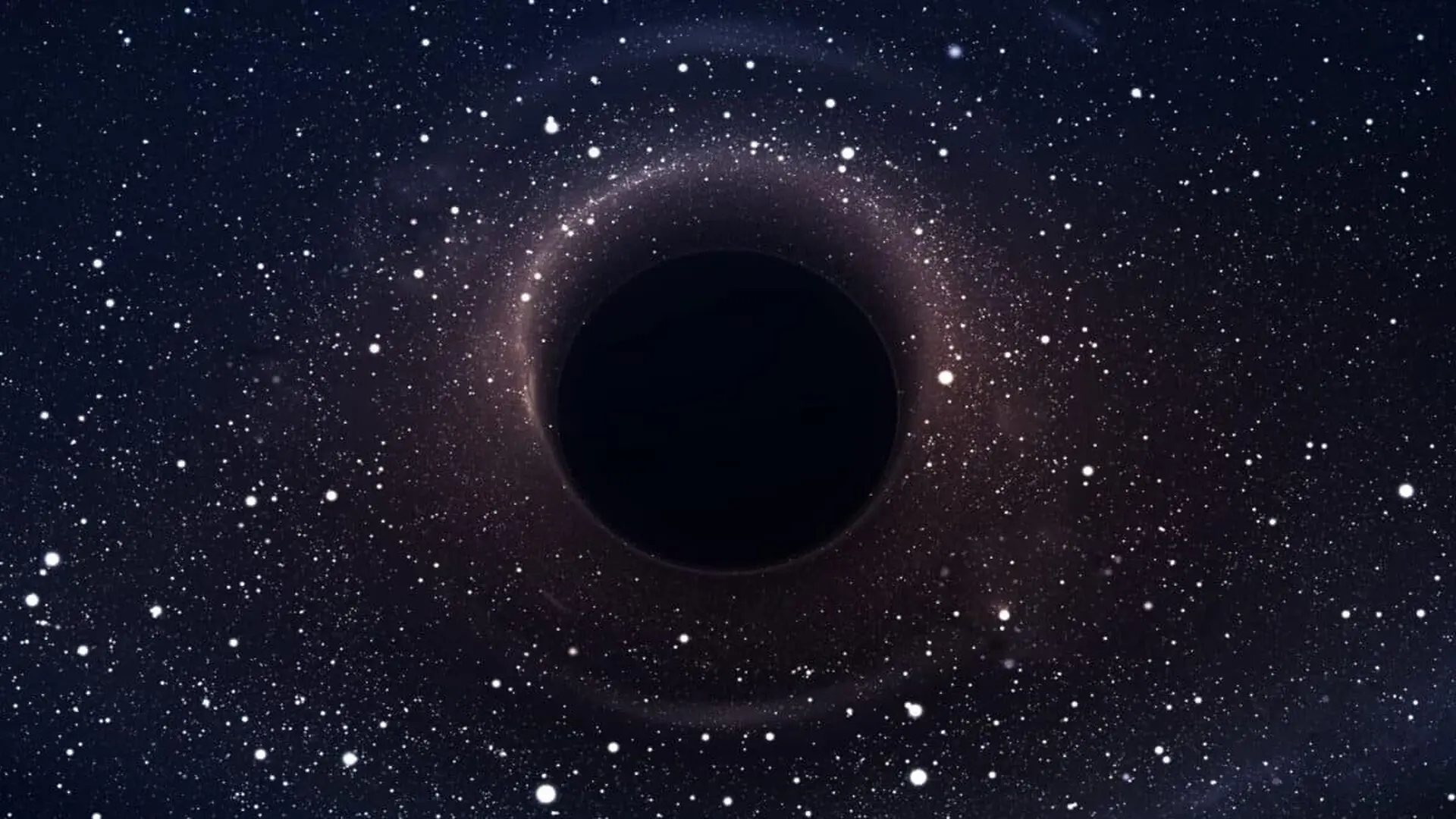
Astronomers Spot First Stellar-Mass Black Hole Inside Omega Centauri Using Hubble and Webb
Hubble and Webb track a star’s subtle motion to reveal Omega Centauri’s first hidden black hole, confirming decades‑old predictions of a missing population.
A joint analysis of more than two decades of Hubble observations and the latest measurements from the James Webb Space Telescope has led to the first confirmed stellar‑mass black hole inside the globular cluster Omega Centauri. The find settles a persistent puzzle about the cluster’s hidden black‑hole population and adds a new benchmark for models of compact‑object formation.
The object, dubbed oMEGACat BH‑2, was uncovered by monitoring the subtle wobble of a bright main‑sequence companion star, rather than by the traditional X‑ray or radio signatures. This astrometric approach provides a fresh window onto black holes residing in crowded stellar environments.
Precise Star‑Tracking Exposes a Dark Partner
Researchers combined archival Hubble images taken between 2002 and 2023 with recent near‑infrared data from Webb’s NIRCam. By charting the tiny positional shifts of the visible star over time, they reconstructed an orbit that points to an unseen mass of about 4.46 solar masses. Such a mass exceeds the limit for a neutron star, confirming the companion as a stellar‑mass black hole, as reported in The Astrophysical Journal Letters.
“With Hubble and Webb data, we were able to see the motion of the visible main‑sequence star that is part of this binary, which is about 18,000 light‑years away in the dense environment of Omega Centauri,” said lead author Matthew Whitaker of the University of Utah. “The precision of these measurements is incredible, down to a fraction of a pixel on both telescopes. It would not have been possible to find this black hole without them.”
The orbital period of the binary is roughly 94 years, making it the longest‑period black‑hole system identified so far. The team’s analysis also suggests the black hole captured its stellar partner after both objects were already embedded in the cluster, rather than forming together.
Implications for the Hidden Black‑Hole Census in Omega Centauri
Theoretical calculations have long predicted that Omega Centauri should host on the order of 10,000 stellar‑mass black holes, remnants of massive stars that exploded as supernovae. Direct evidence, however, has been elusive. The confirmation of oMEGACat BH‑2 offers the first tangible proof that at least a portion of this predicted population remains bound to the cluster.
Although models suggest globular #starcluster Omega Centauri should contain approximately 10,000 stellar-mass black holes, observational evidence of their existence has remained scarce.
Co‑author Anil Seth noted that the black hole’s mass, while too high for a neutron star, is lower than many models predict for objects forming in the metal‑poor environment of Omega Centauri. “While we already knew that the star was 0.78 solar masses, we can now calculate the black hole’s mass, which is 4.46 solar masses and therefore too heavy to be a neutron star. However, its mass is much lower than would be expected in a metal‑poor environment like Omega Centauri. This is surprising and exciting,” he added.
Simulations indicate that the binary will likely be disrupted within a billion years due to close encounters with neighboring stars, a timescale far shorter than the cluster’s estimated 12‑billion‑year age. Understanding such systems is crucial because dense clusters are thought to generate binary black‑hole mergers that produce gravitational‑wave signals.
Future surveys with Hubble, Webb, and the upcoming Nancy Grace Roman Space Telescope aim to uncover additional hidden black holes in crowded regions of the Milky Way, expanding the sample of objects like oMEGACat BH‑2 and refining theories of black‑hole formation and dynamics.
Fact Checked
This article has been fact checked for accuracy, with information verified against reputable sources. Learn more about us and our editorial process.
Last reviewed on .
Article history
Latest version
Reference(s)
Whitaker, Matthew., et al. “A Long Period Stellar-mass Black Hole Binary in
ω
Centauri.” The Astrophysical Journal Letters, vol. 1006, no. 1, July 13, 2026, pp. L1 American Astronomical Society, doi: 10.3847/2041-8213/ae7a5c. <https://doi.org/10.3847/2041-8213/ae7a5c>.
Das, Karan. “Astronomers Spot First Stellar-Mass Black Hole Inside Omega Centauri Using Hubble and Webb.” BioScience. BioScience ISSN 2521-5760, 26 July 2026. <https://www.bioscience.com.pk/en/subject/space-science/this-famous-star-cluster-was-hiding-a-black-hole-in-plain-sight>.
Das, K. (2026, July 26). “Astronomers Spot First Stellar-Mass Black Hole Inside Omega Centauri Using Hubble and Webb.” BioScience. ISSN 2521-5760. Retrieved July 26, 2026 from https://www.bioscience.com.pk/en/subject/space-science/this-famous-star-cluster-was-hiding-a-black-hole-in-plain-sight
Das, Karan. “Astronomers Spot First Stellar-Mass Black Hole Inside Omega Centauri Using Hubble and Webb.” BioScience. ISSN 2521-5760. https://www.bioscience.com.pk/en/subject/space-science/this-famous-star-cluster-was-hiding-a-black-hole-in-plain-sight (accessed July 26, 2026).