Titan’s Hydrocarbon and Water Treasure Could Fuel a Space Refueling Network
Researchers now probe Titan’s hidden interior after studying its rivers, lakes, and hazy atmosphere.
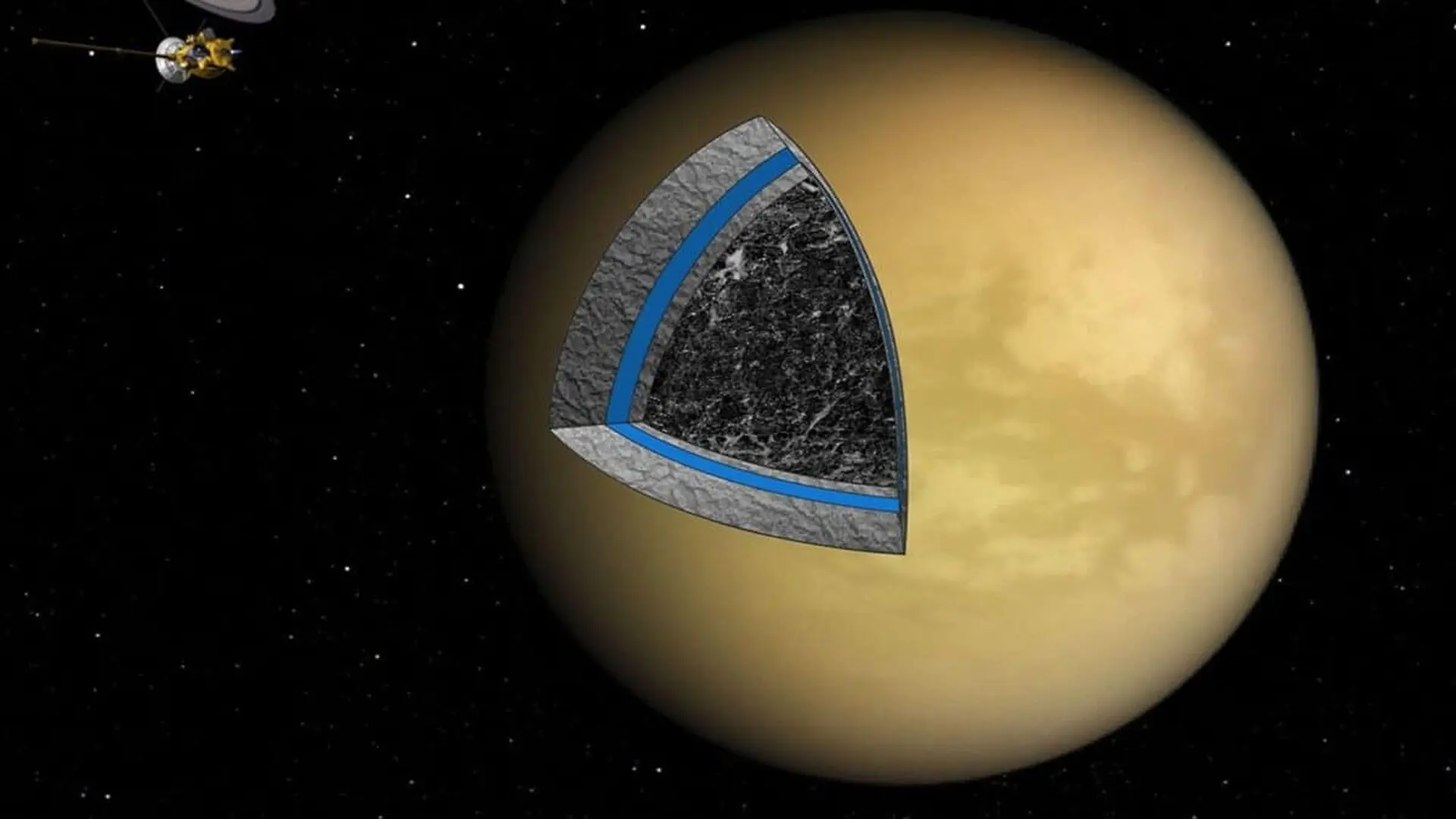
Titan—the massive moon orbiting Saturn—could become a cornerstone for deep‑space operations. New research evaluates how its abundant hydrocarbons, plentiful water, and other native materials might be harvested to refuel spacecraft, manufacture supplies, and sustain missions far from Earth.
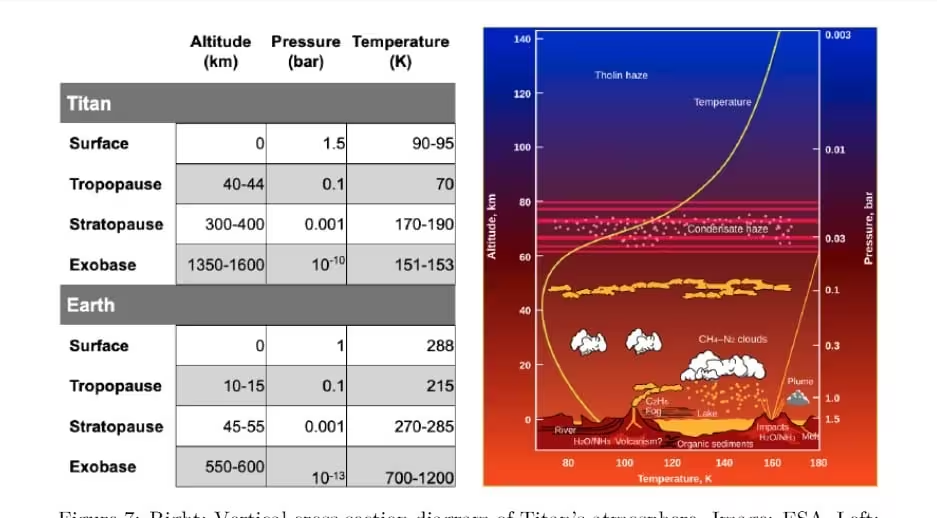
Unlike any other moon in the Solar System, Titan boasts a thick, nitrogen‑rich atmosphere and a climate driven by a methane cycle that produces clouds, rain, rivers, lakes, and even seas of liquid hydrocarbons. This exotic environment has long attracted scientists probing the moon’s chemistry and its possible ties to the origins of life. NASA’s upcoming Dragonfly rotorcraft, slated for launch no earlier than July 2028, will investigate Titan’s surface and atmosphere in unprecedented detail.
Beyond scientific curiosity, the latest study asks whether Titan’s natural inventory could support human‑centric activities and serve as a logistical hub for missions venturing deeper into the outer Solar System.
Titan as a Potential Refueling Outpost
The analysis, appearing in Acta Astronautica, was led by Conor A. Nixon of NASA’s Solar System Exploration Division at Goddard, together with Ye Lu of Worcester Polytechnic Institute and Jennifer E. Ruliffson from the University of Florida.
Focusing on in‑situ resource utilization (ISRU), the team examined how Titan’s native materials could replace Earth‑derived supplies. While most ISRU work has centered on the Moon and Mars, this investigation turns the spotlight on Saturn’s largest satellite.
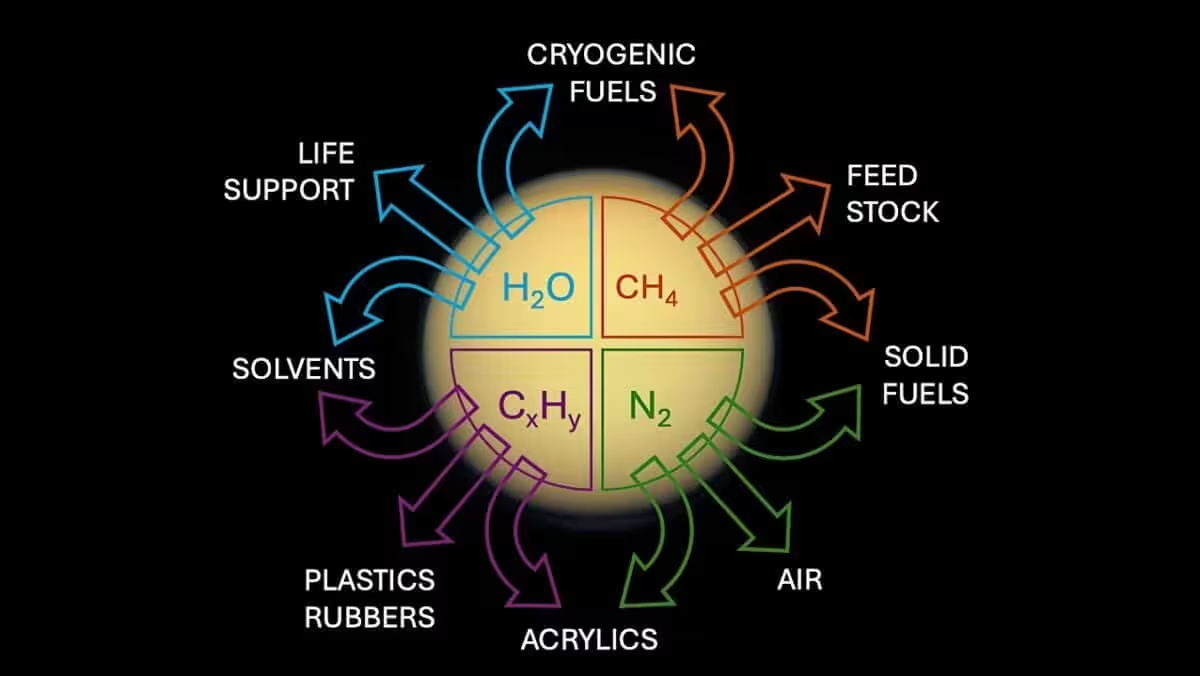
Titan’s atmosphere contains roughly five percent methane, and its surface is coated with heavier hydrocarbons such as propane and butane. These substances could be processed into rocket propellant, plastics, synthetic rubber, and a suite of industrial chemicals. In a recent interview with Universe Today, Nixon described a possible “permanent station on Titan that refines hydrocarbons and stores them as a variety of feedstocks and raw materials: everything from printer ink to fertilizer.”
“So let’s imagine a permanent station on Titan that refines hydrocarbons and stores them as a variety of feedstocks and raw materials: everything from printer ink to fertilizer.”
Methane Fuel for Saturnian Exploration
Hydrocarbons on Titan could underpin a network of refueling points that enable spacecraft to hop between Saturn’s moons or head farther outward. The researchers envision surface‑based processing plants or orbital depots where vessels can top up fuel and replenish consumables before tackling destinations such as Enceladus or Mimas.
A prior analysis by Geoffrey Landis and the Compass Lab at NASA’s Glenn Research Center examined Titan’s resources for a sample‑return mission. Nixon’s team broadened the scope, exploring a wider array of applications, including on‑site manufacturing using 3‑D printers, textile production, and the fabrication of spare parts for future crews.
Abundant Water Enhances Mission Viability
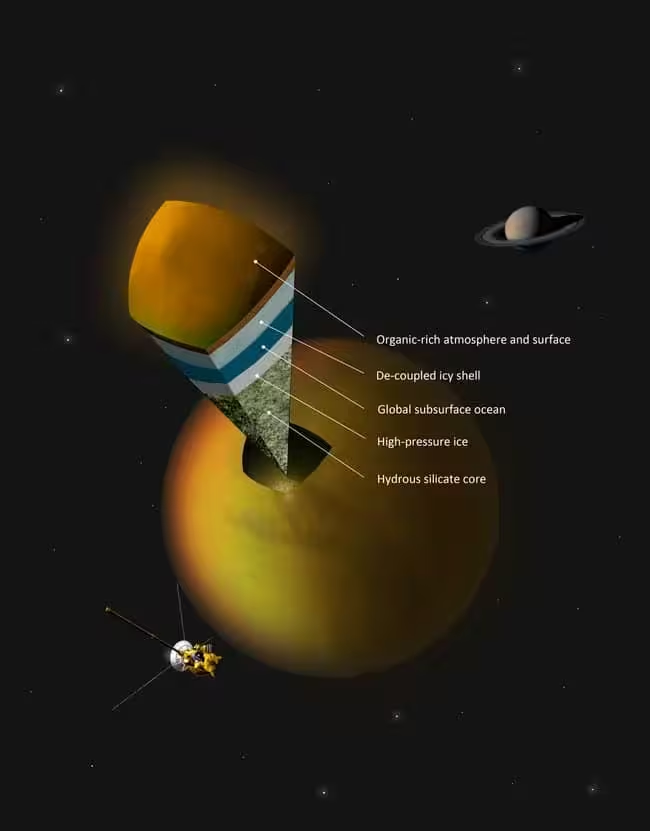
Water is another cornerstone of Titan’s resource portfolio, accounting for roughly half of the moon’s total mass. It exists as surface ice and as a subsurface liquid reservoir, stabilized by dissolved ammonia and salts that keep it from freezing solid.
Extracted ice could be converted into drinking water, split into oxygen for life‑support systems, or electrolyzed to generate hydrogen fuel. Nixon told Universe Today that Titan uniquely combines a dense atmosphere, accessible hydrocarbons, and vast water stores—an “unusual cocktail of resources rarely found together.”
This article has been fact checked for accuracy, with information verified against reputable sources. Learn more about us and our editorial process.
Last reviewed on .
Article history
- Latest version
Reference(s)
- Nixon, Conor. “Titan's Resources and their Utilization.” arXiv.org <https://arxiv.org/abs/2606.06608>.
- “Conor Andrew Nixon - Sciences and Exploration Directorate.” NASA Goddard Sciences and Exploration Directorate <https://science.gsfc.nasa.gov/sci/bio/conor.a.nixon>.
- “Faculty Profile #35891 | Worcester Polytechnic Institute.” Worcester Polytechnic Institute <https://www.wpi.edu/people/faculty/ylu12>.
- “Jennifer E. Ruliffson.” <https://scholar.google.com/citations?user=qh3IloYAAAAJ&hl=en>.
- Williams, Matthew. “New Study Assesses Titan's Resources and their Potential Uses.”, June 15, 2026 Universe Today <https://www.universetoday.com/articles/new-study-assesses-titans-resources-and-their-potential-uses>.
- Society, The. “Geoffrey Landis.”, September 13, 2017 The Planetary Society <https://www.planetary.org/profiles/geoffrey-landis>.
- Wodrich, Julie. “Compass Lab - NASA.”, April 2, 2025 NASA <https://www.nasa.gov/centers-and-facilities/glenn/compass-lab/>.
Cite this page:
- Posted by Karan Das