How a 19th‑Century Super El Niño Fueled a Deadly Famine and Shaped Global Inequality
Drought‑triggered crop failures across Asia, Africa and South America sparked a worldwide famine that may have claimed about 50 million lives.
New analyses of the 1876‑78 famine are reshaping how scientists view one of the deadliest crises of the past century and a half. While the episode has long been linked to a powerful El Niño episode, researchers now argue that a blend of climatic anomalies and policy choices amplified its devastation.
The mortality associated with the famine ranks it alongside the most lethal disasters of the last 150 years. A 2018 article in the Journal of Climate described the 1876‑78 event as “arguably the worst environmental disaster to ever befall humanity.” The same authors noted that the shockwaves from these climate extremes helped forge the enduring divide between what later became known as the “first world” and the “third world.”
Complex Climate Drivers Behind the Late‑19th‑Century Catastrophe
The catastrophe unfolded amid an unusually vigorous phase of the El Niño‑Southern Oscillation (ENSO), the cyclical climate system tied to Pacific Ocean temperature shifts. Under typical conditions, trade winds travel east‑to‑west across the Pacific, piling warm water in its western basin. During an El Niño episode, these winds slacken, curbing the upwelling of cold water off South America and reshaping weather patterns across the globe, often bringing milder winters to the Northwestern United States and heightened flood risk to the Southwest and Florida.
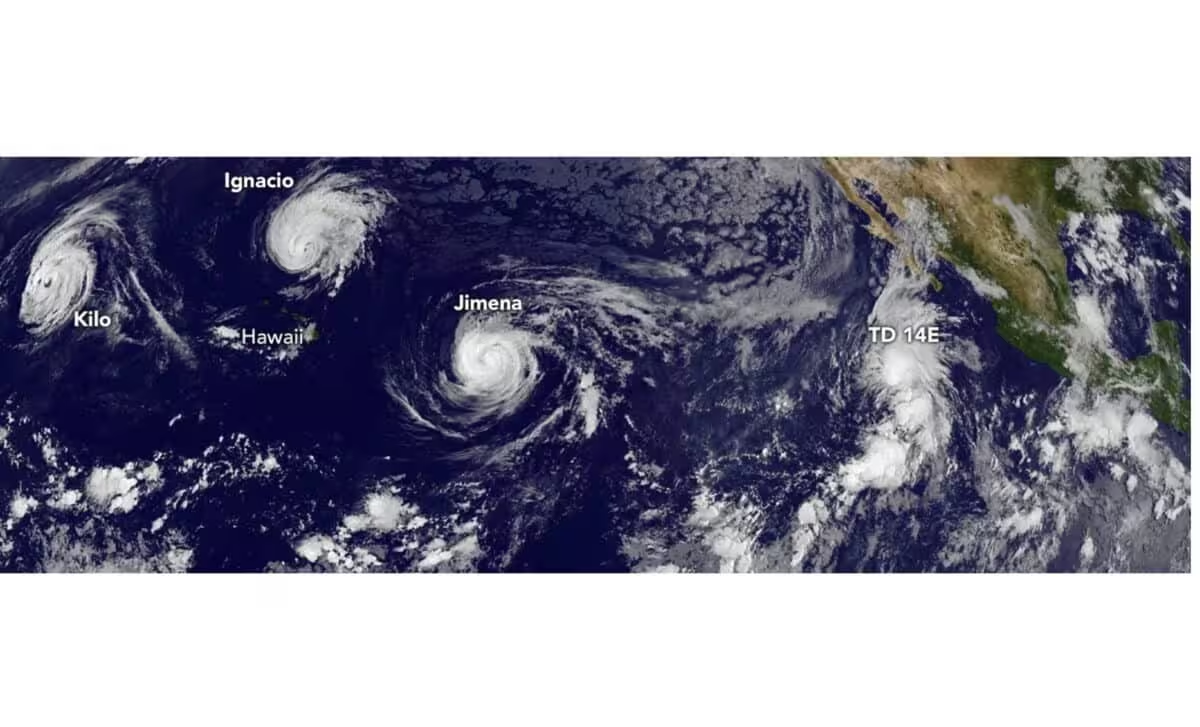
The year 1877 marked a peak in this ENSO swing. Records from the Minnesota Department of Natural Resources show that the Twin Cities endured an average winter temperature of 29 °F—the warmest on record until a comparable anomaly in 2023, itself linked to a strong El Niño episode (NASA).
Simultaneously, vast swaths of the globe experienced severe dryness, setting the stage for widespread harvest failures and food scarcity.
Multiple Oceanic Patterns Converged
A 2018 investigation in the Journal of Climate identified a suite of climatic precursors that lined up before and during the famine. The authors highlighted cooler sea‑surface temperatures in the tropical Pacific in preceding years, an unprecedentedly strong Indian Ocean Dipole, and unusually warm waters in the Atlantic Ocean. Together, these factors fostered an environment primed for an exceptionally vigorous El Niño.
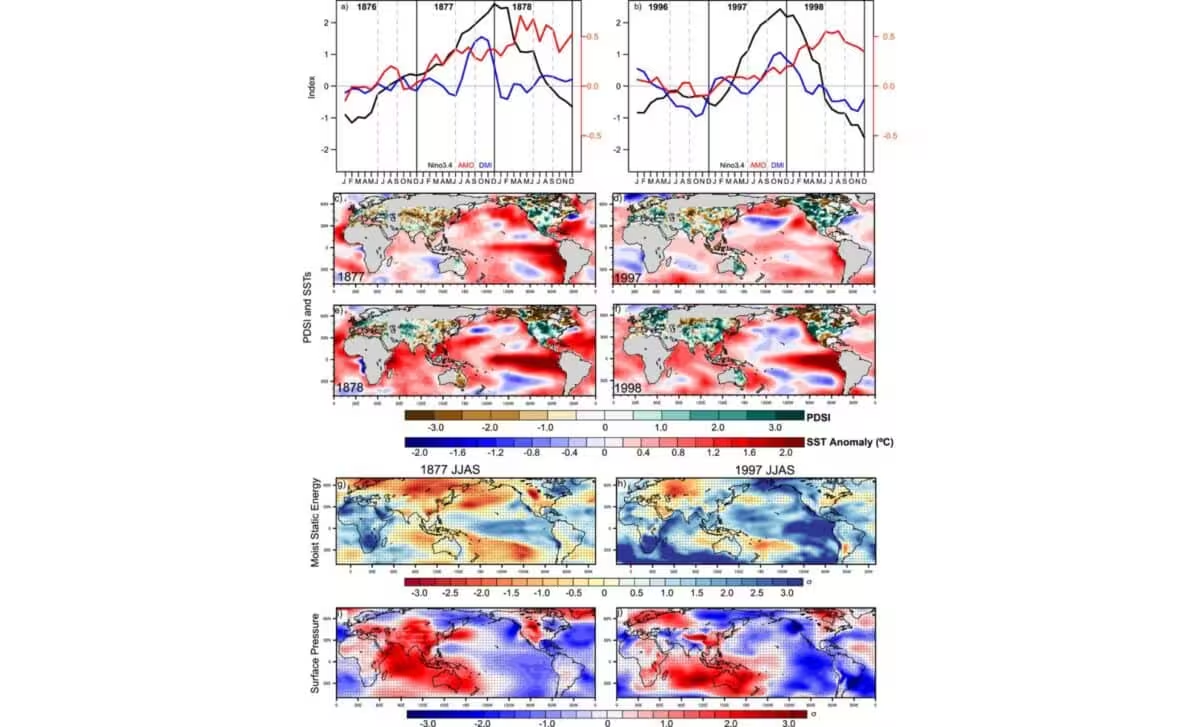
The study concluded that the disaster stemmed from a convergence of adverse conditions that magnified drought impacts across multiple continents rather than from a single climatic trigger.
Policy Shortcomings Turned Drought Into Mass Mortality
Researchers stress that climate alone cannot account for the magnitude of loss. Their analysis points to political and economic choices that exacerbated the crisis, especially the abandonment or destruction of traditional grain‑ and water‑storage infrastructure.
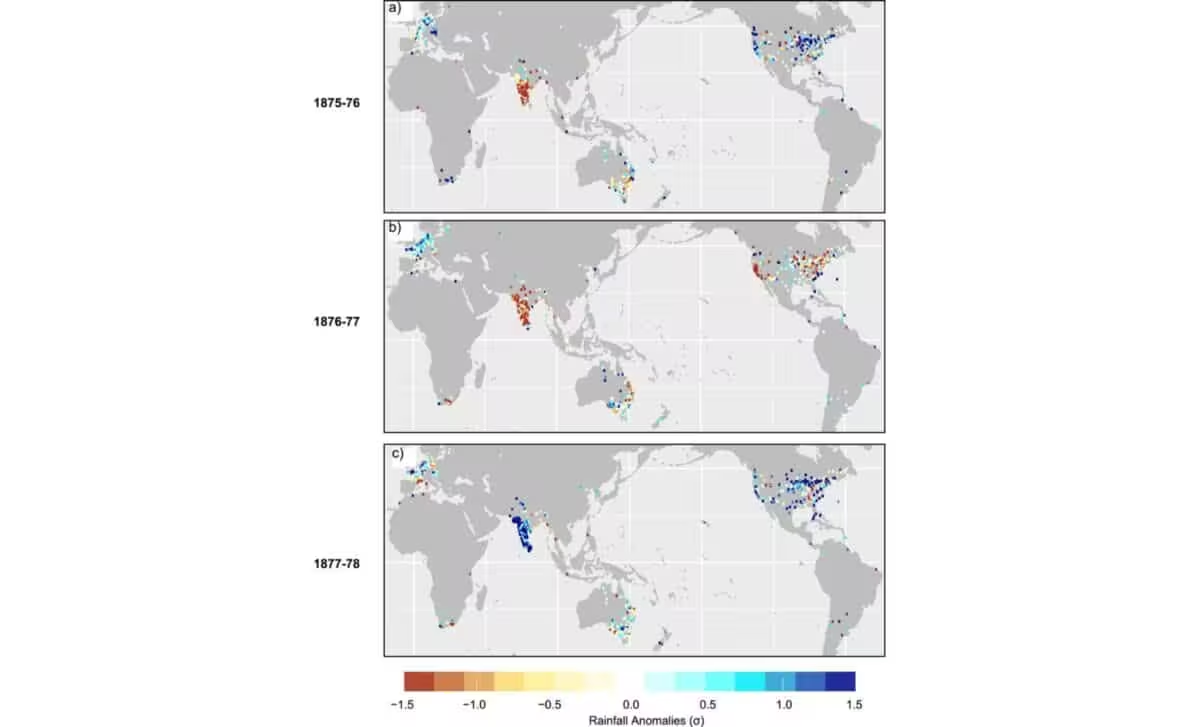
“The immediate catalysts were acute droughts, yet political and economic dynamics—particularly the erosion of customary water and grain reserves—translated crop failure into unprecedented mortality,” the authors wrote in the Journal of Climate.
A follow‑up investigation published in the same journal in 2020 (NOAA repository) determined that the 1877‑78 El Niño was not statistically more intense than other “super El Niño” episodes recorded in 1982‑83, 1997‑98 and 2015‑16.
Today, agricultural planners monitor ENSO developments closely. Though experts do not anticipate a famine of comparable scale, the historical episode continues to shape risk‑assessment strategies. Civil engineer Vimal Mishra of the Indian Institute of Technology Gandhinagar told The New York Times that the 19th‑century disaster “provides a benchmark for preparedness; it illustrates the worst‑case scenario we must guard against.”
This article has been fact checked for accuracy, with information verified against reputable sources. Learn more about us and our editorial process.
Last reviewed on .
Article history
- Latest version
Reference(s)
- <https://www.dnr.state.mn.us/climate/journal/1877_1878_winter.html>.
- Ward, Kevin. “El Niño - NASA Science.”, October 7, 2024 NASA <https://science.nasa.gov/earth/explore/el-nino/>.
- <https://journals.ametsoc.org/view/journals/clim/31/23/jcli-d-18-0159.1.xml>.
- <https://repository.library.noaa.gov/view/noaa/46581>.
- <https://www.nytimes.com/2026/05/21/climate/el-nino-history-famine.html>.
Cite this page:
- Posted by Karan Das