Cosmic Railway: Magnetic Field Channels Gas to Build Massive Star‑Forming Core in DR21
Scientists discover magnetic ’railroad tracks’ that channel gas into massive star formation, shedding light on the growth of a giant stellar nursery.
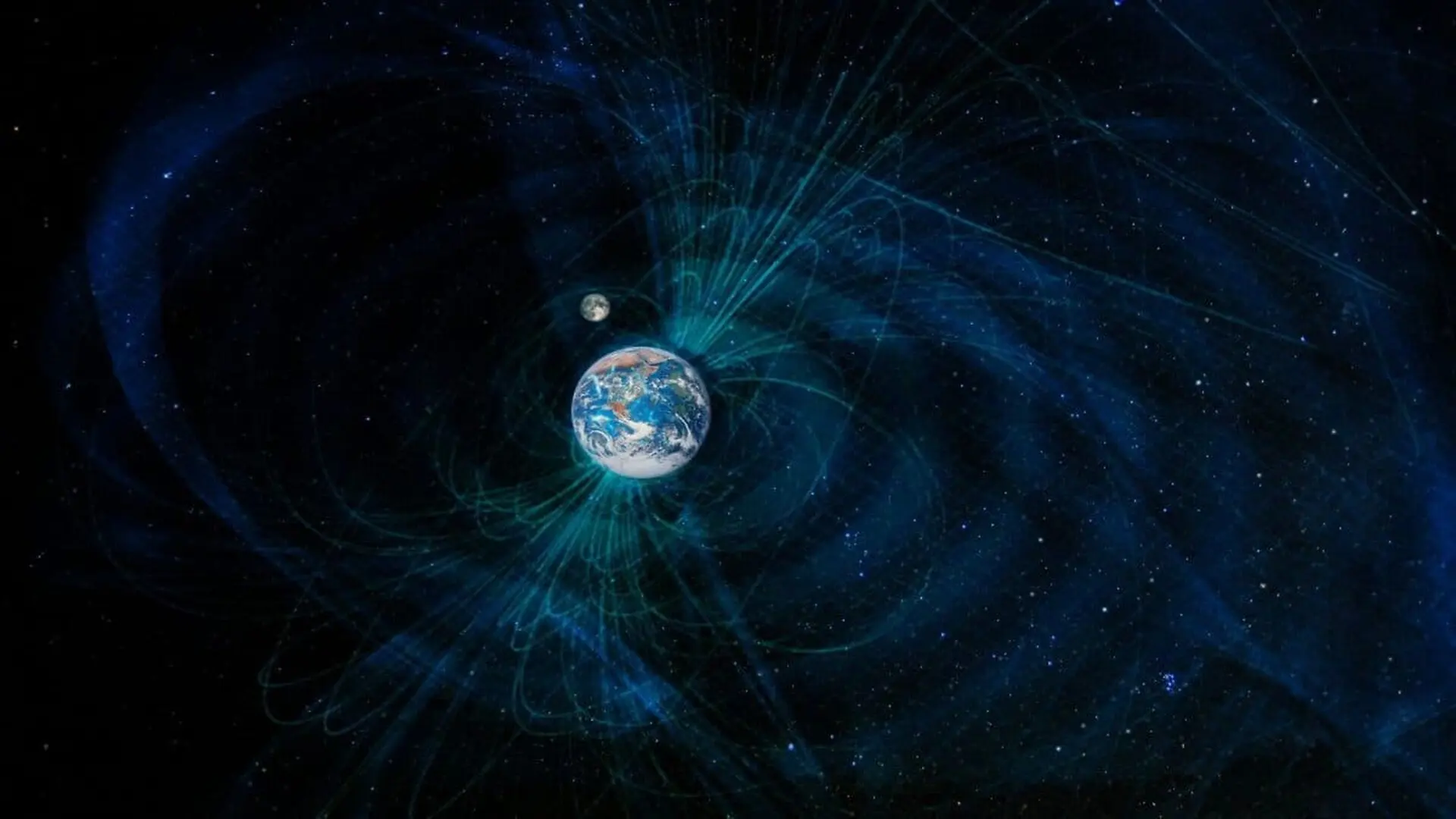
A team of astronomers has produced the most detailed map to date of the magnetic field threading the DR21 star‑forming complex, a prolific nursery located just a few thousand light‑years from the Sun. The new measurements show that the magnetic field does more than merely pervade the cloud—it actively channels gas toward the dense filament at the heart of the region, feeding the material that will eventually become massive stars.
The findings, appearing in The Astrophysical Journal, illuminate how enormous reservoirs of cold molecular gas are directed into the central ridge of DR21, a critical step in the cascade that leads to stellar birth.
DR21 sits within the sprawling Cygnus X molecular complex and hosts the so‑called DR21 Main Ridge, a filament roughly 13 light‑years long that contains about 20,000 solar masses of frigid gas. Encircling this spine is a web of thinner filaments that appear to feed material into the ridge.
Magnetic Pathways Direct Infall Toward the Core
New polarimetric observations reveal that the magnetic field functions like a set of rails, steering gas streams onto the main filament. Lead author Thushara Pillai of MIT Haystack Observatory likened the process to a railway system.
“The magnetic field acts like a set of railroad tracks,” Pillai explained. “Gas travels along these tracks toward the central ridge, accumulating mass over time. Perpendicular to the tracks, the field resists motion, so it doesn’t halt star formation—it simply guides it.”
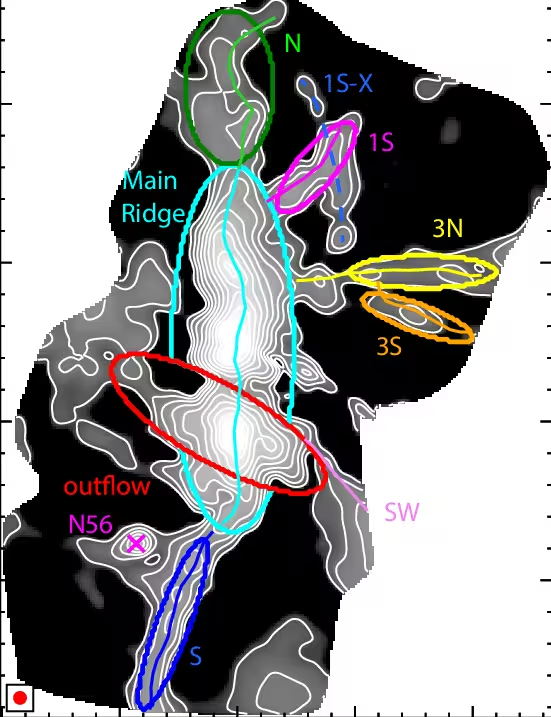
By tracing the magnetic orientation from the dense ridge into the surrounding sub‑filaments, researchers confirmed a long‑standing hypothesis that these smaller structures serve as conduits for material. The new magnetic map links the filaments and demonstrates clear pathways for gas to flow inward.
Steady Inflows Build a Colossal Filament
The data were gathered as part of SIMPLIFI (Study of Interstellar Magnetic Polarization: a Legacy Investigation of Filaments), a SOFIA Legacy Program involving more than a dozen institutions worldwide. By comparing the magnetic field direction with gravitational pull and gas morphology, the team found a tight alignment between gravity and magnetic forces throughout the cloud.
Such alignment is a hallmark of magnetically guided accretion, where gas slides along field lines toward the region of greatest mass. The authors estimate that the surrounding sub‑filaments can supply enough material to grow the Main Ridge to its present size in about one million years.
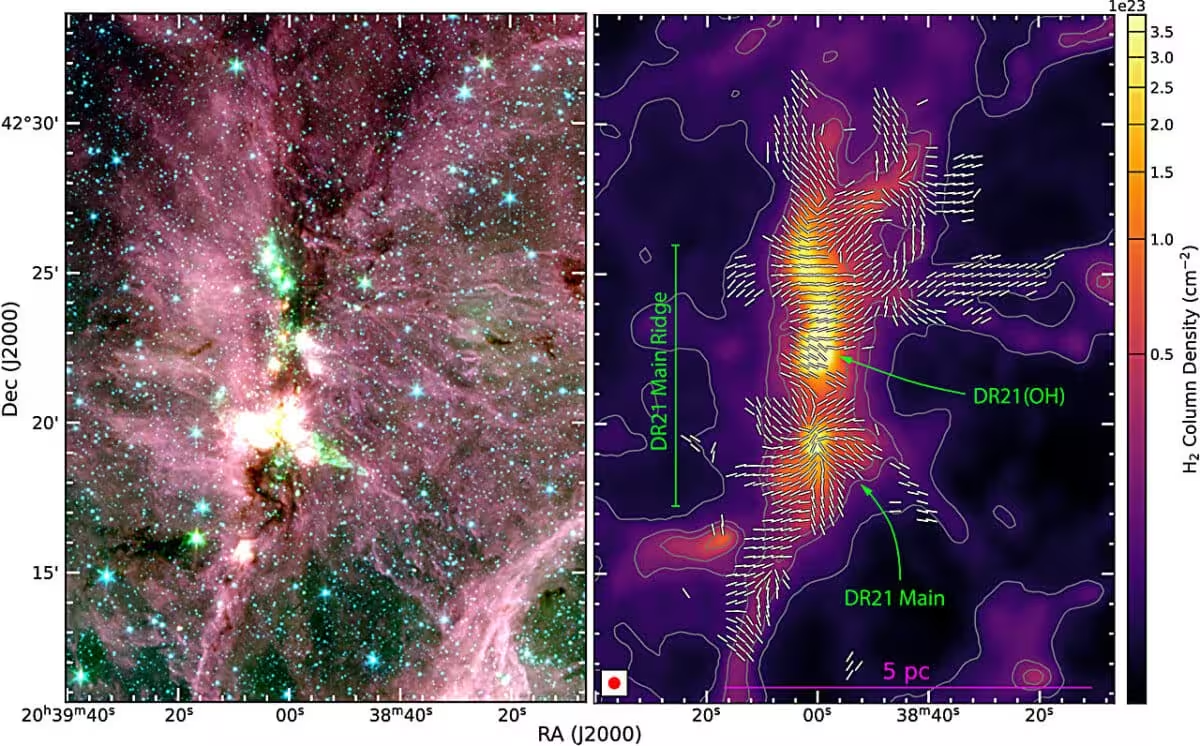
“Working with SOFIA’s polarization data was challenging,” Kauffmann noted. “We had to characterize the reduction systematics from the ground up. The payoff was a uniform magnetic‑field map of an entire star‑forming complex at a resolution no other facility can achieve.”
Resolving a Long‑Standing Velocity Puzzle
Earlier measurements had shown gas moving toward the Main Ridge at speeds that seemed too low for pure gravitational collapse. The new analysis attributes this discrepancy to the orientation of the flow: the magnetic field and the gas it guides lie almost entirely in the plane of the sky, meaning most of the motion is sideways from Earth’s viewpoint.
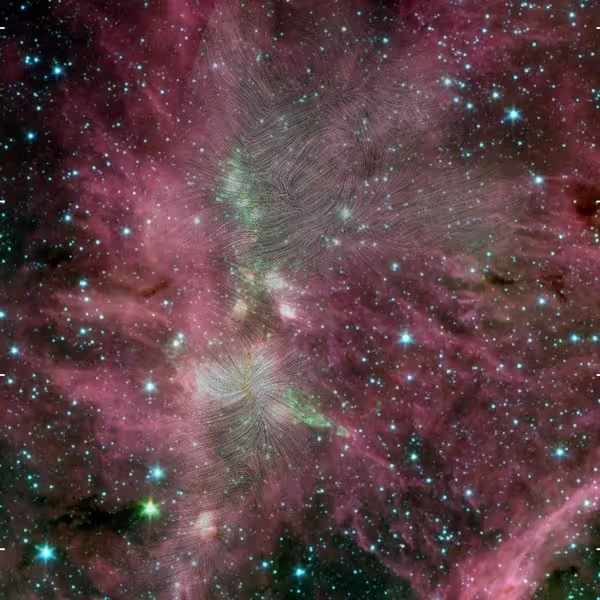
Because the bulk of the velocity lies perpendicular to our line of sight, only a modest component is captured in spectroscopic data, creating the illusion of sluggish infall. In reality, the gas is moving at the expected speeds along the magnetic rails.
The observations were made with the Stratospheric Observatory for Infrared Astronomy (SOFIA), a modified Boeing 747SP equipped with a 2.7‑meter telescope that ceased operations in September 2022 after twelve years of service.
“To truly grasp how magnetic fields sculpt star formation across the galaxy, we need to probe fainter emission, larger sky areas, and clouds at every evolutionary stage,” Pillai emphasized. “That calls for a space‑based far‑infrared mission with polarization capability—something we currently lack and should prioritize in the next decade of astrophysics.”
This article has been fact checked for accuracy, with information verified against reputable sources. Learn more about us and our editorial process.
Last reviewed on .
Article history
- Latest version
Reference(s)
- “Thushara G.S. Pillai - MIT Haystack Observatory.”, September 26, 2022 MIT Haystack Observatory <https://www.haystack.mit.edu/researcher/thushara-g-s-pillai/>.
- “SIMPLIFI: Study of Interstellar Magnetic Polarization: a Legacy Investigation of FIlaments - MIT Haystack Observatory.”, September 26, 2022 MIT Haystack Observatory <https://www.haystack.mit.edu/simplifi-study-of-interstellar-magnetic-polarization-a-legacy-investigation-of-filaments/>.
Cite this page:
- Posted by Karan Das