Super‑Earths May Keep Solid Cores New Mineral Phase Reveals Unexpected Stability
Researchers find that ultra‑high‑pressure mineral phases could solidify deep mantles on many super‑Earths, reshaping ideas of their interior structure.
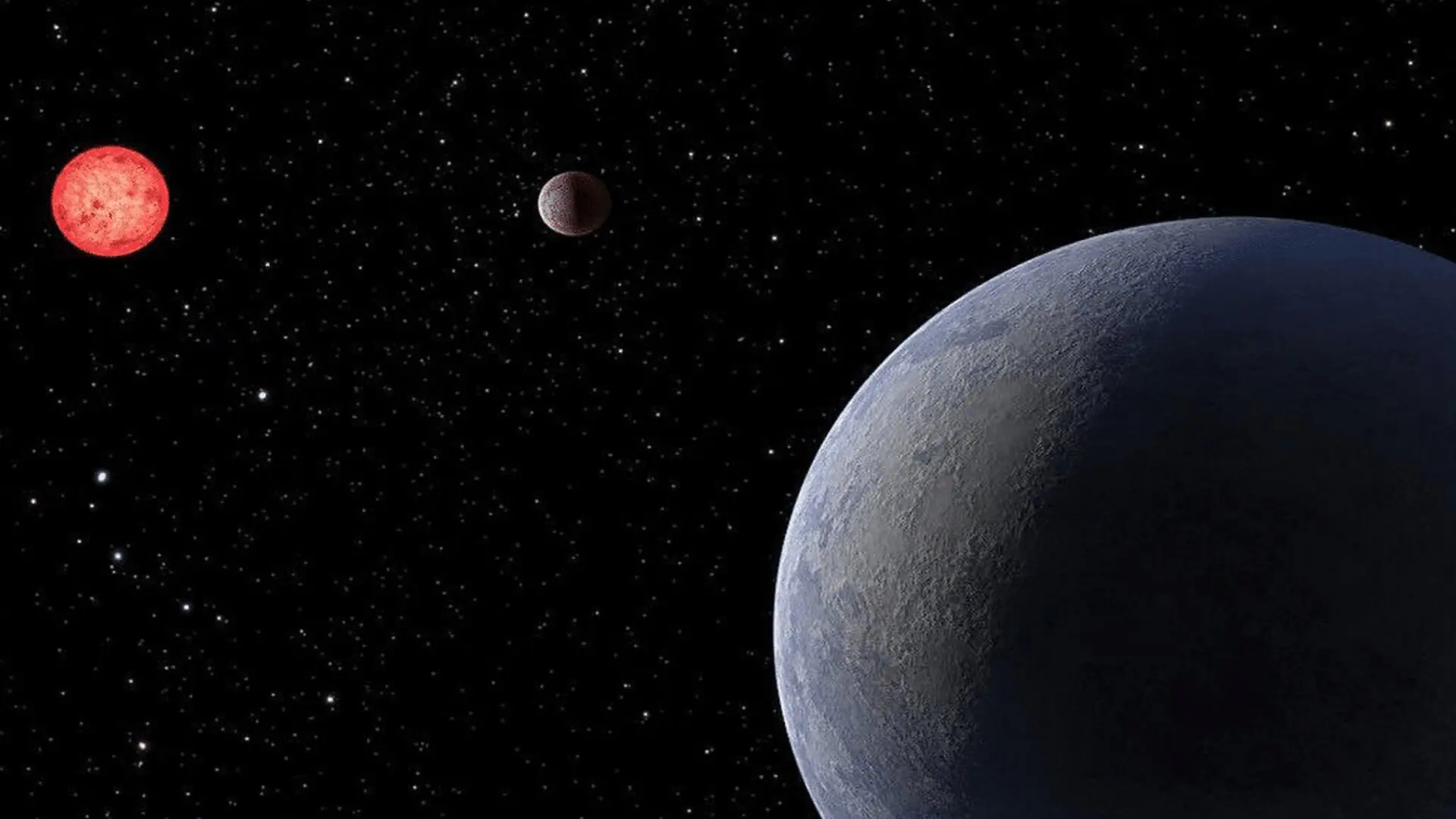
A recent investigation published in AGU Advances indicates that the innermost layers of many super‑Earths could stay solid despite the extreme pressures and temperatures expected deep within these massive rocky planets. The work identifies an ultra‑high‑pressure form of magnesium orthosilicate that may survive conditions previously thought to cause widespread melting, reshaping theoretical models of exoplanet interiors.
Extreme Pressures Redefine Rocky Planet Interiors
Super‑Earths—planets ranging from one to ten times the mass of Earth—experience interior pressures that dwarf anything found beneath our own crust. Under such conditions, familiar minerals can reorganize into entirely new crystal structures, producing phases that have no analogue on Earth’s surface. This study focuses on magnesium orthosilicate (Mg₂SiO₄), a mineral expected to dominate the mantles of rocky worlds, and explores how its atomic lattice adapts when compressed far beyond terrestrial limits.
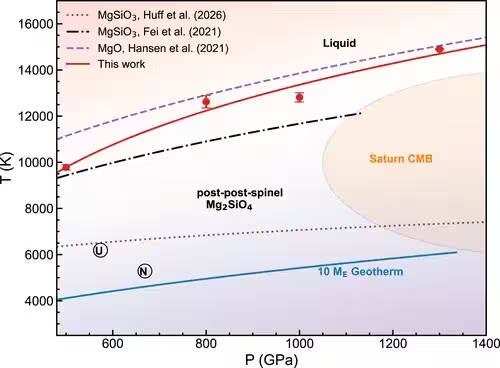
Laboratory experiments have already revealed several high‑pressure phases within Earth’s mantle, but the simulations presented here predict an additional transformation, termed post‑post‑spinel. This phase becomes thermodynamically stable at pressures that exceed those in Earth’s deepest layers, suggesting that the deepest mantles of super‑Earths might retain a solid framework rather than melting into a global magma ocean.
A Mineral Phase Tailored for Alien Mantles
On Earth, Mg₂SiO₄ transitions from its ambient structure to a spinel configuration, then to bridgmanite and ferropericlase as depth and pressure increase. Bridgmanite, the most abundant mineral in our mantle, governs much of Earth’s seismic behavior. In planets several times more massive, the pressure regime can push Mg₂SiO₄ beyond the bridgmanite stability field, allowing the emergence of the post‑post‑spinel phase—an arrangement that does not occur naturally at the surface of our planet.
The research team examined how this exotic phase would melt under the extreme temperatures expected inside massive rocky exoplanets. If the mineral remains solid at temperatures where other silicates would liquefy, it could create a deep, rigid mantle layer with distinct thermal conductivity and convection patterns, influencing the planet’s long‑term cooling and magnetic‑field generation.
High‑Performance Simulations Reveal Melting Limits
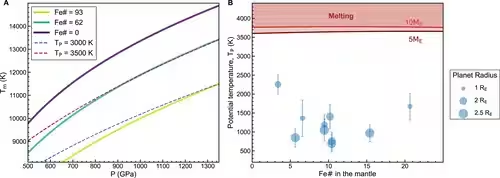
Because recreating pressures above one thousand gigapascals in the laboratory is virtually impossible, the authors turned to advanced thermodynamic integration techniques within large‑scale computer models. By incrementally increasing pressure up to 1,300 GPa, they traced the solid‑to‑liquid transition of post‑post‑spinel Mg₂SiO₄ and produced a comprehensive melting curve applicable to the interiors of the most massive rocky exoplanets.
The resulting temperature‑pressure relationships indicate that, even at the scorching conditions expected near the cores of 10‑Earth‑mass worlds, the post‑post‑spinel phase may retain its solid state. This finding implies that such planets could possess deep, rigid mantles that influence heat transport, mantle convection, and magnetic‑field generation over geological timescales.
Published in AGU Advances, the study provides a quantitative framework for future interior models of super‑Earths. As next‑generation telescopes begin to characterize the masses, radii, and atmospheric compositions of distant rocky planets, these simulations will help scientists infer the hidden structures that shape planetary evolution across the galaxy.
This article has been fact checked for accuracy, with information verified against reputable sources. Learn more about us and our editorial process.
Last reviewed on .
Article history
- Latest version
Reference(s)
- Zheng, Donghao., et al. “Massive Rocky Planets May Suppress Deep Melting.” AGU Advances, vol. 7, no. 4, July 18, 2026 American Geophysical Union (AGU), doi: 10.1029/2026AV002326. <https://agupubs.onlinelibrary.wiley.com/doi/10.1029/2026AV002326>.
Cite this page:
- Posted by Karan Das