New Mathematical Framework Slashes Astrophysics Simulation Costs by Over a Thousand Times
Combining tensor networks with adaptive mesh refinement lets supercomputers model complex cosmic radiation transport without running out of memory.
A team of computational astrophysicists has developed a new mathematical framework that compresses the immense data requirements of radiation transport simulations by a factor exceeding one thousand. The method tackles thermal radiation transport, a vital process in modeling extreme cosmic environments where photons interact continuously with matter across space, angles, and frequencies.
Simulating how radiation moves through systems like accreting black holes or stellar nursery cores is notoriously difficult because the required memory scales exponentially with resolution. In a study available on the arXiv preprint server, Alex A. Gorodetsky and their co-authors introduced an approach that pairs tensor networks with adaptive mesh refinement grids to drastically reduce computational overhead without sacrificing accuracy.
Overcoming the Curse of Dimensionality in Space and Angle
Radiation transport equations require tracking photon specific intensity across multidimensional spaces, creating what mathematicians call the curse of dimensionality. Traditional uncompressed grid models demand astronomical amounts of computer memory, often overwhelming even the most powerful supercomputers when scientists attempt to resolve fine details.
The research team utilized tensor-train decomposition, a mathematical technique that breaks complex multi-variable data structures down into interconnected core components. While previous efforts applied tensor compression globally across an entire simulation domain, they often struggled when localized regions of high complexity forced the entire system to maintain unnecessarily high mathematical ranks.
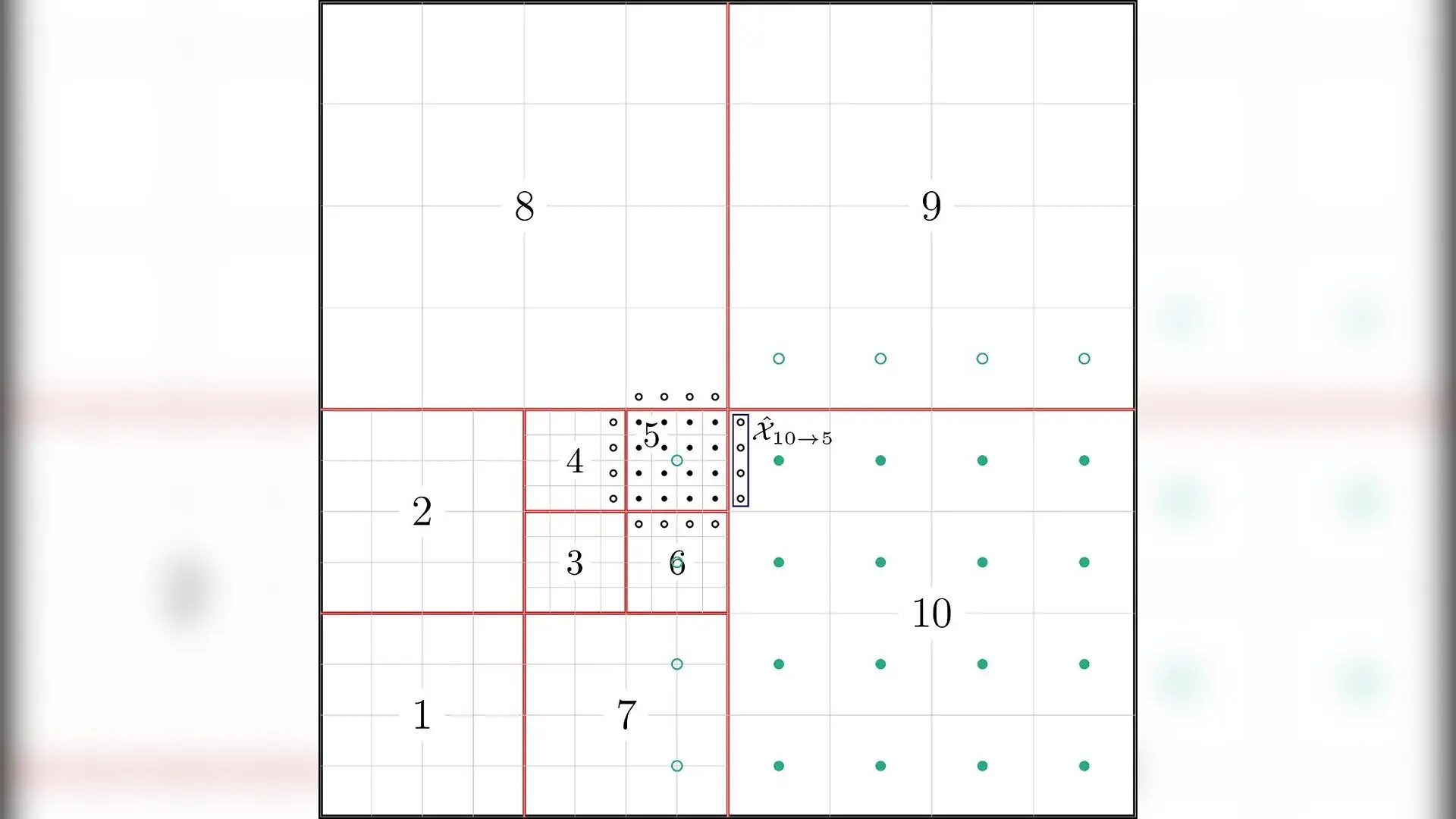
To solve this, the authors constructed a block-local tensor representation that aligns seamlessly with block-structured adaptive mesh refinement. By dividing computational domains into smaller, distinct blocks, the model isolates complex radiation features to the exact zones where they occur, such as fast-moving radiation fronts or shock boundaries.
How Local Compression Isolates Complex Radiation Data
In the new framework, different sections of a simulated cosmic cloud or accretion disk maintain independent tensor ranks tailored to their local physical conditions. Regions containing smooth, uniform radiation fields are compressed aggressively down to minimal ranks, while turbulent zones with sharp directional changes retain the higher mathematical fidelity they require.
The study tested the technique across several demanding benchmark scenarios, including a two-dimensional line source problem, a crooked pipe test featuring sharp material interfaces, and a multigroup stellar irradiation simulation involving thirty-two frequency groups. Across these tests, the block-adaptive tensor method achieved compression factors surpassing one thousand compared to conventional uniform grid methods.
The authors also established vital conservation protocols to ensure that energy remains balanced across block boundaries. By implementing conservative ghost-cell communication and coarse-fine flux corrections, the algorithm maintains physical conservation laws even when neighboring grid blocks operate at different resolution levels.
Balancing Mesh Refinement with Mathematical Rounding Errors
Integrating mesh adaptivity with tensor compression introduces unique challenges in error control. The team formulated a practical error model that balances spatial discretization errors against tensor rounding tolerances, ensuring that neither grid refinement nor mathematical compression dominates the overall simulation uncertainty.
The researchers also explored advanced strategies such as sparse-block thresholding, which forces negligible regions into rank-one compression based on their local Frobenius norms. This optimization successfully eliminated spurious numerical noise and improved early-time compression efficiency by up to sixty percent.
By bridging the gap between tensor network mathematics and standard astrophysical fluid dynamics infrastructure, this approach provides a scalable pathway for modeling complex multiphysics phenomena. The framework allows modern simulation codes to target previously intractable problems in high-energy density physics and stellar evolution with unprecedented computational economy.
The study was posted to the arXiv preprint server on November 5, 2026.
This article has been fact checked for accuracy, with information verified against reputable sources. Learn more about us and our editorial process.
Last reviewed on .
Article history
- Latest version
Reference(s)
- Gorodetsky, Alex. “Tensor Networks for Block Adaptive Thermal Radiation Transport.” arXiv.org <http://arxiv.org/abs/2611.08410v1>.
Cite this page:
- Posted by John Williams