New GPU Tool Models Scorching Exoplanet Atmospheres in Minutes
The open-source framework cuts exoplanet analysis times from days to minutes by shifting heavy calculations to graphics cards.
A new open-source software tool called BeAR cuts the time required to analyze alien weather down to minutes, allowing researchers to rapidly model complex exoplanet atmospheres using graphics card acceleration. The framework handles both high-resolution ground telescope observations and low-resolution space telescope data within a single system.
Astronomers studying distant worlds often face a computational bottleneck when trying to match computer models with actual telescope data. A single analysis run can take days or weeks on traditional computer processing units, making rigorous testing of atmospheric models difficult. The new tool, detailed in a study published on the arXiv preprint server, transfers the heaviest mathematical calculations entirely onto graphics processing units, or GPUs.
The research team tested their software on the hot Jupiter exoplanet WASP-77A b, a scorching gas giant with a surface temperature hovering around 1740 Kelvin (about 1470 degrees Celsius). Located approximately 340 light-years away from Earth, this massive world orbits its host star in just 1.36 days. Because the planet is tidally locked, one side perpetually faces its scorching star while the other remains in darkness, creating a dynamic dayside atmosphere rich in molecular signatures.
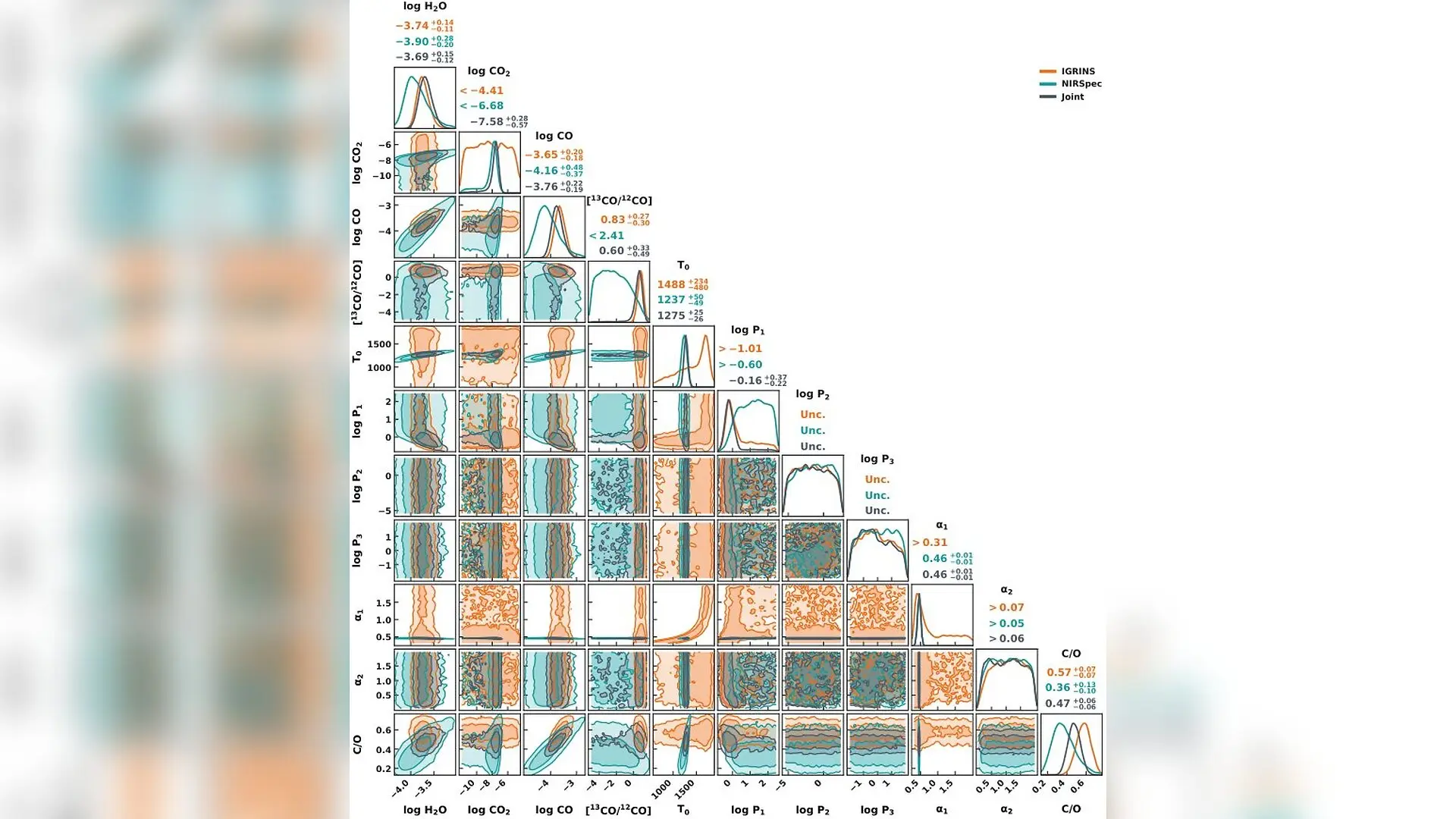
By combining high-resolution data from the Immersion Grating Infrared Spectrometer, known as IGRINS, on the Gemini South telescope with space-based observations from the James Webb Space Telescope, the authors successfully reproduced previous atmospheric abundance measurements. Their joint analysis indicates a sub-solar metallicity and a near-solar carbon-to-oxygen ratio for the planet, matching independent findings from earlier studies while operating at a fraction of the computational cost.
How Graphics Cards Speed Up Alien Weather Modeling
The core innovation of the software lies in its ability to compute forward models in roughly one millisecond on specialized hardware. While a typical desktop computer CPU requires over half a second to evaluate a single model likelihood, a modern graphics card handles the same task almost instantly. When deployed across a cluster of multiple graphics processors, the framework generates millions of atmospheric models per minute.
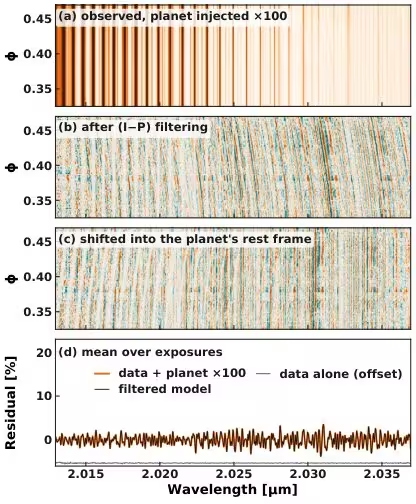
This massive leap in processing speed transforms how scientists approach exoplanet characterization. Instead of waiting days for a single retrieval run, researchers can complete complex Bayesian analyses in less than an hour. The system also incorporates fast model filtering and specialized re-injection techniques to account for how data reduction pipelines remove stellar and atmospheric artifacts from ground-based telescope recordings.
Unlocking Hidden Chemical Clues in Starlight
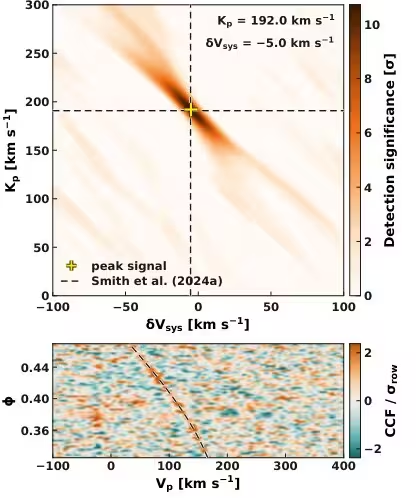
Ground-based high-resolution spectroscopy splits starlight passing through or reflecting off an exoplanet into thousands of individual spectral lines, separating distinct molecules even when their absorption bands overlap. However, the data processing steps required to strip away unwanted light from Earth’s atmosphere inadvertently erase the broader continuum shape of the planetary spectrum. Low-resolution space telescope data provide the absolute flux scale needed to anchor these measurements, making combined analyses exceptionally powerful.
The joint retrieval successfully constrained the vertical temperature structure and key chemical abundances, including water vapor and carbon monoxide, while placing strict upper limits on trace gases. Injection and recovery tests conducted by the team revealed that while the software accurately recovers known atmospheric properties, the statistical uncertainties derived from high-resolution cross-correlation techniques may be underestimated by a factor of roughly two due to correlated residual noise in the observations.
Next Steps for Exoplanet Atmospheric Retrieval
The authors suggest that open-source GPU-accelerated tools will become essential as astronomers accumulate vast archives of spectroscopic data from next-generation telescopes. By standardizing comparisons of temperature profiles at fixed pressures rather than relying solely on abstract parameter values, the scientific community can better evaluate minor discrepancies between independent modeling codes. The software package is freely available on GitHub for researchers worldwide to test and expand upon.
The study was posted to the arXiv preprint server on November 5, 2026.
This article has been fact checked for accuracy, with information verified against reputable sources. Learn more about us and our editorial process.
Last reviewed on .
Article history
- Latest version
Reference(s)
- Wang, Esther. “BeAR: The Bern Atmospheric Retrieval code - A GPU-accelerated framework for low-resolution, high-resolution, and joint retrievals of exoplanet atmospheres.” arXiv.org <http://arxiv.org/abs/2611.08489v1>.
Cite this page:
- Posted by John Williams