Balloon Telescope Reveals Hidden Magnetic Secrets Within The Sun’s Quiet Atmosphere
By lifting a telescope above atmospheric turbulence, scientists have captured stunning new views of the Sun that are rewriting our understanding of the star.
A sophisticated balloon-borne observatory launched in 2024 has captured unprecedented data on the Sun, revealing that regions previously dismissed as magnetically dormant are actually host to a complex, chaotic environment. The findings from the SUNRISE III mission, detailed in a series of three papers in the Astrophysical Journal Letters, reshape our understanding of the solar atmosphere, identifying intricate magnetic threads and quantifying the energy behind solar jets.
To bypass the blurring effects of Earth’s turbulent atmosphere, the SUNRISE III mission utilized a high-altitude helium balloon. Carrying a suite of instruments, including a one-meter solar telescope, the gondola cruised at an altitude of approximately 35 kilometers. By operating well above the densest layers of the atmosphere, the mission achieved the high-resolution imagery necessary to resolve the Sun’s smallest magnetic features.
Unveiling the Hidden Complexity of the Chromosphere
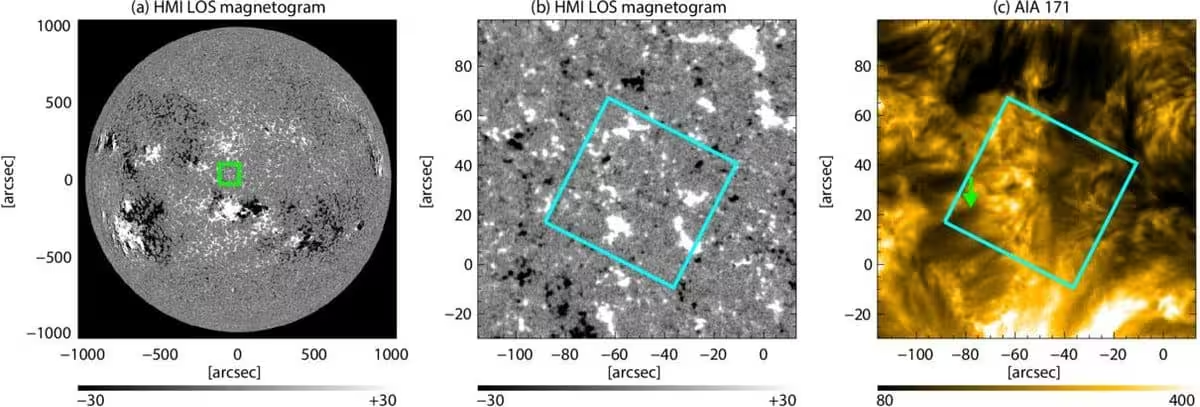
The mission’s primary diagnostic tool, the Sunrise Chromospheric Infrared spectroPolarimeter (SCIP), allowed researchers to perform full Stokes polarimetry. This technique enables astronomers to map the orientation and intensity of magnetic fields across different layers of the solar atmosphere.
In the so-called “Quiet Sun,” where solar activity is generally minimal compared to sunspots, scientists had long envisioned a relatively simple “canopy” of vertical magnetic flux tubes. However, SCIP data indicates that this canopy is far more structured, consisting of a dense network of magnetic threads. Each thread measures roughly 725 kilometers across and exhibits magnetic field strengths between 10 and 20 Gauss. These structures often display an alternating pattern, creating a complex three-dimensional landscape ripe for magnetic reconnection, a process that releases energy to heat the surrounding plasma.
The Role of Twisted Magnetic Ropes
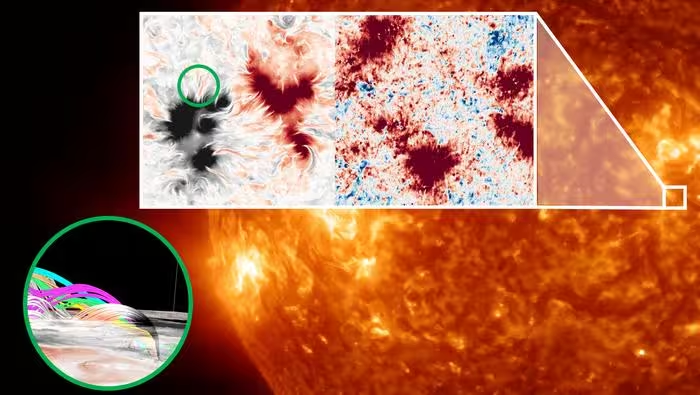
A companion study utilized the 3D radiative-magnetohydrodynamic algorithm known as MURaM-ChE, integrating SUNRISE III observations to investigate “opposite-polarity intrusions” (OPIs)—areas where the magnetic field flips direction. The simulations confirmed that these intrusions are the result of twisted magnetic flux ropes.
Typically associated with massive solar flares, these flux ropes—ranging from 2,000 to 7,000 kilometers in length—appear to be woven into the “quiet” solar surface as well. While they contribute to explosive energy release in more active regions, their influence in quieter zones appears more contained, though they remain a critical component of the Sun’s magnetic architecture.
Quantifying Plasma Jets
The final paper in the series addressed the plasma jets ejecting from the solar poles, which are thought to be significant drivers of heat in the corona. For the first time, researchers provided reliable measurements of the magnetic strength within these jets.
In the lower regions of the canopy, the field strength was measured between 10 and 20 Gauss, a figure lower than previous theoretical models suggested. However, this value increases to roughly 40 Gauss at higher altitudes. Scientists suggest this discrepancy is likely due to the density of the solar spicules; at lower heights, the telescope cannot easily peer through the thicket, but higher up, the canopy thins, allowing for more precise measurements of the magnetic field.
These results highlight the profound complexity of the Sun’s surface, proving that even its calmest regions are teeming with magnetic activity. Future efforts, such as the SOLAR-C mission, aim to further clarify how these magnetic fields and ropes integrate to influence the broader solar atmosphere and the heating of the corona.
This article has been fact checked for accuracy, with information verified against reputable sources. Learn more about us and our editorial process.
Last reviewed on .
Article history
- Latest version
Reference(s)
- Katsukawa, Y.. “The Sunrise Chromospheric Infrared Spectro-Polarimeter SCIP: an instrument for SUNRISE III.” arXiv.org, doi: 10.1007/s11207-026-02696-0. <https://arxiv.org/abs/2603.17929>.
- Ondratschek, Patrick A.., et al. “Cause of Chromospheric Opposite Polarity Intrusions Discovered in Sunrise III/SCIP Data: MURaM-ChE Simulations Point to Twisted Flux Ropes.” The Astrophysical Journal Letters, vol. 1008, no. 1, August 27, 2026, pp. L18 American Astronomical Society, doi: 10.3847/2041-8213/ae9607. <https://iopscience.iop.org/article/10.3847/2041-8213/ae9607>.
- Kubo, Masahito., et al. “Three-dimensional Magnetic Field Structure of a Quiet-Sun Region Revealed by SUNRISE III/SCIP.” The Astrophysical Journal Letters, vol. 1008, no. 1, August 26, 2026, pp. L9 American Astronomical Society, doi: 10.3847/2041-8213/ae909b. <https://iopscience.iop.org/article/10.3847/2041-8213/ae909b>.
- “Next-generation solar-observing satellite SOLAR-C.” <https://solar-c.nao.ac.jp/en/>.
Cite this page:
- Posted by Aisha Ahmed