New Imaging Technique Unlocks Hidden Exoplanets Lost in the Glare of JWST Observations
A new digital twin technique for the James Webb Space Telescope removes stellar glare, allowing astronomers to detect faint, hidden exoplanets.
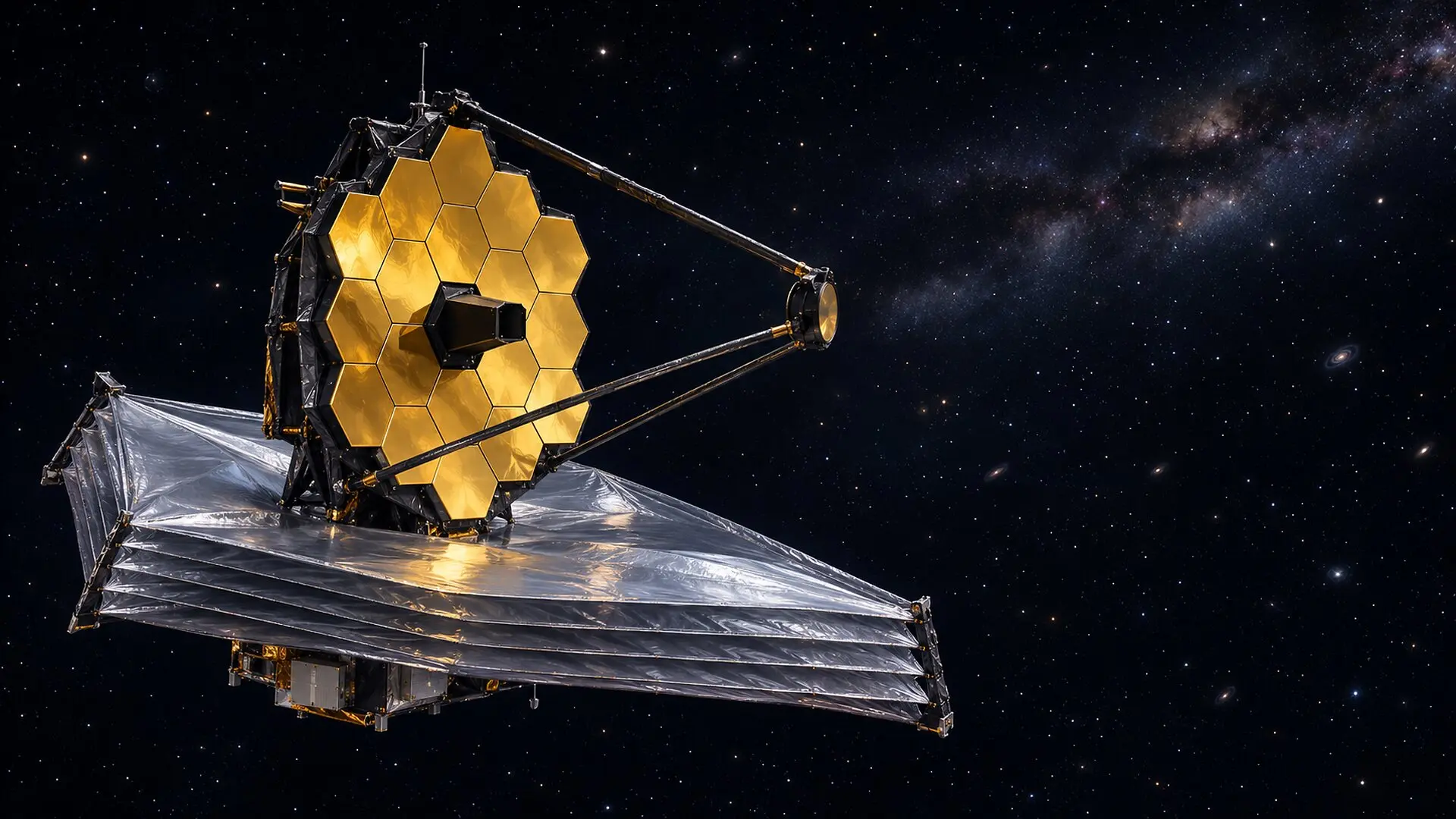
A sophisticated new image-processing technique has successfully pulled a previously hidden exoplanet from the archives of the James Webb Space Telescope (JWST). By creating a digital model of the observatory’s optical path, researchers have managed to strip away the blinding glare of host stars that typically masks faint, orbiting worlds.
The method, dubbed Physics-based Learning for Imaging Planets (FLIP), was developed by a team at Northwestern University and Caltech. As detailed in Nature, the approach significantly boosts the sensitivity of the telescope’s Near Infrared Camera (NIRCam), enhancing detection capabilities by up to 15 times in certain configurations.
Overcoming the Glare of Distant Suns
Directly photographing exoplanets is an immense challenge. Even massive, young gas giants can be 100,000 times fainter than the stars they orbit. While coronagraphs are used to physically block the direct light of a star, the residual glare—distorted by minute thermal shifts and optical imperfections—often creates complex patterns on the detector that mimic or conceal planets.
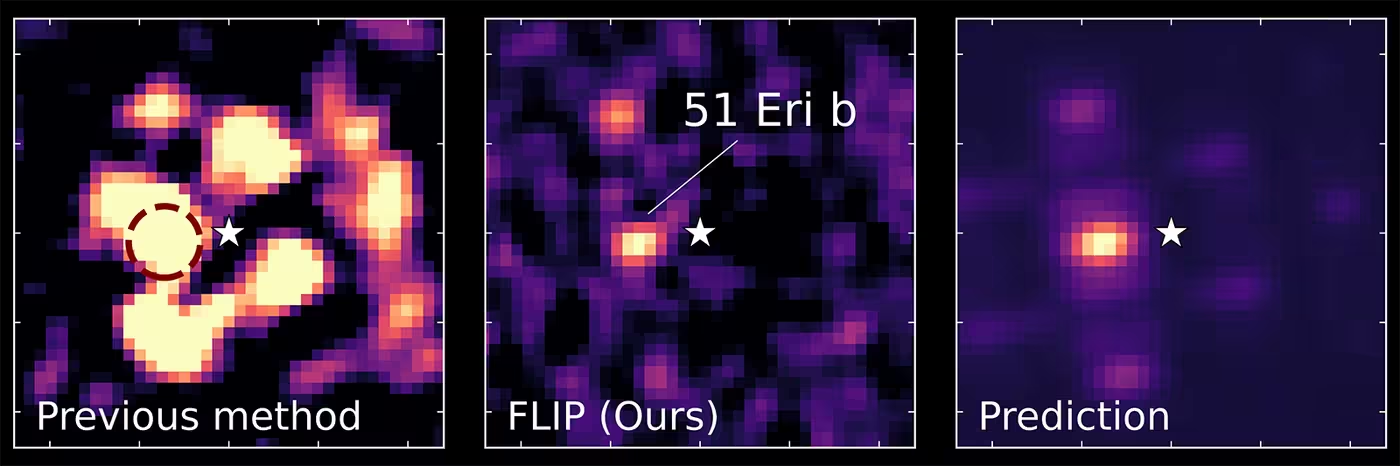
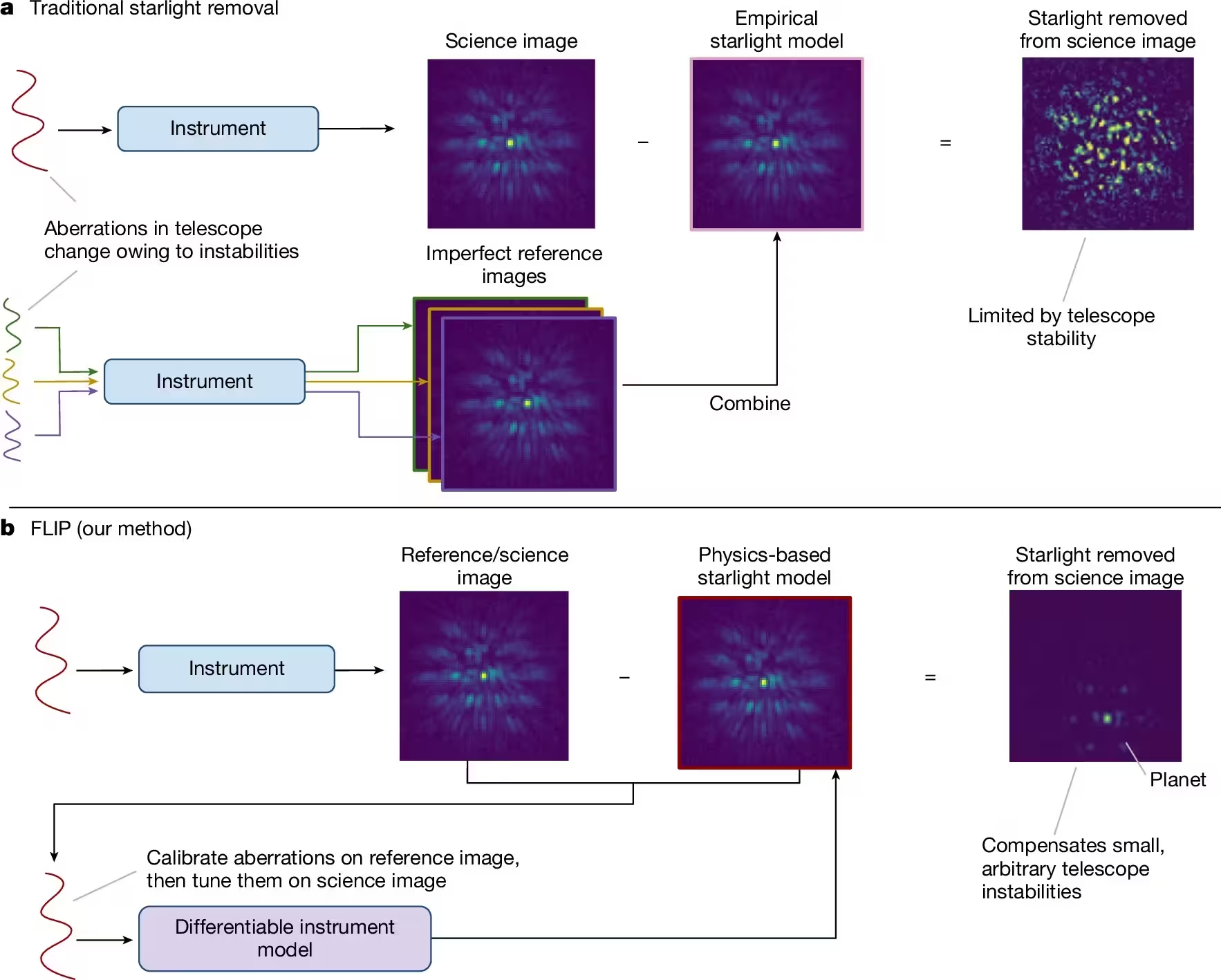
Traditionally, astronomers subtract this glare using reference images taken of other stars. However, because no two observations are identical, these models often leave behind “noise” that limits the search for smaller or dimmer planets. FLIP moves beyond this by building a physics-based “digital twin” of the telescope itself.
“What’s exciting is that we’re showing how computation can help overcome limitations of the telescope itself,” said Caltech professor Katie Bouman, a key collaborator on the project. By simulating how light propagates through the instrument, the team can use computational optimization to refine model parameters—such as stellar brightness and optical aberrations—to match the observed data with high precision.
New Eyes on Known Worlds
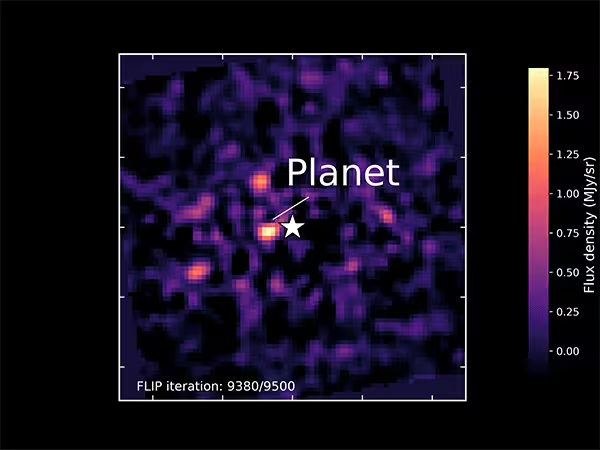
To validate the technique, the researchers applied it to existing JWST observations, including the system 51 Eridani. While the giant planet 51 Eridani b had been discovered previously via ground-based telescopes, it had remained elusive in certain JWST infrared filters. FLIP successfully recovered the planet’s signature at 4.3 microns—a crucial wavelength where carbon dioxide absorption provides vital clues about planetary atmospheres.
The team was careful to prevent the model from “fitting away” real planets. By injecting synthetic planetary signals into the data during the processing phase, they could track whether these signals were preserved or accidentally erased, allowing them to quantify detection limits accurately.
The Path to Future Discoveries
While the results represent a significant leap in data processing, the researchers emphasize that they have not yet reached the fundamental “photon-noise limit”—the theoretical floor of how clearly we can see objects based on the number of photons collected. Future improvements will focus on refining the detector models and reducing the computational time required to process these complex datasets.
Beyond the JWST, this framework holds promise for ground-based observatories and future missions like the Nancy Grace Roman Space Telescope. The ultimate, long-term goal is to refine these computational techniques enough to assist in the detection of Earth-like planets orbiting Sun-like stars—a task that requires isolating signals ten billion times fainter than their host stars.
For now, the astronomical community has a powerful new tool to revisit the wealth of data already stored in the JWST archives, potentially uncovering hidden worlds that have been sitting in plain sight all along.
Further Reading
- Habitable Worlds Observatory (NASA)
- NIRCam Bar Coronagraphy and Atmospheric Analysis (The Astronomical Journal)
- Exoplanet Imaging via Differentiable Rendering (IEEE Transactions on Computational Imaging)
- Discovery of 51 Eridani b (Science)
- Standard Image Subtraction Methodology (KLIP) (The Astrophysical Journal Letters)
This article has been fact checked for accuracy, with information verified against reputable sources. Learn more about us and our editorial process.
Last reviewed on .
Article history
- Latest version
Reference(s)
- Ferrer-Chavez, Rodrigo. “Imaging exoplanets below the telescope stability limit - Nature.”, vol. 659, no. 8139, pp. 58-62. Nature, doi: 10.1038/s41586-026-11213-z. <https://www.nature.com/articles/s41586-026-11213-z>.
- Arroyo, Yesenia. “Habitable Worlds Observatory - NASA Science.”, December 11, 2023 NASA <https://science.nasa.gov/astrophysics/programs/habitable-worlds-observatory/>.
- Balmer, William. “JWST-TST High Contrast: Living on the Wedge, or, NIRCam Bar Coronagraphy Reveals CO$_2$ in the HR 8799 and 51 Eri Exoplanets' Atmospheres.” arXiv.org, doi: 10.3847/1538-3881/adb1c6. <https://arxiv.org/abs/2503.13608>.
- <https://authors.library.caltech.edu/records/67k68-vvp90>.
- <https://pubmed.ncbi.nlm.nih.gov/26272904/>.
- Soummer, Rémi., et al. “DETECTION AND CHARACTERIZATION OF EXOPLANETS AND DISKS USING PROJECTIONS ON KARHUNEN-LOÈVE EIGENIMAGES.” The Astrophysical Journal, vol. 755, no. 2, August 3, 2012, pp. L28 American Astronomical Society, doi: 10.1088/2041-8205/755/2/L28. <https://doi.org/10.1088/2041-8205/755/2/L28>.
Cite this page:
- Posted by Aisha Ahmed