How Plants Survive Under Salt Stress: Understanding the Mechanisms of Salt Tolerance
An educational review examining the physiological and molecular mechanisms that enable plants to tolerate soil salinity and maintain agricultural productivity.
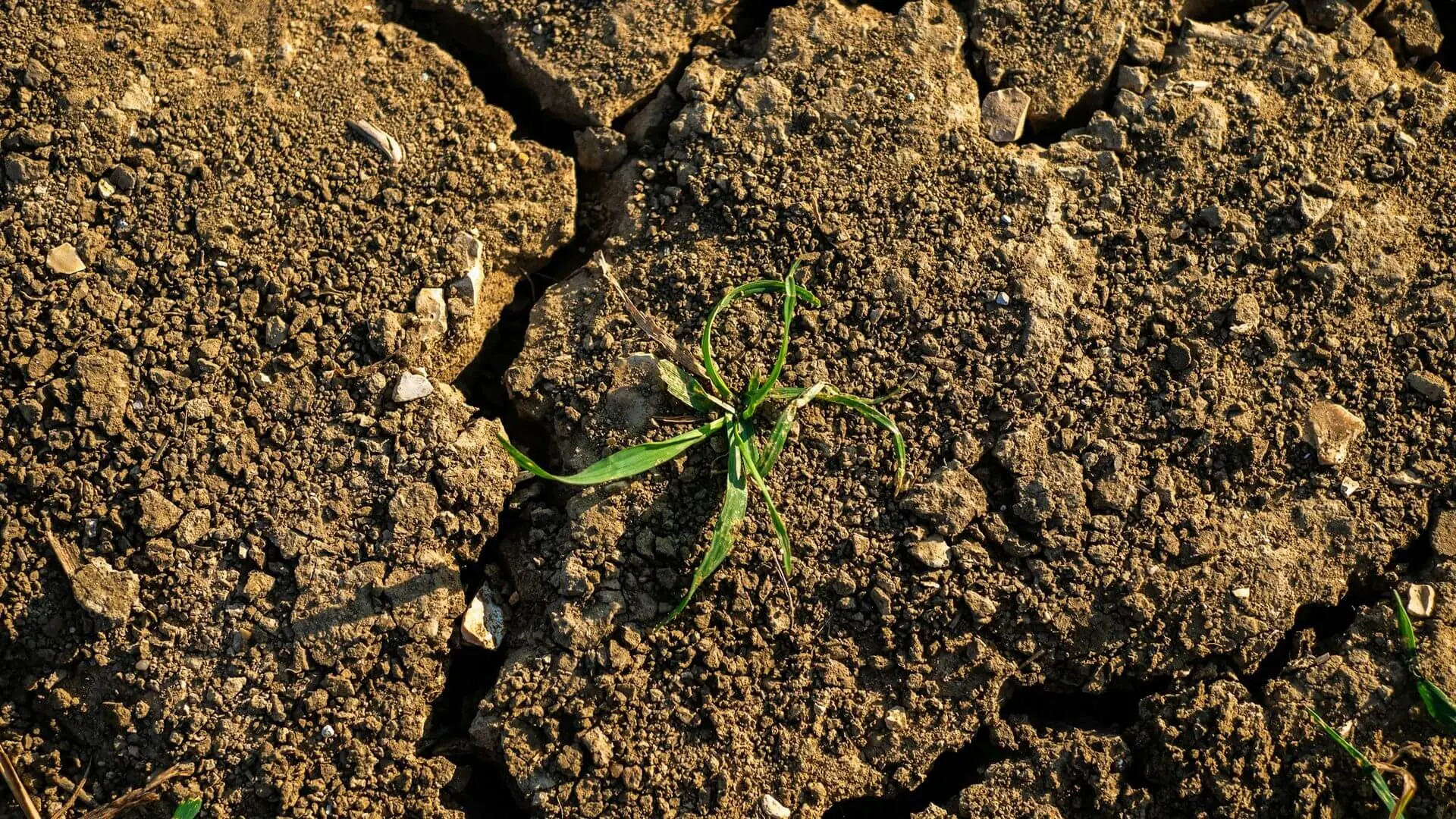
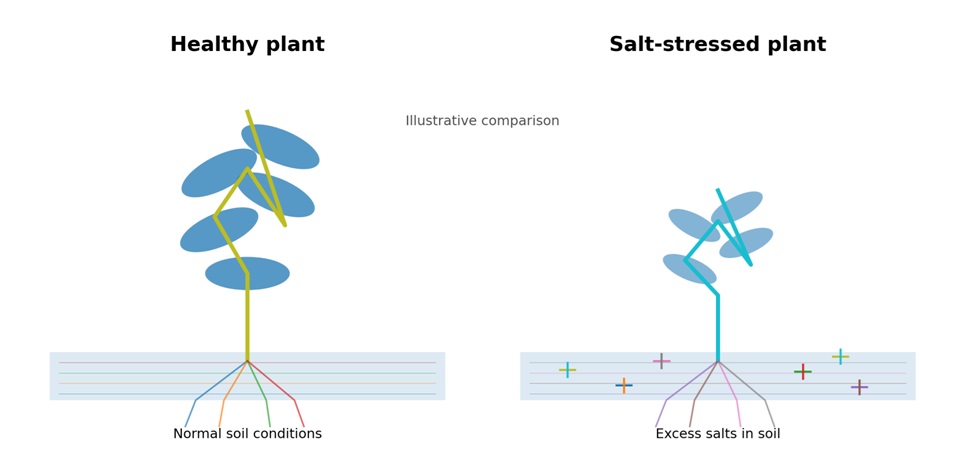
Soil salinity is a major environmental constraint on plant growth and agricultural productivity. It is especially important in arid and semi-arid regions, where high evaporation, limited rainfall, poor drainage and the use of saline irrigation water can cause soluble salts to accumulate in the root zone. When the salt concentration around roots becomes excessive, plants have difficulty absorbing water and may accumulate toxic amounts of sodium and chloride ions. These effects can reduce seed germination, restrict root and shoot growth, damage leaves and ultimately lower crop yield.
Plants are not equally sensitive to salinity. Some species are salt-sensitive, while others can tolerate moderate or even high salt concentrations. The ability to survive under saline conditions is known as salt tolerance. It is not controlled by a single feature; rather, it depends on a combination of physiological, biochemical, anatomical and molecular responses. Understanding these responses can help researchers develop crops that maintain growth and productivity in salt-affected soils.
How Salinity Affects Plants
1. Osmotic stress
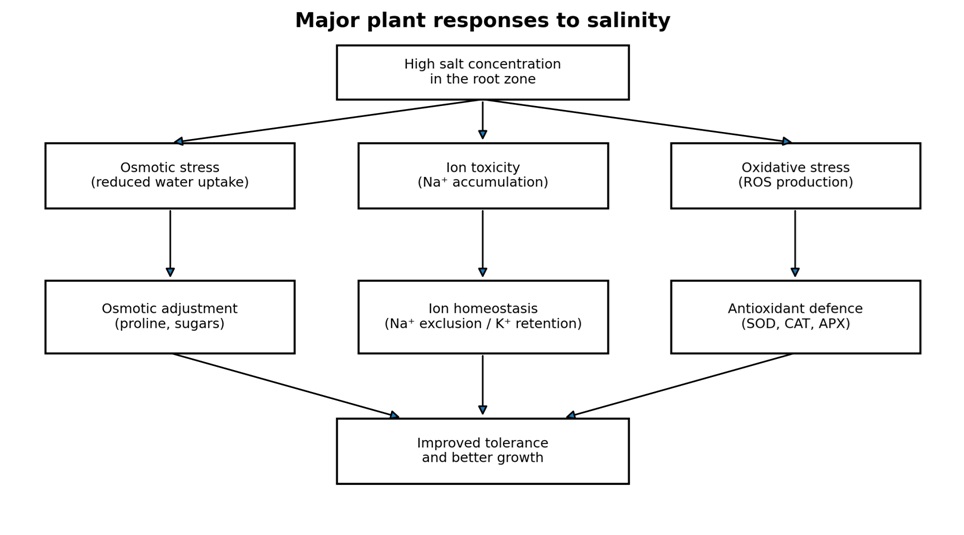
When salts accumulate in soil water, the water potential of the soil solution decreases. Roots must then work harder to take up water. Even when the soil appears moist, a plant may experience a condition similar to drought because water is less available to its roots. This early osmotic effect can slow cell expansion, leaf development and overall growth.
2. Ion toxicity and nutrient imbalance
Sodium (Na⁺) and chloride (Cl⁻) can enter plant tissues with water. If these ions accumulate to damaging levels, they disturb enzyme activity, membrane function and cellular metabolism. Excess sodium can also interfere with the uptake of potassium (K⁺), an essential nutrient involved in enzyme activation, stomatal regulation and many other processes. Maintaining a suitable balance between Na⁺ and K⁺ is therefore an important part of salt tolerance.
3. Oxidative stress
Salinity can increase the production of reactive oxygen species (ROS), including superoxide radicals and hydrogen peroxide. At controlled levels, ROS can act as signals, but excessive ROS can damage membranes, proteins, pigments and DNA. Salt-tolerant plants limit this damage through antioxidant enzymes and protective molecules.
Major Mechanisms of Salt Tolerance
1. Osmotic adjustment
Plants can partly maintain water uptake by accumulating compatible solutes inside their cells. Examples include proline, glycine betaine, soluble sugars and some sugar alcohols. These compounds help lower cellular osmotic potential without seriously interfering with normal biochemical reactions. Proline may also contribute to membrane and protein protection and can help the plant recover after stress. The amount of a compatible solute is not, by itself, proof of tolerance; it should be considered alongside growth, water status and ion measurements.
2. Ion homeostasis: excluding sodium and retaining potassium
A salt-tolerant plant must control where sodium moves and where it accumulates. Roots may restrict the entry of Na⁺, while transport systems can help move sodium out of the cytoplasm or store it inside vacuoles. The SOS signalling pathway is involved in cellular responses to sodium stress. The SOS1 protein is a plasma-membrane Na⁺/H⁺ exchanger that can help export sodium from cells. NHX-type exchangers located on vacuolar membranes can contribute to sodium compartmentalisation in vacuoles. By keeping cytoplasmic sodium low and maintaining potassium, plants protect many essential cellular processes.
3. Antioxidant defence
Plants use enzymatic and non-enzymatic antioxidant systems to control ROS. Important antioxidant enzymes include superoxide dismutase (SOD), catalase (CAT), ascorbate peroxidase (APX) and enzymes involved in glutathione metabolism. SOD converts superoxide radicals into hydrogen peroxide, while CAT and APX help remove hydrogen peroxide. Ascorbate, glutathione, carotenoids and phenolic compounds can also contribute to antioxidant protection. A balanced antioxidant response is important because ROS also have signalling functions.
4. Protection of photosynthesis and membranes
High salinity can cause stomata to close, reducing carbon dioxide entry and limiting photosynthesis. Salt stress may also damage chlorophyll, photosynthetic proteins and thylakoid membranes. Tolerant plants can preserve photosynthetic activity by regulating stomatal behaviour, protecting chloroplast structures and maintaining cellular water balance. Membrane stability is supported by compatible solutes, antioxidants and appropriate lipid composition.
5. Plant hormones and stress signalling
Plant hormones coordinate growth and stress responses. Abscisic acid (ABA) is particularly important during water deficit and salinity because it helps regulate stomatal closure and stress-responsive gene expression. Jasmonic acid, salicylic acid and ethylene also participate in signalling networks, with effects that depend on plant species, tissue, stress intensity and exposure time. These pathways help plants adjust growth, activate protective responses and recover when conditions improve.
6. Stress-responsive genes and molecular regulation
Salt stress changes the expression of many genes involved in ion transport, osmotic adjustment, antioxidant defence and signalling. Researchers study transcription factors such as DREB, NAC and bZIP proteins because they can regulate groups of stress-responsive genes. Genes involved in proline biosynthesis, ion transport and membrane protection are also important research targets. Transcriptomic analysis, gene-expression studies and functional experiments can help identify candidate genes, but their roles need to be confirmed rather than inferred from expression patterns alone.
Root Adaptations and Whole-Plant Responses
Roots are the first plant organs to encounter saline soil. Changes in root architecture, root growth rate, suberisation and selective ion transport can influence how much salt reaches the shoot. Some plants maintain root growth under moderate salinity, while others reduce leaf area to limit water loss. Older leaves may accumulate salts and eventually senesce, allowing younger tissues to remain protected. These responses differ among species and should be evaluated under realistic growing conditions.
How Researchers Evaluate Salt Tolerance
Salt tolerance is assessed using a combination of measurements. Common observations include seed germination, root and shoot length, fresh and dry biomass, leaf injury, chlorophyll content and survival. Physiological measurements may include relative water content, photosynthetic performance, stomatal conductance and membrane stability. Biochemical analyses can measure proline, soluble sugars, antioxidant enzyme activity and lipid peroxidation. Ion analysis, particularly Na⁺ and K⁺ concentrations in roots and leaves, helps determine whether a plant can maintain ion balance.
Experiments should include an appropriate non-saline control, clearly defined salt concentrations, biological replicates and a suitable exposure period. Researchers should also distinguish between short-term seedling responses and performance across the full life cycle. A plant that survives a short laboratory treatment may not necessarily maintain grain yield or fruit production in the field.
Applications in Crop Improvement
Knowledge of salt-tolerance mechanisms can support crop improvement through conventional breeding, marker-assisted selection, genomic approaches and biotechnology. Researchers can screen diverse varieties for useful traits, identify genomic regions associated with tolerance and study candidate genes involved in ion transport or stress signalling. Tissue culture and controlled-environment experiments can help evaluate selected lines, while field trials are essential for testing performance under natural soil conditions.
An effective crop-improvement strategy should consider both tolerance and productivity. A variety may survive salinity but still produce a low yield. Therefore, breeding programmes aim to combine salt tolerance with desirable agronomic traits, local adaptation, disease resistance and acceptable grain or fruit quality.
Conclusion
Salt stress affects plants through reduced water availability, ion toxicity and oxidative damage. Plants tolerate salinity by coordinating several protective mechanisms, including osmotic adjustment, sodium exclusion or compartmentalisation, potassium retention, antioxidant defence, protection of photosynthesis and hormone-mediated signalling. These processes are connected and vary among species, varieties and developmental stages. A clear understanding of the underlying physiology and molecular regulation can guide the selection and development of crops better suited to salt-affected environments. Combining laboratory research with careful field evaluation will be essential for translating this knowledge into sustainable agricultural solutions.
This article has been fact checked for accuracy, with information verified against reputable sources. Learn more about us and our editorial process.
Last reviewed on .
Article history
- Latest version
- Last updated by Dayyal Dungrela, MLT, BSc, BS
Reference(s)
- Deinlein, Ulrich., et al. “Plant salt-tolerance mechanisms.” Trends in plant science, vol. 19, no. 6, 2014, pp. 371-379., doi: 10.1016/j.tplants.2014.02.001. <https://doi.org/10.1016/j.tplants.2014.02.001>.
- Flowers, Timothy J., et al. “Salinity tolerance in halophytes.” The New phytologist, vol. 179, no. 4, 2008, pp. 945-963., doi: 10.1111/j.1469-8137.2008.02531.x. <https://doi.org/10.1111/j.1469-8137.2008.02531.x>.
- Munns, Rana., et al. “Mechanisms of salinity tolerance.” Annual review of plant biology, vol. 59, 2008, pp. 651-681., doi: 10.1146/annurev.arplant.59.032607.092911. <https://doi.org/10.1146/annurev.arplant.59.032607.092911>.
- Zhu, Jian-Kang. “Salt and drought stress signal transduction in plants.” Annual review of plant biology, vol. 53, 2002, pp. 247-273., doi: 10.1146/annurev.arplant.53.091401.143329. <https://doi.org/10.1146/annurev.arplant.53.091401.143329>.
Cite this page:
- Posted by Maria Shahid