Astronomers Just Discovered Strange Chains Of Cosmic Knots Around A Zombie Star
Astronomers have discovered glowing chains of gas knots surrounding the surviving star of an ancient supernova, shedding new light on the cosmic explosion.
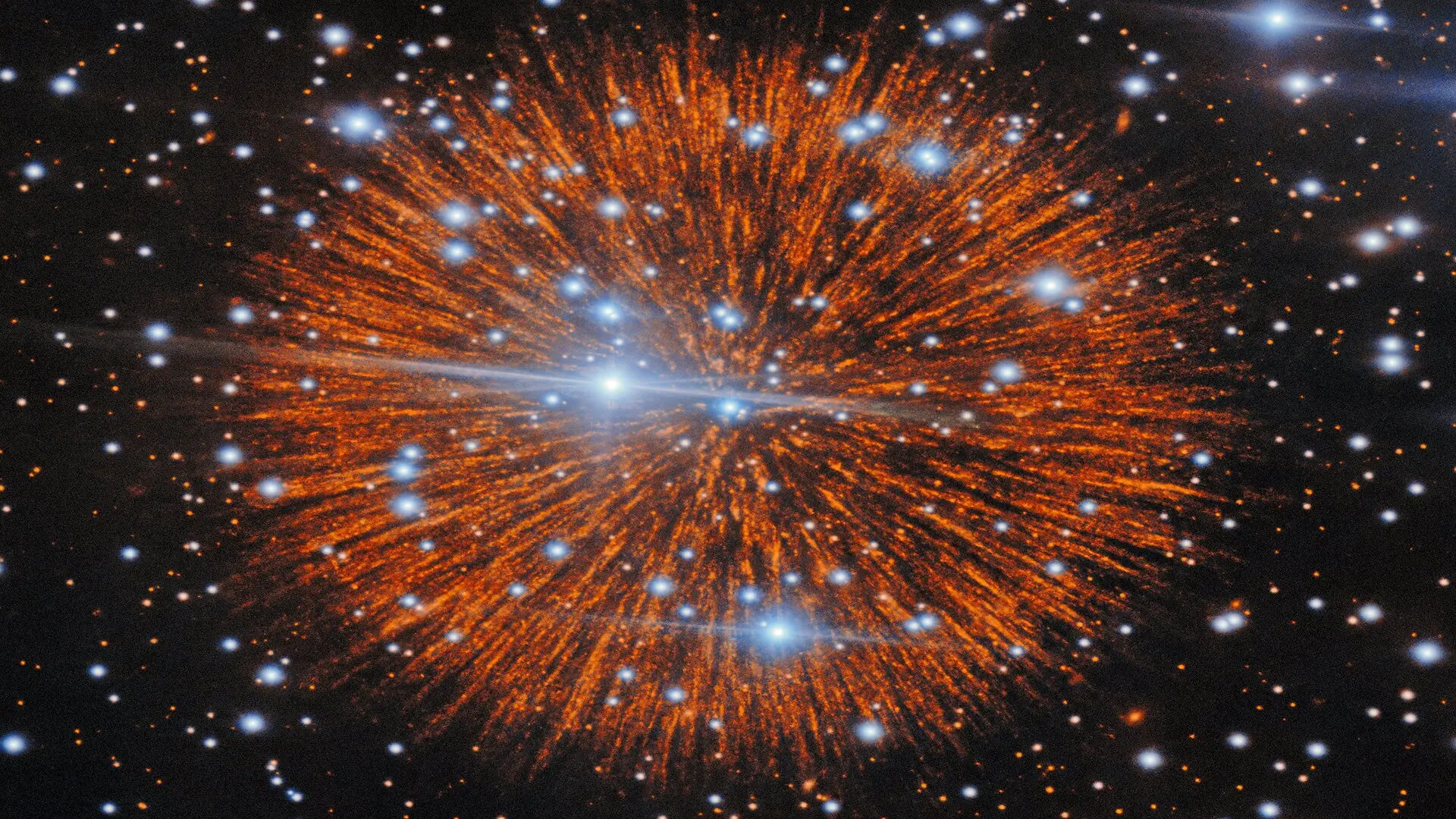
New high-resolution imagery of the supernova remnant Pa 30 has unveiled a surprising structure: long, radiating filaments composed of perfectly uniform chains of gas knots. These cosmic pearls, discovered using the Gemini North telescope in Hawai‘i, provide fresh insights into one of the most enigmatic stellar explosions in the Milky Way.
The study, published in The Astrophysical Journal, marks a significant step forward in understanding the aftermath of a stellar event first recorded by observers in 1181. By utilizing the Gemini Multi-Object Spectrograph, researchers were able to isolate light from specific ionized elements, revealing a filamentary network far more complex than previously documented.

A Survivor in the Ashes
Pa 30, located approximately 7,500 light-years away, is widely considered the remnant of a Type Iax supernova, a faint and rare thermonuclear explosion. Unlike more violent supernovae that obliterates the progenitor star, this event left behind a hot, central object often described as a zombie star. The presence of this survivor offers a unique laboratory for astronomers to study the mechanics of incomplete stellar destruction.
The research team, co-led by Tim Cunningham of the University of Warwick and Ilaria Caiazzo of the Institute of Science and Technology Austria (ISTA), analyzed the nebula to determine if the explosion imparted a recoil, or “kick,” to the central star. Their findings suggest the star experienced minimal lateral movement, with an upper limit on its transverse velocity of 14 kilometers per second. This constraint provides a crucial benchmark for theoretical models of how white dwarfs merge and explode.
Revealing the Chains
By focusing on light emitted by ionized sulfur and oxygen, the researchers identified that the nebula’s radial streaks are not continuous flows but rather cascades of discrete knots. These structures are remarkably consistent, each measuring roughly 100 billion kilometers across—roughly ten times the diameter of Neptune’s orbit.
“The knots are quite strikingly uniform. We are excited to try to model them,” said Caiazzo. While the exact physical process creating these chains remains a mystery, the team posits that instabilities in the expanding debris, perhaps triggered by rapid cooling or interaction with surrounding gas, may be responsible. Current models suggesting that the central star’s wind simply strips material from slower ejecta fail to fully account for the precise, repetitive nature of these knots.
Setting a New Standard
The high-resolution imaging from Gemini North serves as a template for identifying similar remnants across the galaxy. As astronomers search for other “guest stars” recorded in historical texts, the specific morphology of Pa 30—its clumpy, filamentary architecture and central survivor—provides a new diagnostic tool for classification.
Future observations, potentially utilizing the Hubble Space Telescope, may further clarify whether the gaps between these bright filaments contain diffuse gas or simply smaller, dimmer chains of knots. For now, the intricate “pearls” of Pa 30 remain a captivating, if challenging, puzzle for theorists attempting to reconstruct the final, incomplete moments of a star that defied total annihilation nearly a millennium ago.
![Narrowband imaging of the Pa 30 nebula obtained with Gemini/GMOS with the [S ii] filter. The imaging reveals a high filling factor of filaments. In general the filaments are a cascade of knots.](https://www.bioscience.com.pk/images/7c2e850382.avif)
Key Scientific References
- Expansion Properties of the Young Supernova Type Iax Remnant Pa 30 Revealed
- Discovery of an Exceptional Optical Nebulosity in the Suspected Galactic SN Iax Remnant Pa 30 Linked to the Historical Guest Star of 1181 CE
- The Remnant and Origin of the Historical Supernova 1181 AD
- A massive white-dwarf merger product before final collapse
- Type Iax Supernovae: A New Class of Stellar Explosion
This article has been fact checked for accuracy, with information verified against reputable sources. Learn more about us and our editorial process.
Last reviewed on .
Article history
- Latest version
Reference(s)
- Cunningham, Tim., et al. “Expansion Properties of the Young Supernova Type Iax Remnant Pa 30 Revealed.” The Astrophysical Journal Letters, vol. 975, no. 1, October 24, 2024, pp. L7 American Astronomical Society, doi: 10.3847/2041-8213/ad713b. <https://doi.org/10.3847/2041-8213/ad713b>.
- Fesen, Robert A.., et al. “Discovery of an Exceptional Optical Nebulosity in the Suspected Galactic SN Iax Remnant Pa 30 Linked to the Historical Guest Star of 1181 CE.” The Astrophysical Journal Letters, vol. 945, no. 1, March 1, 2023, pp. L4 American Astronomical Society, doi: 10.3847/2041-8213/acbb67. <https://doi.org/10.3847/2041-8213/acbb67>.
- Ritter, Andreas., et al. “The Remnant and Origin of the Historical Supernova 1181 AD.” The Astrophysical Journal Letters, vol. 918, no. 2, September 15, 2021, pp. L33 American Astronomical Society, doi: 10.3847/2041-8213/ac2253. <https://doi.org/10.3847/2041-8213/ac2253>.
- Gvaramadze, Vasilii. “A massive white-dwarf merger product before final collapse - Nature.”, vol. 569, no. 7758, pp. 684-687. Nature, doi: 10.1038/s41586-019-1216-1. <https://www.nature.com/articles/s41586-019-1216-1>.
- Foley, Ryan J.., et al. “TYPE Iax SUPERNOVAE: A NEW CLASS OF STELLAR EXPLOSION.” The Astrophysical Journal, vol. 767, no. 1, March 25, 2013, pp. 57 American Astronomical Society, doi: 10.1088/0004-637X/767/1/57. <https://doi.org/10.1088/0004-637X/767/1/57>.
Cite this page:
- Posted by Aisha Ahmed