Astronomers Just Found The Lightest Neutron Star Pair Ever Seen Putting Einstein To The Test
Astronomers using the FAST telescope have discovered the lowest-mass double neutron star system ever recorded, which is losing energy via gravitational waves.
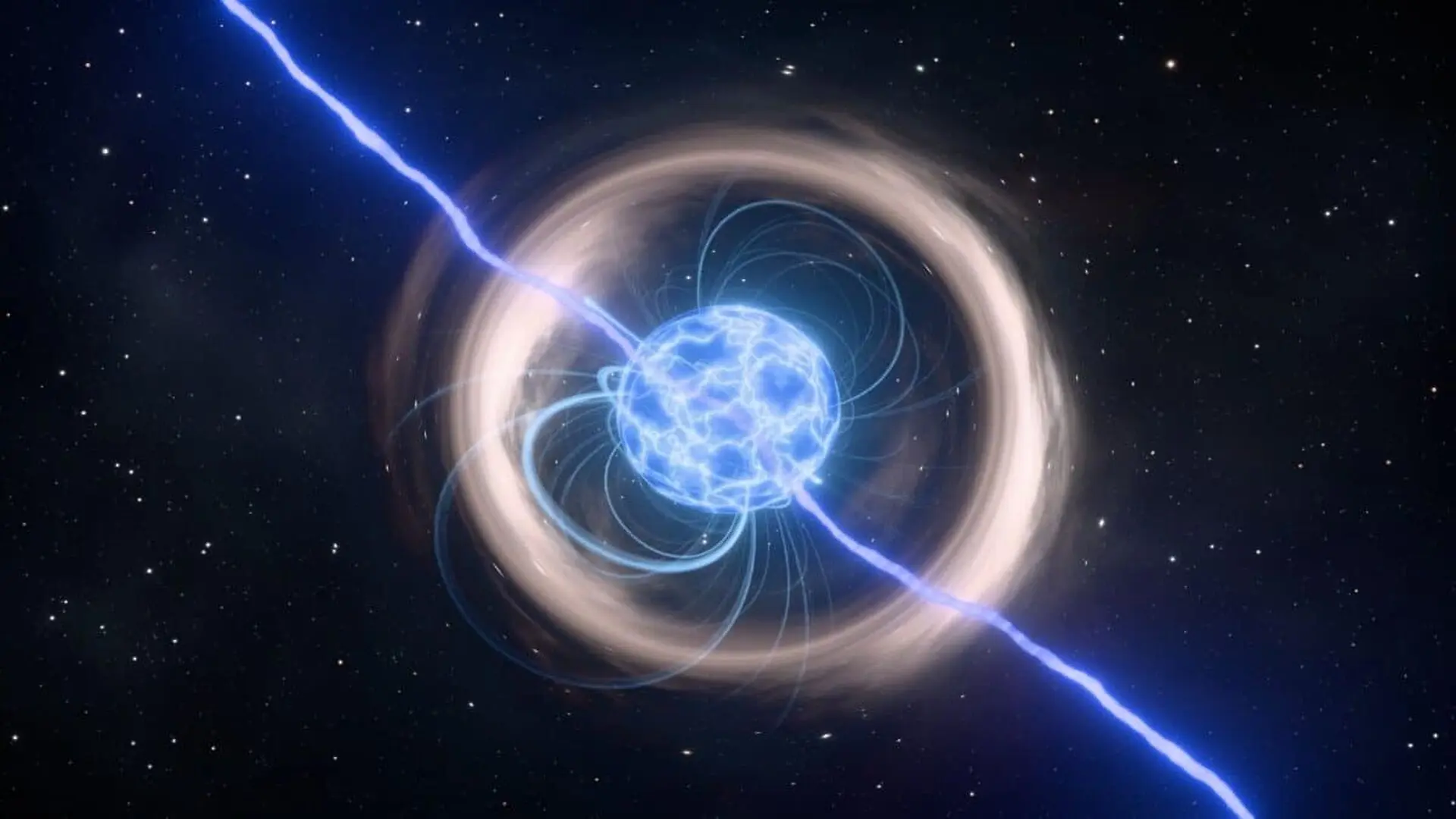
Astronomers using the Five-hundred-meter Aperture Spherical Telescope (FAST) have identified a unique binary system that is challenging our understanding of stellar evolution. Designated PSR J1856–0039, this double neutron star system has been confirmed as the lightest of its kind ever recorded, providing a rare laboratory for testing the limits of Einstein’s theory of general relativity.
The system was first discovered on May 4, 2020, as part of an expansive pulsar survey conducted by the facility. According to JinLin Han, a researcher involved in the study, the FAST program has cataloged approximately 900 pulsars to date. However, PSR J1856–0039 stands out due to its extremely tight, eccentric orbit and the clarity with which it displays relativistic phenomena.
Precision Timing Reveals a Featherweight Pair
To unravel the secrets of this system, researchers conducted 17 observation sessions between 2020 and 2025, capturing 253 distinct measurements of the pulsar’s radio pulse arrival times. The pulsar, which spins every 23.4 milliseconds, orbits its companion once every 2.36 hours. This makes it the second-shortest-period binary neutron star system confirmed to date.
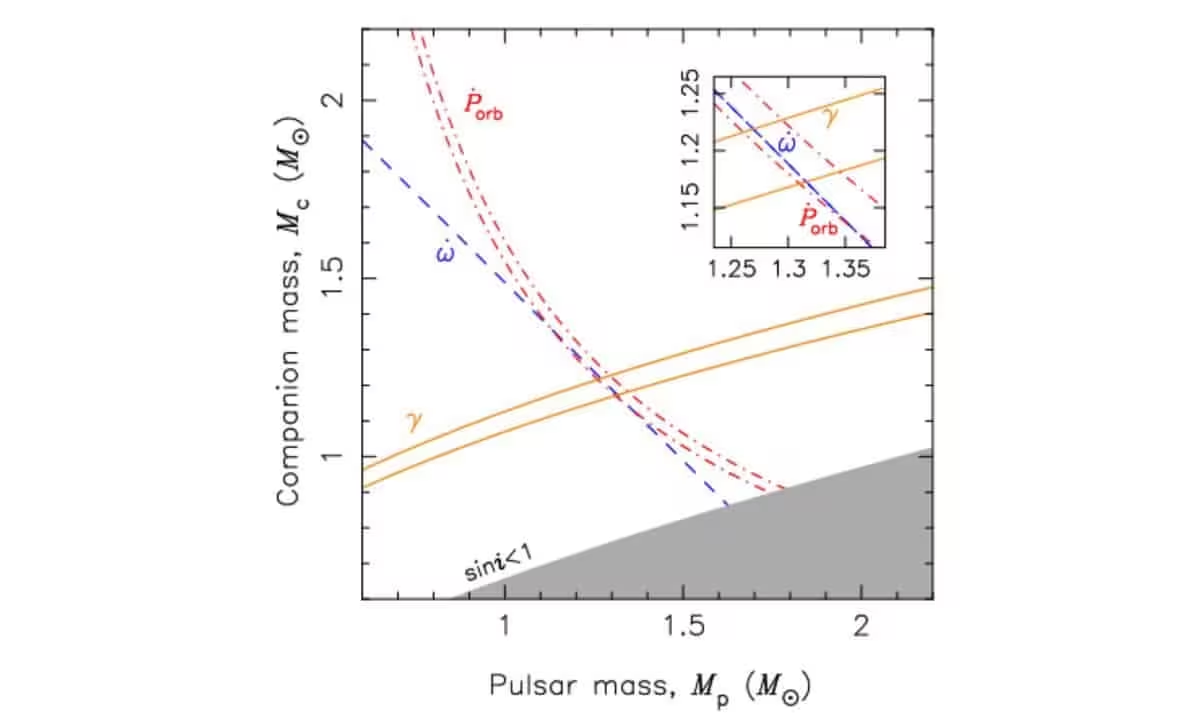
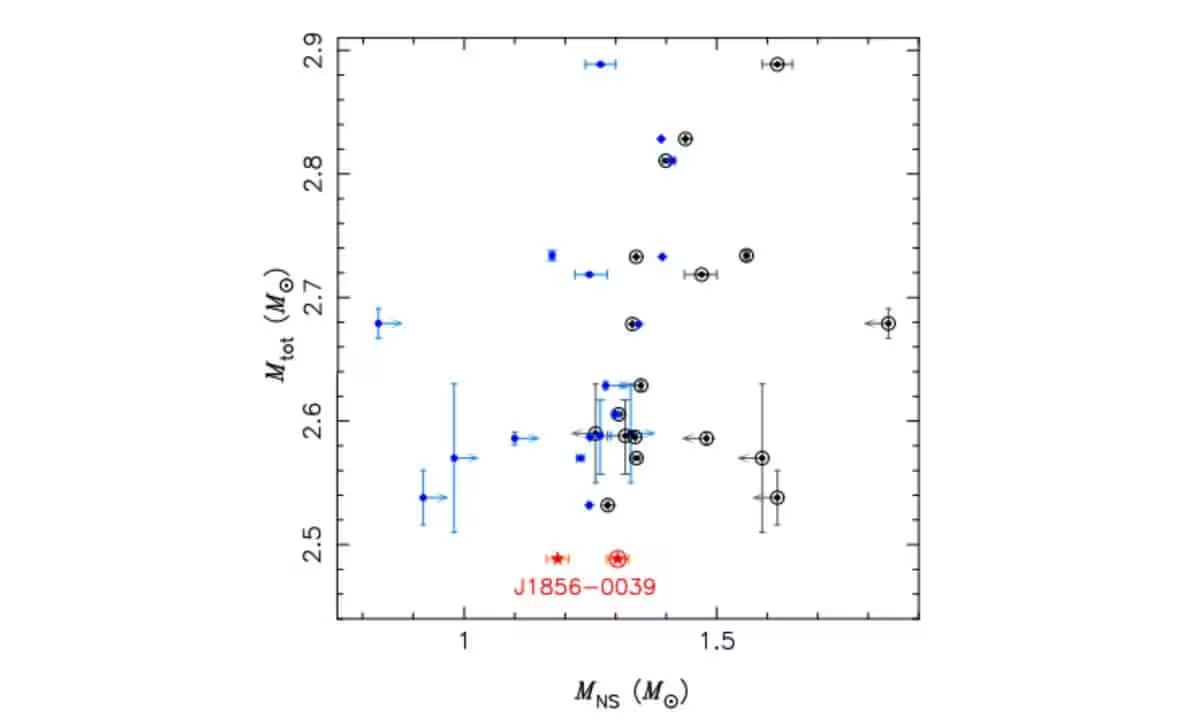
By applying a general-relativistic timing model to the data, the team determined the system’s total mass to be approximately 2.488 solar masses. Specifically, the pulsar was measured at 1.304 solar masses, while its companion registered at 1.185 solar masses—ranking it among the lightest neutron stars ever detected.
The findings, detailed in Physical Review Letters, confirm that the system’s orbital decay—caused by the emission of gravitational waves—matches theoretical predictions with a high degree of accuracy. The observed orbital period derivative, the advance of the periastron, and the relativistic Einstein delay all align with the expectations of general relativity.
Future Observations and Cosmic Mergers
While the pair is currently locked in a tight dance, their future is already written. Scientists project that the system will undergo a final merger in approximately 82 million years. Whether the aftermath results in a stable, singular neutron star or a collapse into a black hole remains a subject of ongoing investigation.
Beyond confirming established theories, the system holds promise for probing more elusive aspects of astrophysics. Han noted that the current data provides a strong foundation for potentially detecting Lense–Thirring precession, or frame-dragging, a phenomenon where the rotation of a massive object drags the fabric of spacetime around it. If successful, such a measurement could offer unprecedented insights into the exotic state of matter contained within the dense hearts of neutron stars.
For now, the discovery serves as a benchmark for astronomers, combining record-breaking low mass measurements with the rigorous validation of gravitational wave-driven orbital decay.
This article has been fact checked for accuracy, with information verified against reputable sources. Learn more about us and our editorial process.
Last reviewed on .
Article history
- Latest version
Reference(s)
- “Homepage of Dr. J.L. Han.” <http://zmtt.bao.ac.cn/hjl/index.html>.
- Yang, Z. L.., et al. “Relativistic Effects of PSR J1856–0039 Double Neutron Star System in a 2.36-Hour Compact Orbit.” Physical Review Letters, vol. 137, no. 12, September 15, 2026 American Physical Society (APS), doi: 10.1103/hmjp-htd1. <https://journals.aps.org/prl/abstract/10.1103/hmjp-htd1>.
Cite this page:
- Posted by Aisha Ahmed