Physicists Flip Magnetic Memory Using Ultra-Low Rare-Earth Concentrations
Advanced simulations reveal that ultrafast laser switching does not require magnetic compensation if atomic damping is carefully tuned.
Ultra-fast laser pulses can flip the magnetic orientation of specific metal alloys in less than a trillionth of a second without using any magnetic field, and researchers have just discovered this phenomenon can occur at rare-earth concentrations far lower than previously thought. The breakthrough centers on alloys made of gadolinium and cobalt, which are vital for next-generation data storage and spintronic devices because they manipulate data on femtosecond timescales.
For years, physicists believed that this unique behavior, known as all-optical helicity-independent switching, required a delicate balance called magnetic compensation, where the opposing magnetic moments of different metal components cancel each other out. However, recent experiments challenged that rule by showing successful switching in platinum, cobalt, and platinum heterostructures containing only tiny amounts of gadolinium localized at the interfaces. To understand how this works at an atomic level, a team of researchers from institutions including the National Institute of Research and Development for Technical Physics in Romania, the Spanish National Research Council, the University of York, and the Université de Lorraine used sophisticated computer simulations.
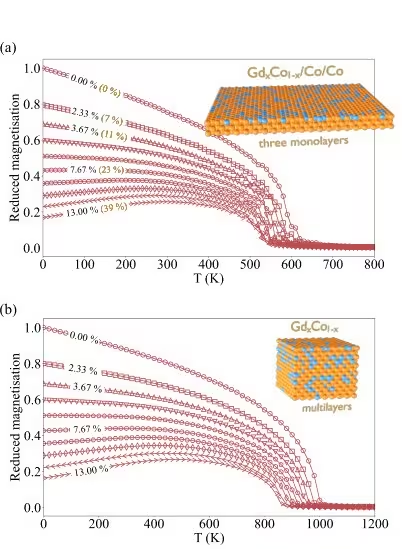
The study, available on the arXiv preprint server, examined atomistic spin-dynamics simulations to test an effective interfacial gadolinium-cobalt alloy picture. The authors investigated how species-dependent spin-bath coupling controls the minimum gadolinium concentration required for magnetic reversal. They compared two distinct models: a three-monolayer cobalt film with gadolinium confined solely to the surface layer, and a three-dimensional uniformly alloyed gadolinium-cobalt model.
How Low Can Gadolinium Concentrations Go During Laser Heating?
Within their uniform-heating model, the team found that robust, transient toggle-like magnetic reversal is obtained far from any compensation point when the gadolinium coupling to the thermal bath is substantially weaker than that of cobalt. Specifically, when setting the cobalt damping parameter to 0.02 and the gadolinium damping parameter to 0.001, reversal occurs down to just 1.5 atomic percent total gadolinium under selected laser pulse parameters. This brings the material much closer to a pure ferromagnetic state rather than a traditional ferrimagnet.
The simulations reveal that increasing the gadolinium content actually accelerates the magnetic reversal process. This observation aligns with the interpretation of gadolinium acting as an angular-momentum reservoir during ultrafast heating. Conversely, extremely dilute interfacial gadolinium produces much slower and more stochastic dynamics. The researchers note that while traditional models often assume equal damping parameters for different atomic species due to shared itinerant electrons, that assumption breaks down at low concentrations where large pure transition-metal islands emerge.
What Controls the Speed of Ultrafast Magnetic Switching?
When analyzing magnetization dynamics, the team observed a two-step process characteristic of these alloys. This involves an initial fast demagnetization on a timescale of hundreds of femtoseconds, followed by a slower recovery of magnetization over tens of picoseconds. Interestingly, the uniformly alloyed configuration switched and recovered its magnetization much faster than the surface-dusted film configuration. This difference stems from the fact that in the three-monolayer setup, gadolinium is restricted to the interface where switching initiates, whereas in the volumetric alloy, switching nuclei are distributed throughout the material.
The authors also identified a counter-intuitive speedup of dynamics when decreasing the gadolinium damping value relative to cobalt. In the high-concentration regime, standard scaling criteria would predict slower dynamics with decreasing rare-earth damping. However, the team suggests this traditional framework does not apply in the dilute gadolinium limit. At very low concentrations, the switching process likely proceeds through the formation of a limited number of localized reversal regions resembling magnon-droplet excitations. These fluctuating regions must survive, expand, and merge to complete the reversal, explaining the observed slowdown.
Why These Findings Matter for Future Data Storage
These findings demonstrate that magnetic compensation is not a fundamental requirement for ultrafast all-optical switching. By showing that efficient switching can be achieved with ultra-low gadolinium concentrations provided that intrinsic damping remains sufficiently low, the work opens new pathways for materials design. It enables engineers to drastically reduce the content of scarce rare-earth elements in spintronic devices while maintaining high-speed functional switching behavior.
The study was posted to the arXiv preprint server on November 16, 2026.
This article has been fact checked for accuracy, with information verified against reputable sources. Learn more about us and our editorial process.
Last reviewed on .
Article history
- Latest version
Reference(s)
- Gavriloaea, Paul-Iulian. “Atomistic Insights into the All-Optical Switching of GdCo Alloys with Minimal Gd Concentration.” arXiv.org <http://arxiv.org/abs/2611.21410v1>.
Cite this page:
- Posted by Bilal Abbasi