New Algorithm Solves Quantum States Without Costly Penalties
By reparameterizing neural wavefunctions, scientists have bypassed long-standing computational bottlenecks in quantum chemistry calculations.
Researchers have successfully adapted a low-rank approximation framework, known in machine learning as LoRA, to solve the electronic Schrödinger equation for multiple quantum excited states of atoms without requiring complex penalty weights or costly matrix inversions. The method computes accurate energy levels for the first-row atoms lithium through neon, matching the precision of existing state-of-the-art computational techniques while drastically cutting down computational overhead. Full details of the new approach are published on the arXiv preprint server.
Overcoming the Computational Bottlenecks in Quantum Chemistry
Computing the electronic structure of molecules involves solving the Schrödinger equation, a task that scales exponentially with the number of electrons due to the curse of dimensionality. While neural-network variational Monte Carlo methods have achieved remarkable precision for the ground states of small molecules using advanced architectures like FermiNet and Psiformer, extending this success to excited states has remained an uphill battle. Until now, scientists relied on two main paradigms, each carrying severe limitations.
Penalty-based methods add artificial overlap penalties to encourage orthogonality between different energy states, but these require tuning delicate penalty weights that depend on unknown energy gaps. Alternatively, natural excited states variational Monte Carlo transforms the problem into a grand extended system, successfully avoiding penalties but introducing a massive computational wall time. Evaluating local energy in that framework demands a quadratic number of Laplacian calculations per optimization step, scaling poorly as the number of target states grows.
How Nested Low-Rank Approximation Changes the Equation
To resolve this trade-off, a team of researchers led by Minchan Jeong, J. Jon Ryu, Se-Young Yun, and Gregory W. Wornell turned to a mathematical principle called low-rank approximation. Originally developed to decompose operators in low-dimensional systems, the low-rank approximation objective was previously incompatible with variational Monte Carlo because it relied on intractable high-dimensional integral norms.
The study authors overcame this hurdle through a straightforward reparameterization. By representing each wavefunction as a normalized neural network multiplied by a trainable scale parameter, they made the objective fully compatible with the probability density sampling used in Monte Carlo algorithms. Furthermore, they incorporated a sequential nesting technique that recovers ordered energy states one by one without requiring post-training matrix diagonalizations.
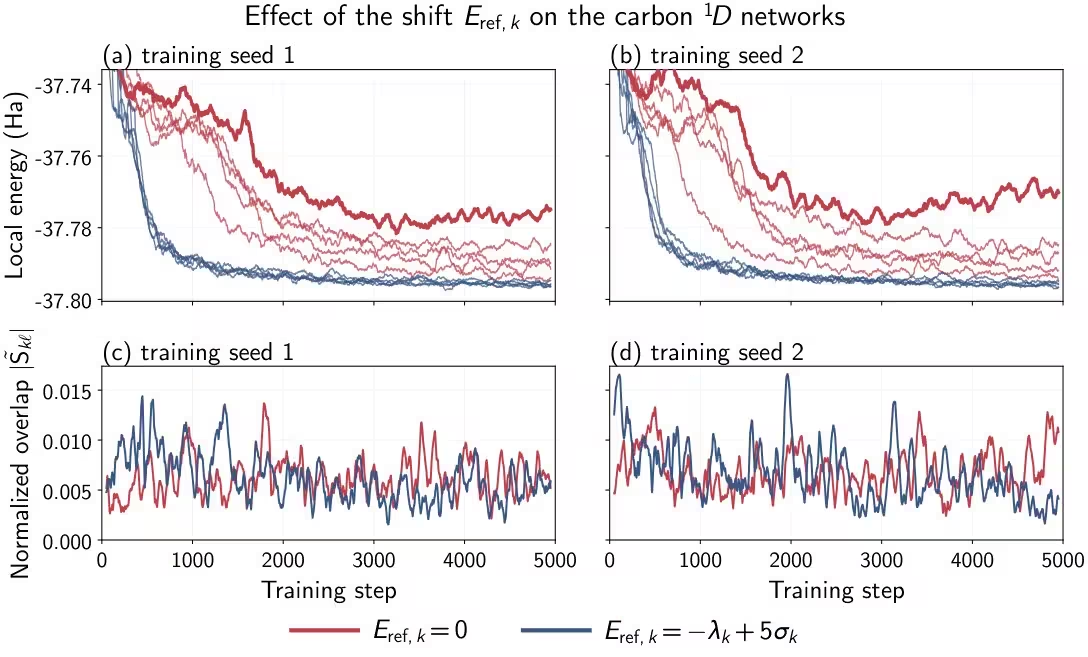
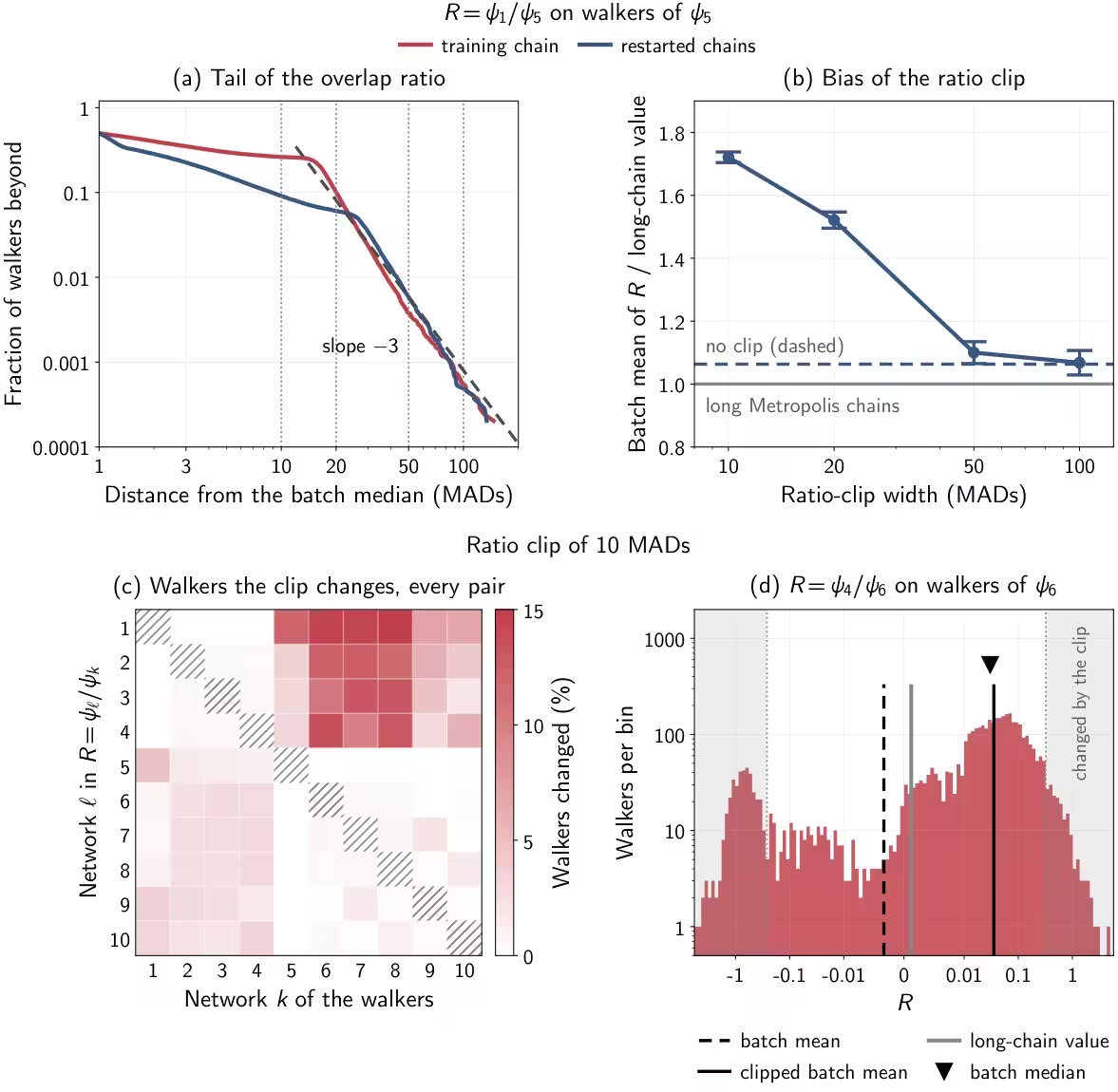
The resulting algorithm, named NestedLoRA-VMC, requires only a linear number of Laplacian evaluations per training step, matching the efficiency of penalty-based methods while remaining entirely penalty-free. The authors also introduced asymmetric clipping strategies to handle heavy-tailed statistical noise near nodal surfaces and deployed a per-network operator shift to stabilize training convergence.
Testing the Limits on First-Row Atoms
The research team evaluated their algorithm on the first-row atoms lithium, beryllium, boron, carbon, nitrogen, oxygen, fluorine, and neon, targeting the lowest ten eigenstates for each element. Using Psiformer neural network architectures, the per-atom mean absolute errors against experimental term centroids from the National Institute of Standards and Technology stayed below standard chemical accuracy thresholds.
On carbon atoms, the team demonstrated that their operator shift successfully controlled curvature imbalances, bringing degenerate energy levels into tight alignment. Despite these successes, the authors note certain limitations. The current validation is restricted to first-row atoms, and scaling the approach to larger molecules remains bottlenecked by the inherent computational cost of calculating second-order derivatives for multi-electron systems. Future work aims to incorporate advanced optimization techniques, such as Wasserstein gradient flows, to push quantum neural network calculations even further.
The study was posted to the arXiv preprint server on November 16, 2026.
This article has been fact checked for accuracy, with information verified against reputable sources. Learn more about us and our editorial process.
Last reviewed on .
Article history
- Latest version
Reference(s)
- Jeong, Minchan. “Variational Monte Carlo for Quantum Excited States via Nested Low-Rank Approximation.” arXiv.org <http://arxiv.org/abs/2611.21434v1>.
Cite this page:
- Posted by Bilal Abbasi