Scientists Have Created a Bizarre New Plastic That Can Turn Into Gas and Rebuild Itself
Researchers have identified unusual material behaviors that could pave the way for a new generation of fully recyclable and sustainable plastics.
Researchers at the University of Surrey have engineered a novel polymer capable of undergoing a dramatic physical transformation: it can shift directly from a solid state into a gas when heated, only to reconstruct itself into the original material upon cooling. This unique behavior offers a potential new blueprint for the development of sustainable, circular plastics designed for seamless recovery and reuse.
The global plastic crisis is largely driven by the inherent durability of materials like polyethylene. While its resistance to degradation is precisely what makes it ideal for food packaging and consumer goods, that same stability creates a monumental hurdle for recycling. Once these materials enter the waste stream, the complex processes required to separate and reprocess them often prove ineffective or economically unviable. The new material, known as poly(1,2-dithiolane), bypasses these traditional limitations by utilizing a reversible chemical structure previously unseen in polymer science.
Vaporization and Recovery: A New Paradigm for Polymers
The secret to this material lies in its molecular architecture. Comprised of repeating 1,2-dithiolane units—a ring structure incorporating carbon, hydrogen, and sulfur—the polymer benefits from sulfur-based linkages that facilitate easier breaking and reforming of chemical bonds. As detailed in the journal Macromolecules, the material undergoes sublimation at approximately 90 degrees Celsius. Unlike conventional plastics, which typically require temperatures exceeding 200 degrees Celsius and transition through a liquid melt, this polymer skips the liquid phase entirely, shifting straight from solid to gas.
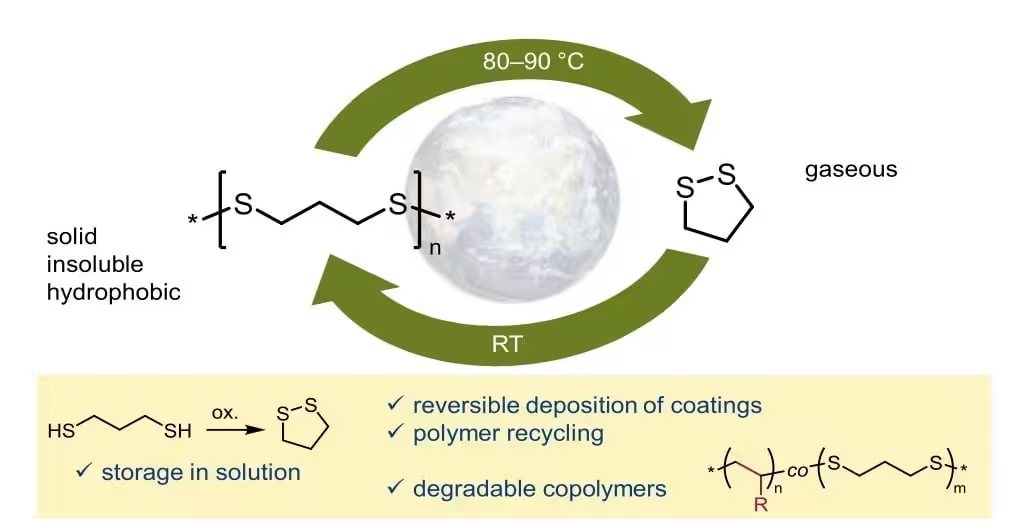
Chemical engineer Peter Roth of the University of Surrey emphasizes that this discovery is not intended as a direct substitute for mass-market plastics. Instead, he views it as a conceptual breakthrough. “It’s certainly not a solution to the global plastic waste problem,” Roth noted. “But it does introduce a new concept that could inspire an entirely new generation of circular materials.”
Practical Applications in Surface Protection and Purification
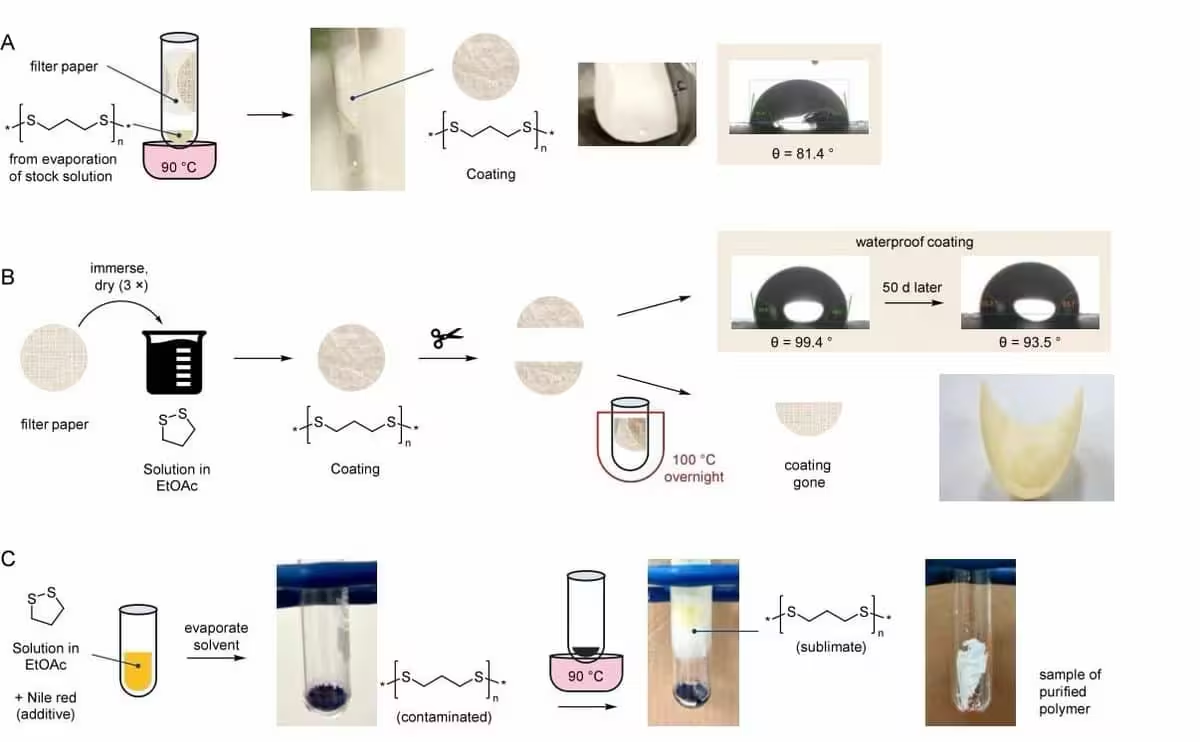
To demonstrate the utility of this discovery, the research team applied the polymer as a temporary, waterproof coating on rolled-up filter paper. Upon heating, the coating vanished, allowing the paper to regain its original absorbent properties, while the material itself could be captured and reused. This capability opens doors for temporary protective barriers against corrosion or moisture that can be removed cleanly without compromising the integrity of the underlying substrate.
Furthermore, the team explored the material’s potential in purification. By incorporating Nile red dye into the polymer, they demonstrated that the contaminant could be stripped away in a single heating cycle, suggesting that this reversible chemistry could significantly streamline complex separation processes in industrial manufacturing.
Engineering the Future of Material Lifecycle
The core success of this study lies in the intentional design of “reversibility” into the chemical backbone of the polymer. Lead author Touseef Kazmi believes this approach changes the fundamental criteria for how we define sustainable plastics. “If we can learn how to tailor this chemistry, it could eventually lead to new materials that are easier to apply, remove and recycle than many of today’s plastics,” said Kazmi.
Beyond standard industrial use, the team is already looking toward specialized fields where such reversible properties could be transformative, including the development of advanced hydrogels, surgical adhesives, and responsive drug delivery systems. By focusing on how materials can be intelligently disassembled and rebuilt, the researchers are laying the groundwork for a future where the end of a product’s life is merely the beginning of its next cycle.
This article has been fact checked for accuracy, with information verified against reputable sources. Learn more about us and our editorial process.
Last reviewed on .
Article history
- Latest version
Reference(s)
- Kazmi, Touseef., et al. “Lipoic Acid Without the Side Chain: Sublimable Homopolymers and Degradable Copolymers Based on 1,2-Dithiolane.” Macromolecules, August 11, 2026 American Chemical Society (ACS), doi: 10.1021/acs.macromol.6c01500. <https://doi.org/10.1021/acs.macromol.6c01500>.
- “Dr Peter Roth | University of Surrey.” <https://www.surrey.ac.uk/people/peter-roth>.
Cite this page:
- Posted by Bilal Abbasi