Chemists Finally Break 100 Year Old Rule Long Thought to Be Impossible
Chemists have successfully synthesized highly strained molecules once thought impossible, effectively pushing past the long-standing limits of Bredt’s Rule.
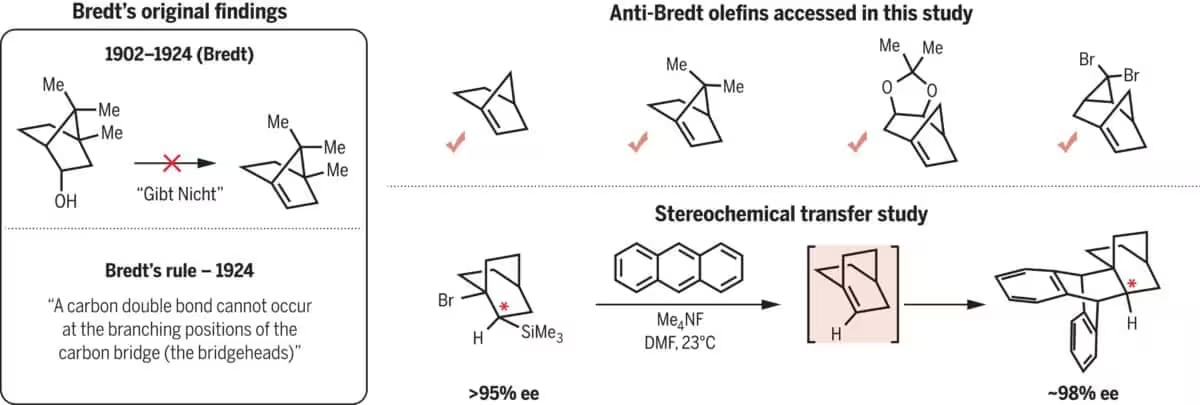
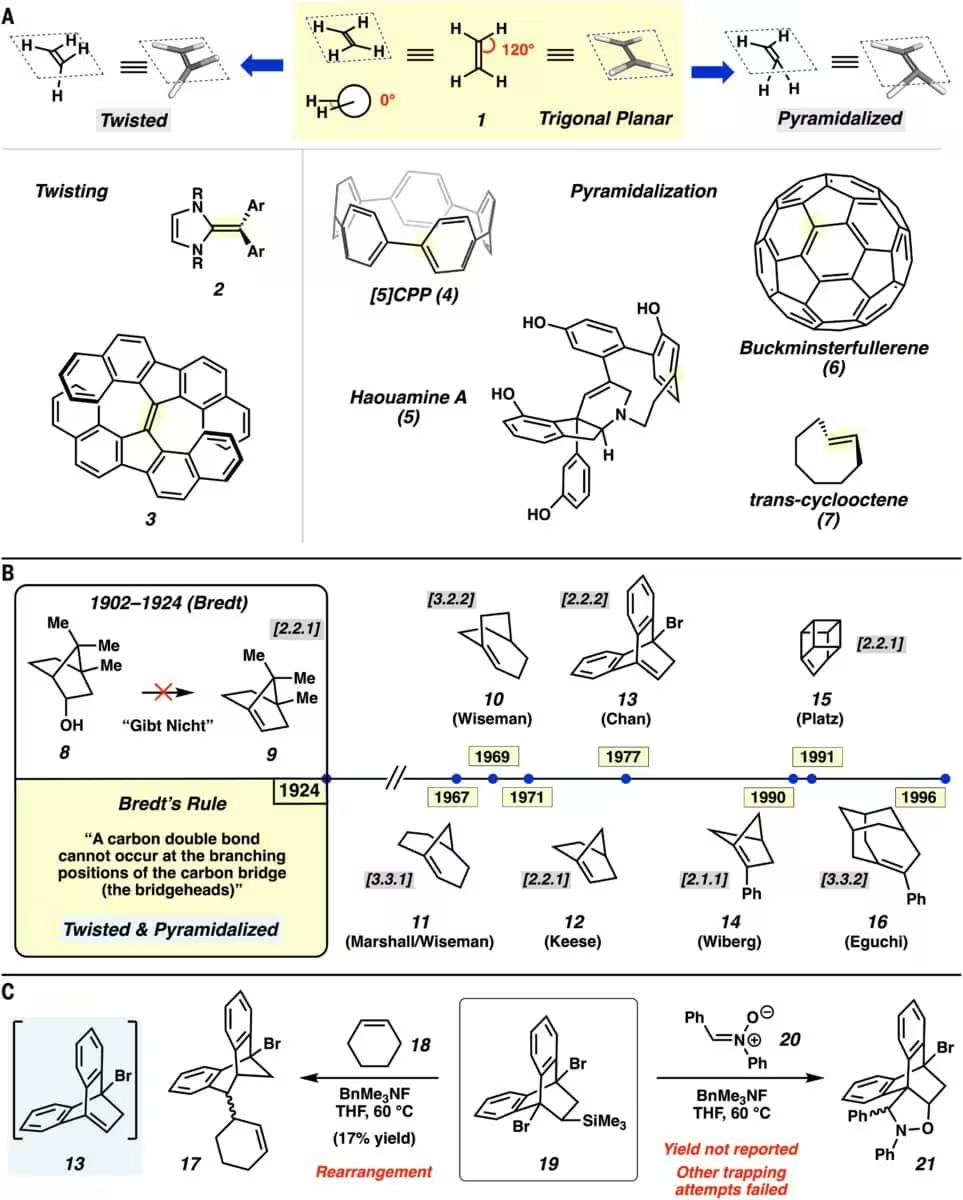
For more than a century, organic chemists have operated under a rigid constraint known as Bredt’s Rule. The principle suggests a fundamental impossibility: the formation of a carbon-carbon double bond at the bridgehead position of a small, bridged ring system. Because such structures force the double bond into a highly distorted, non-planar geometry, generations of students have been taught that these molecules are essentially forbidden by the laws of chemistry.
New research from a team at UCLA, published in the journal Science, has effectively dismantled this long-standing assumption. By shifting the focus from isolation to reaction management, the researchers have proven that these supposedly impossible “anti-Bredt olefins” (ABOs) can indeed be generated and successfully utilized in chemical synthesis.
Challenging the Geometry of Strained Bonds
The core of the issue lies in the preferred shape of carbon-carbon double bonds, which typically favor a flat, planar arrangement. In small, rigid ring systems, the bridgehead atoms are locked into positions that make this planar geometry difficult, if not impossible, to achieve. When a double bond is forced into such a site, it must undergo significant twisting and bending.
Named after German chemist Julius Bredt, whose early 20th-century work on camphor defined these structural limitations, the rule functioned for decades as a practical shorthand. It allowed researchers to dismiss potential target molecules as synthetic dead ends without ever attempting to build them. However, the UCLA team suspected that the instability of these compounds was being conflated with total impossibility.
Capturing Transient Molecules
Rather than attempting to store these volatile intermediates, the UCLA researchers developed a strategy to catch them in the act. They used specific precursor molecules that, when triggered by a fluoride source, underwent an elimination reaction to form the strained double bond. By immediately introducing a trapping agent into the reaction mixture, the team was able to capture the intermediates before they could decompose.
The experiment successfully demonstrated the formation of strained intermediates in several ring systems, including [3.2.1], [2.2.2], and the highly strained [2.2.1] structures. Through cycloaddition reactions, these intermediates were transformed into stable, identifiable compounds, providing chemical evidence that the anti-Bredt structures were not just theoretical constructs, but functional, if fleeting, tools for synthesis.
Strain Versus Impossibility
To confirm their findings, the researchers employed density functional theory to calculate the energy state of the [2.2.1] anti-Bredt olefin. The analysis revealed a significant olefin strain energy of approximately 54.2 kcal/mol. Despite this massive geometric deformation, the C-C bond distance of 1.35 Å confirmed that the molecule retained its double-bond characteristics.
This data confirms that while these structures are under immense physical pressure, that strain does not automatically render them non-existent. The successful synthesis of these intermediates provides a new pathway to access complex molecular architectures that were previously considered outside the reach of conventional chemistry.
![Structural Analysis Of [2.2.1] Abo 12 And Synthesis Of A Precursor For Abo Generation](https://www.bioscience.com.pk/images/5be7916140.avif)
Expanding the Horizons of Medicinal Chemistry
The ability to create these strained, 3D frameworks has significant implications for fields like drug discovery, where the push for increasingly complex molecular shapes is accelerating. Lead researcher Neil Garg and his team suggest that by treating such rules as guidelines rather than absolute barriers, chemists can unlock a wider array of testable compounds.
While the study does not suggest that anti-Bredt compounds are themselves pharmaceutical products, it establishes a vital methodological framework for future exploration. As Garg noted, “We shouldn’t have rules like this — or if we have them, they should only exist with the constant reminder that they’re guidelines, not rules.” With this discovery, the boundaries of organic chemistry have been pushed significantly further, marking the end of a century-long misunderstanding.
This article has been fact checked for accuracy, with information verified against reputable sources. Learn more about us and our editorial process.
Last reviewed on .
Article history
- Latest version
Reference(s)
- Ober, Holly. “UCLA chemists just broke a 100-year-old rule and say it’s time to rewrite the textbooks.”, October 31, 2024 UCLA <https://newsroom.ucla.edu/releases/chemists-broke-100-year-old-rule-time-to-rewrite-textbooks>.
- projects, Contributors. “German organic chemist (1855–1937).”, March 14, 2008 Wikimedia Foundation, Inc. <https://en.wikipedia.org/wiki/Julius_Bredt>.
- “Garg, Neil K. – UCLA.” <https://www.chemistry.ucla.edu/directory/garg-neil-k/>.
Cite this page:
- Posted by Bilal Abbasi