Blue Origin Unveils Massive 20 Meter Power Tower To Electrify The Moon South Pole
Blue Origin has unveiled a 20-meter lunar solar tower designed to provide over 10 kilowatts of power for future operations near the Moon’s south pole.
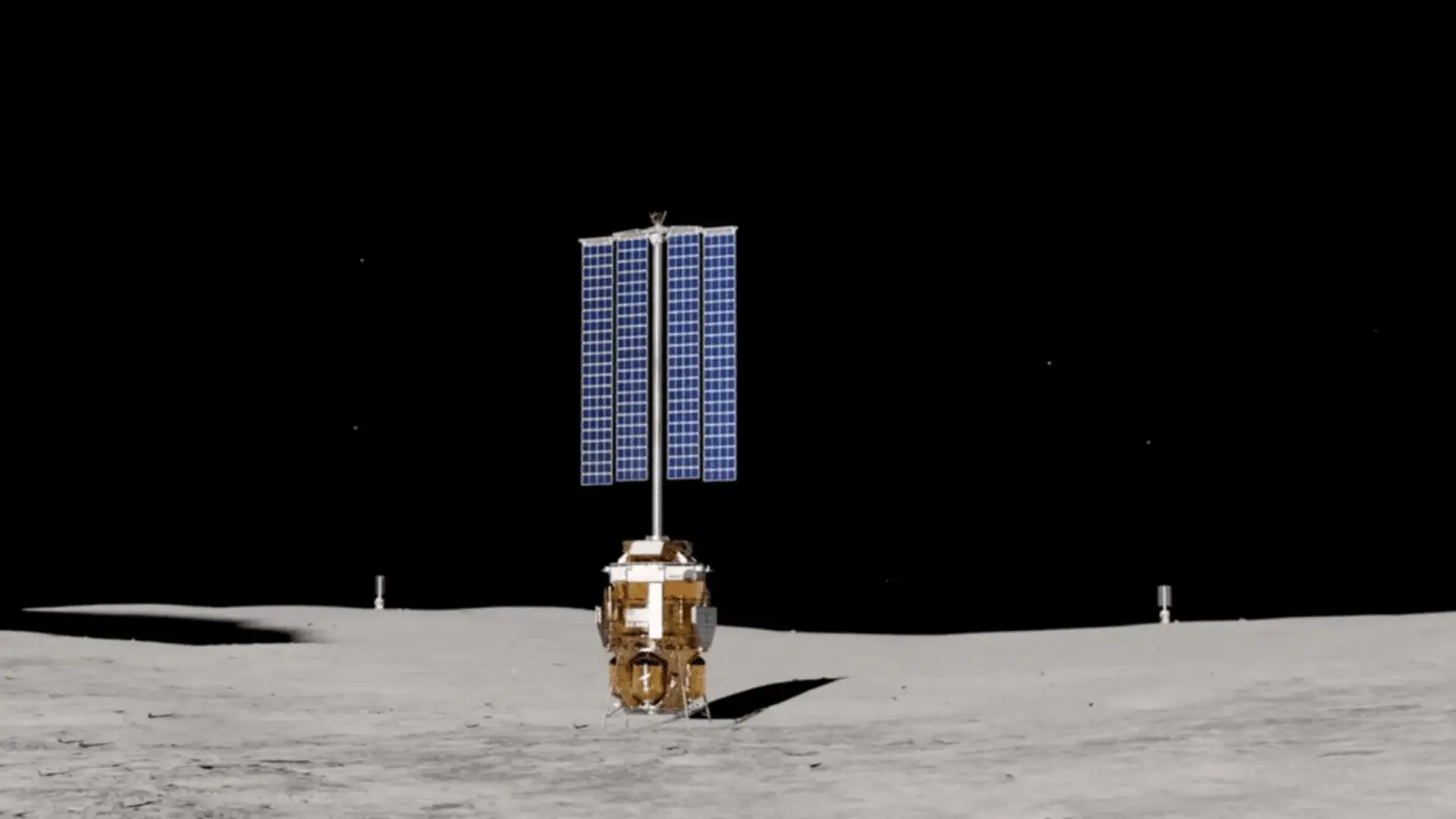
Blue Origin has unveiled plans for a towering lunar solar array, a 20-meter structure designed to deliver more than 10 kilowatts of power to the lunar south pole. The concept marks a shift in space exploration strategy, moving away from self-contained landers toward a model where permanent energy infrastructure becomes the foundation for sustained lunar operations.
Vertical Infrastructure for the Lunar South Pole
The proposed system, dubbed the Power Tower, is engineered as a deployable solar array that rises approximately 65 feet above the lunar surface. By elevating its photovoltaic panels, the design aims to overcome a persistent challenge in lunar exploration: the sun’s perpetually low angle near the poles. In this region, even minor topographical features like crater rims or hills can cast long shadows, potentially cutting off power to equipment situated on the ground. By reaching higher, the array maintains a better line of sight to the sun, ensuring more consistent energy collection.
The company shared details of the concept in a recent announcement, emphasizing that the system is intended to function as a utility for a broader moon base rather than a singular power source for a lone craft. By providing over 10 kilowatts, the tower could support a suite of equipment, from scientific sensors and communication hubs to thermal management systems and mobile rovers.
Power changes what’s possible on the lunar surface.
— Blue Origin (@blueorigin) September 25, 2026
Our Power Tower is a 20-meter-tall, vertically deployed solar array system designed to provide more than 10 kilowatts of power for Moon Base operations at the lunar South Pole. Its modular architecture will support future… pic.twitter.com/I1BwBnxKAv
Engineering Power in a Harsh Environment
Providing reliable electricity is one of the most significant hurdles for long-term lunar missions. While solar energy is highly efficient because it eliminates the need to transport heavy fuel, the environment is unforgiving. Unlike on Earth, where atmospheric and environmental factors dominate engineering, lunar hardware must contend with extreme thermal fluctuations, persistent dust, and the logistical difficulty of deploying complex structures autonomously after surviving the rigors of launch and landing.
The Power Tower addresses these constraints through a modular, collapsible design that can be transported compactly and extended only once it has reached the surface. Because the Moon lacks an atmosphere, the structure does not need to account for wind loads, allowing for a slender, towering design. However, engineers must still ensure the tower remains stable on uneven, rocky terrain without the benefit of nearby human maintenance teams.
Building a Shared Lunar Power Grid
The broader vision behind the Power Tower is the creation of a distributed energy network. Historically, space missions have functioned like isolated islands, with each rover or lander carrying its own independent battery and solar systems. As agencies look toward establishing a permanent human presence, this approach becomes inefficient.
A centralized, modular power hub would allow different mission assets—such as habitats and resource-processing units—to tap into a shared electrical supply. This shift in architecture offers mission planners greater flexibility, as it detaches the source of power from the location of the equipment. If the infrastructure is scalable, future missions can simply arrive and plug into an existing grid, effectively treating power as a communal utility rather than a mission-specific burden.
Scaling Up for Human Exploration
A power capacity exceeding 10 kilowatts represents a significant jump in capabilities. While small robotic probes can function on a fraction of that, the demands of human-tended habitats, life support, and high-energy scientific equipment require a robust and continuous supply of electricity. The Power Tower acts as a proof-of-concept for this scalability, suggesting that base infrastructure can be built incrementally, mission by mission.
By designing for modular expansion, Blue Origin is aiming to solve the problem of obsolescence in space hardware. Rather than replacing an entire station when energy needs increase, future lunar planners could theoretically integrate additional Power Tower units or distribution nodes into the existing network. This approach to energy management is likely to be a critical component in moving from short-term expeditions to a sustainable, long-term presence on the Moon.
This article has been fact checked for accuracy, with information verified against reputable sources. Learn more about us and our editorial process.
Last reviewed on .
Article history
- Latest version
Reference(s)
- “https://twitter.com/blueorigin/status/2103523065011302765/video/1.” <https://t.co/I1BwBnxKAv>.
Cite this page:
- Posted by Zara Tariq