AI Just Deciphered a 108 Year Old WWI German Code and Found an Unexplainable Mystery
An AI has finally cracked a 108-year-old coded message sent by German officers in 1918, revealing surprising details that align with historical records.
An enigmatic German military transmission, which has remained locked in a web of complexity for over a century, has finally been decrypted. The message, intercepted during the final days of World War I, warned of an impending arrival of an English cruiser at Sevastopol. Its contents have now been brought to light by OpenAI’s GPT-6 Astra, an advanced model that has demonstrated an uncanny ability to navigate both intricate data structures and the logic-heavy environments of modern gaming.
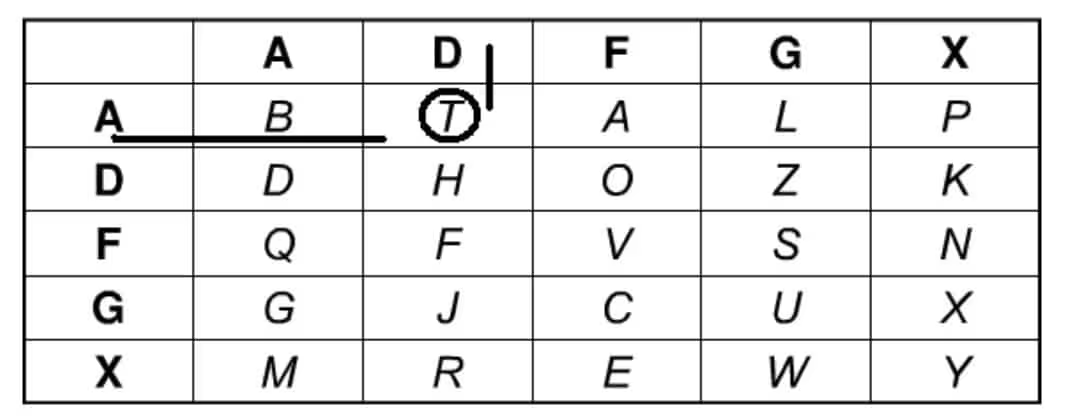
The transmission utilized the ADFGVX cipher, a sophisticated fractional transposition system employed by the German military during the Great War. This method relies on a 6x6 grid containing the alphabet and digits, where each character is represented by a pair of letters corresponding to its grid coordinates. Decrypting such a message usually requires immense computational brute force or a deep understanding of the specific keyword used to organize the grid.
Decoding a Century-Old Military Secret
Software developer Prinz leveraged the capabilities of GPT-6 Astra to solve the puzzle, providing the model with the keyword TRUPPENVERSCHIEBUNG—a term meaning “troop redeployment.” While the choice of keyword seems mundane given the message’s content, such labels were often chosen arbitrarily for administrative convenience. According to reporting from Popular Mechanics, the ease with which Astra parsed these coordinates suggests a significant leap in machine reasoning.
The plaintext reveals a report from the field indicating that an English cruiser had reached the Crimean port of Sevastopol. Furthermore, it warned that an Allied squadron was scheduled to follow on the 26th. This information aligns remarkably well with the historical logs of the H.M.S. Canterbury, which confirm the vessel’s transit from Constantinople to Sevastopol, arriving on November 24, 1918, followed by the Allied squadron on the 26th.
An Anomalous Discrepancy
Despite the successful decryption, the AI identified an inexplicable chronological mismatch. Astra determined that the encryption key used for this specific transmission was not officially placed into service until December 9, 1918. However, the message itself is dated November 27, 1918—a full twelve days before the key was supposedly active. Adding to the mystery is a peculiar question mark preceding a date reference in the text, leaving researchers to speculate whether it represents a critical typo, a forgotten code variation, or a deliberate signal.
While the historical significance of the message itself may be limited, the successful application of AI to such a long-standing cryptographic problem highlights the evolving potential of large language models. Prinz noted that the process serves as a compelling demonstration of the software’s analytical range, noting that this is likely the first time the content of this specific intercepted transmission has been fully understood in the 108 years since it was sent.
This article has been fact checked for accuracy, with information verified against reputable sources. Learn more about us and our editorial process.
Last reviewed on .
Article history
- Latest version
Reference(s)
- <https://crypto.interactive-maths.com/adfgvx-cipher.html>.
- Rayne, Elizabeth. “Nobody Could Decode This 108-Year-Old German Military Cipher. AI Just Did..”, October 1, 2026 Popular Mechanics <https://www.popularmechanics.com/science/a73939196/ai-wwi-german-code/>.
Cite this page:
- Posted by Zara Tariq