The 1960 Scientific Paper That Predicted A Mathematical Doomsday For November 2026
In 1960, researchers pinpointed a specific date in 2026 for Doomsday. It wasn’t due to war or disease, but a strange mathematical prediction of human growth.

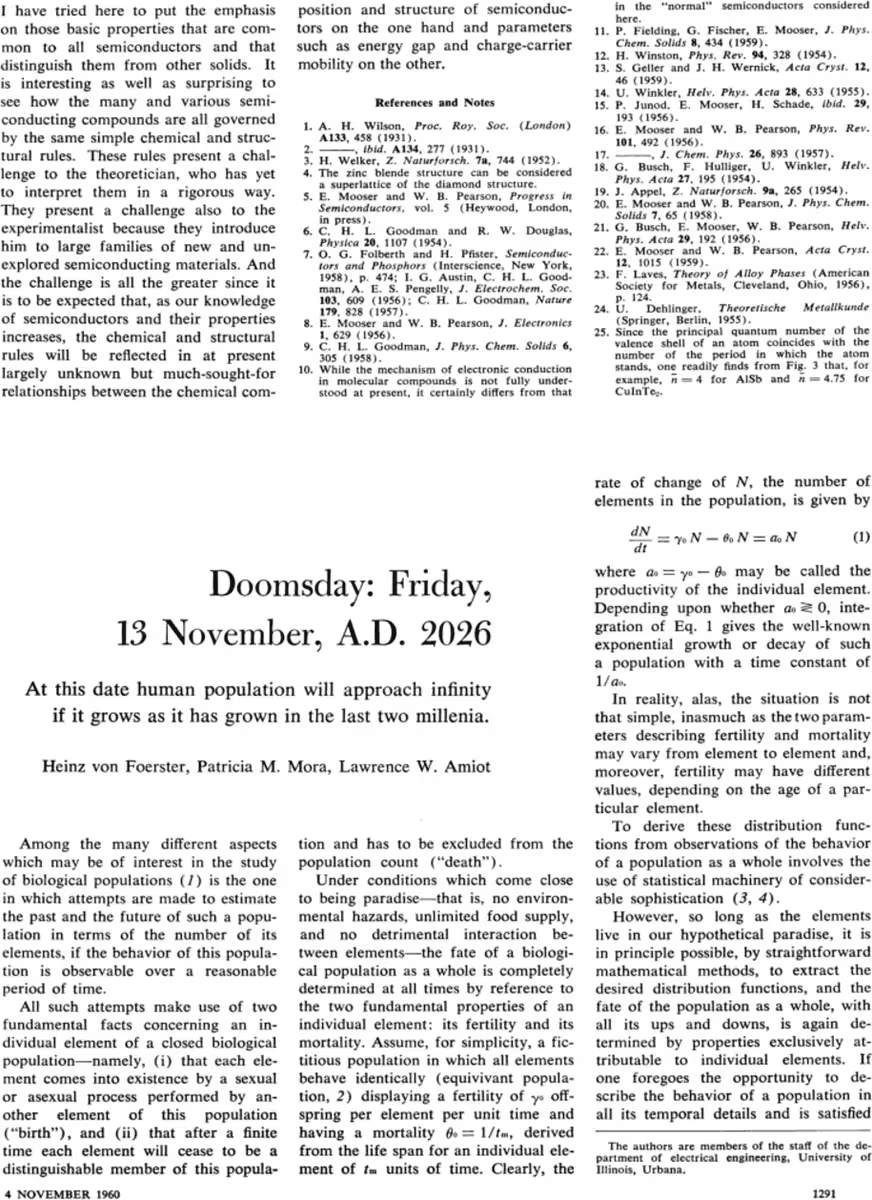
On November 4, 1960, the pages of the journal Science featured a mathematical projection that defied conventional demographic wisdom. Tucked beneath an analysis of semiconductors, a provocative headline announced: “Doomsday: Friday, 13 November, A.D. 2026.”
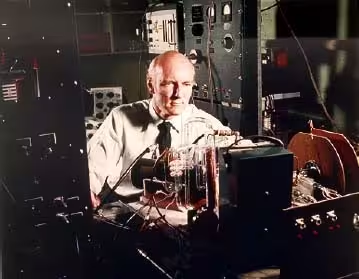
The study was not the work of population experts. It originated from the University of Illinois, authored by Heinz von Foerster—a physicist who had recently established the Biological Computer Laboratory—alongside Patricia M. Mora and Lawrence W. Amiot. Rather than forecasting the collapse of society through war, disease, or cosmic disaster, the trio focused on a simple, singular metric: the trajectory of human population growth.
By fitting a curve to 24 independent historical population estimates spanning from the time of Christ through the late 1950s, the researchers observed a trend that refused to plateau. Their calculations suggested that the population would approach infinity at a specific mathematical singularity, which they pinned to November 13, 2026, with a margin of error of about five and a half years.
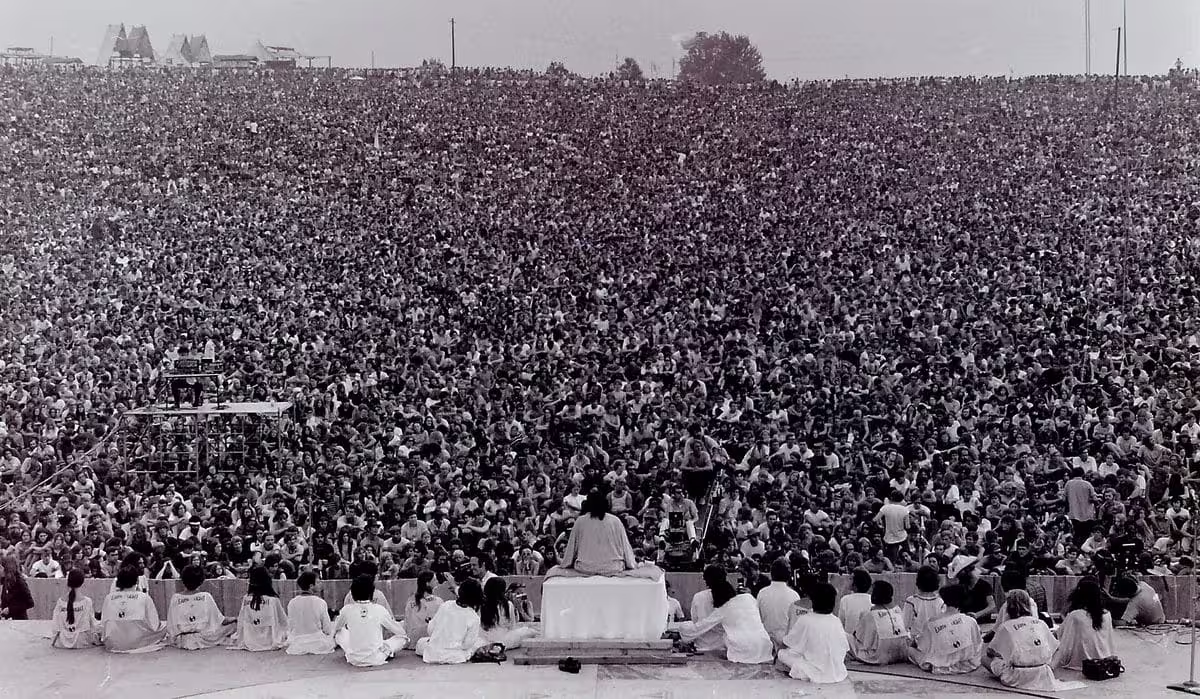
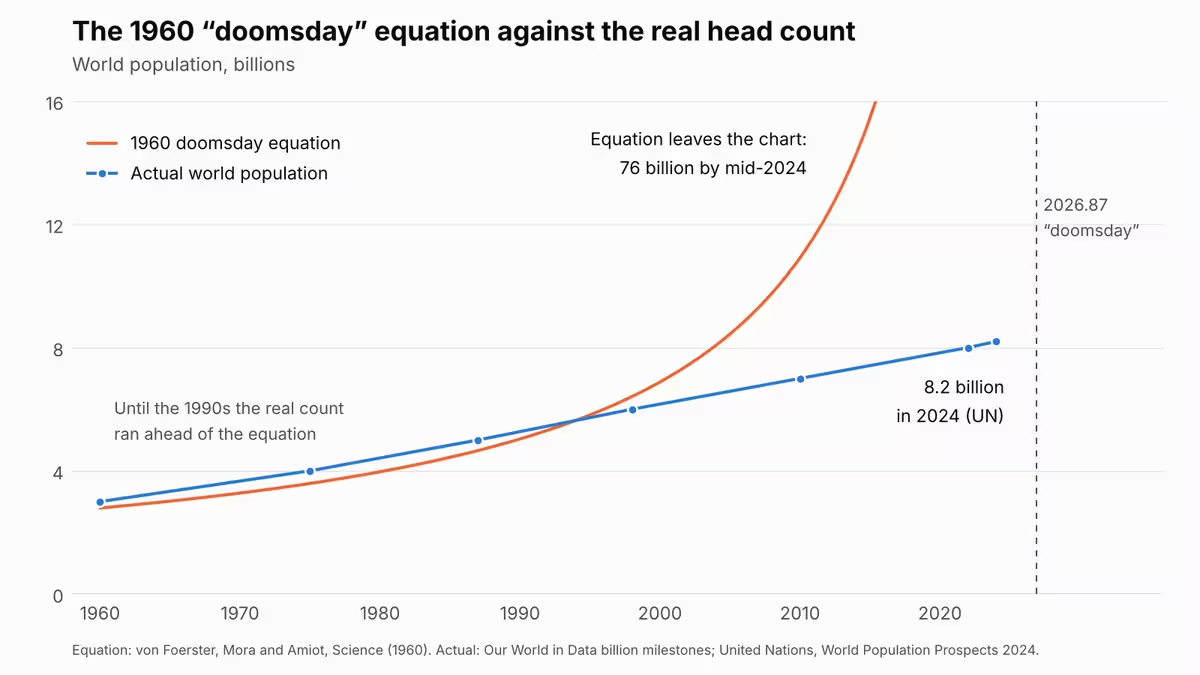
The authors argued that humanity would not perish due to a lack of resources. Instead, they posited that technological advancement would continue to sustain food production, leading to a different fate: “our great-great-grandchildren will not starve to death. They will be squeezed to death.” As the year 2026 approaches, the paper has resurfaced in public discourse, though the reality of the 21st century diverges sharply from their forecast. While the 1960 formula predicts a global population of roughly 76 billion by mid-2024, United Nations data currently places the figure at approximately 8.2 billion.
Challenging the Models of Growth
Most mid-century population models relied on biological observations, such as the behavior of bacteria in a petri dish or fruit flies in a bottle, where resource competition forces a population to reach a ceiling. Von Foerster and his colleagues argued that humans operate differently. They suggested that because humans communicate and form cooperative coalitions, we are uniquely capable of overcoming environmental hurdles and enhancing our survival conditions, causing growth to accelerate rather than stall.
Their equation, which roughly equates the global population to 179 billion divided by the number of years remaining until the predicted date, implies that as time nears the “doomsday” mark, the population growth rate should skyrocket. The authors labeled this point of infinite growth as the moment the “clever population annihilates itself.”
While the mathematical premise was treated as serious research—including a formal proposal for a “peoplo-stat” to cap birth rates—the authors likely included the specific calendar date as a playful nod, as November 13 happened to be von Foerster’s birthday. Furthermore, projecting the curve backward to a single “Adam” resulted in a timeline of 200 billion years, far exceeding the age of the universe as understood at the time.
The Divergence of Reality
The academic community was quick to respond, with many critics questioning the validity of applying such a simple mathematical model to complex social phenomena. IFLScience and other observers noted that the work sparked significant skepticism from the outset. For a few decades, however, the growth numbers appeared to track closely with the formula. Stuart Umpleby, an academic at George Washington University who monitored the equation for years, noted that for several decades, real-world population numbers ran slightly ahead of the curve.
The critical flaw in the projection was the assumption that past growth rates would remain constant. Data from Our World in Data shows that global population growth peaked in 1963 at 2.3 percent and has steadily declined to 0.9 percent as of 2023. A 2014 study from the Universidad Autónoma de Madrid highlighted that while UN population counts aligned with the “doomsday” curve through the 1990s, the trajectory shifted dramatically thereafter.
Current United Nations projections suggest a very different future: a global population that is likely to peak at approximately 10.3 billion in the mid-2080s, followed by a gradual decline. With fertility rates falling below replacement levels in more than half of the world’s nations, the hyperbolic growth predicted in 1960 appears increasingly like a relic of a different demographic era.
This article has been fact checked for accuracy, with information verified against reputable sources. Learn more about us and our editorial process.
Last reviewed on .
Article history
- Latest version
Reference(s)
- <https://www.iflscience.com/an-old-paper-really-did-suggest-a-mathematical-doomsday-on-13-november-2026-but-theres-no-need-to-worry-84777>.
- Ritchie, Hannah. “Population Growth.”, July 11, 2023 Our World in Data <https://ourworldindata.org/population-growth>.
- “World%20Population%20Declline %20Gonzalo EAWPS 2014.” <https://repositorio.uam.es/bitstream/handle/10486/662532/World%20Population%20Declline_%20Gonzalo_EAWPS_2014.pdf>.
- Nations, United. “UN projects world population to peak within this century | United Nations.” United Nations <https://www.un.org/en/UN-projects-world-population-to-peak-within-this-century>.
Cite this page:
- Posted by Zara Tariq