New Study Reveals the Solar System May Collapse Sooner Than We Thought
New simulations suggest the solar system’s giant planets could descend into orbital chaos far sooner after the Sun’s death than previously predicted.
The long-term future of our solar system is likely to be far more volatile than previously imagined. A new study published in The Astrophysical Journal Letters indicates that the orbital stability of the outer planets—Jupiter, Saturn, Uranus, and Neptune—could collapse just one billion years after the Sun completes its final transition into a white dwarf. This finding significantly shortens earlier estimates, which had suggested these massive worlds might maintain their orderly configuration for as long as a quintillion years.
Rethinking the Solar System’s Final Act
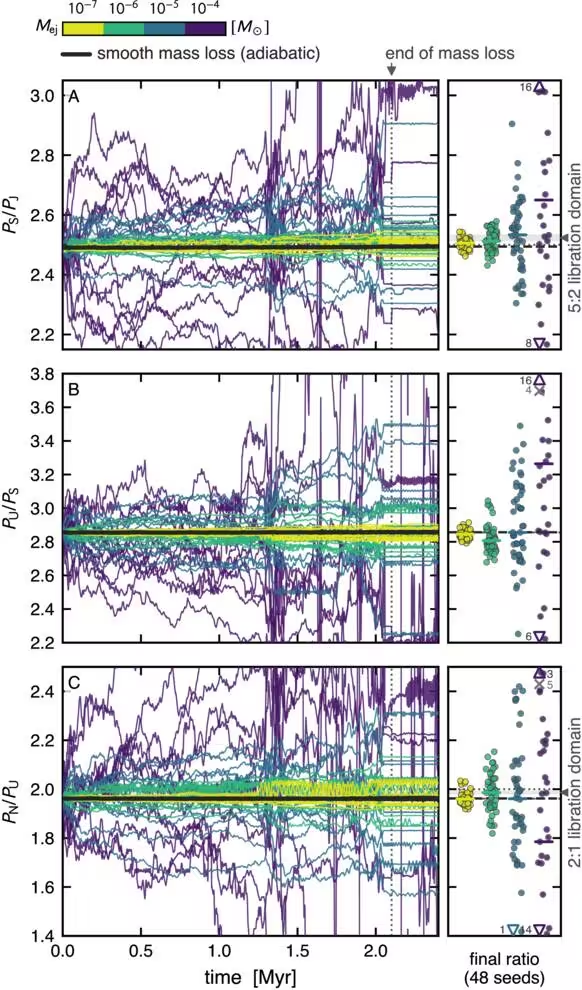
For generations, astrophysical models operated on the assumption that as the Sun dies, it would lose mass in a smooth, predictable manner. Under this framework, the giant planets would simply drift into wider, stable orbits as the gravitational tether of their host star gradually relaxed. However, the new research suggests this perspective may be overly optimistic. By accounting for “stochastic kicks”—random, episodic bursts of mass loss during the Sun’s final stages—researchers have identified a mechanism that could introduce chaos into the system much sooner than previously anticipated.
High-Resolution Simulations Reveal Hidden Instability
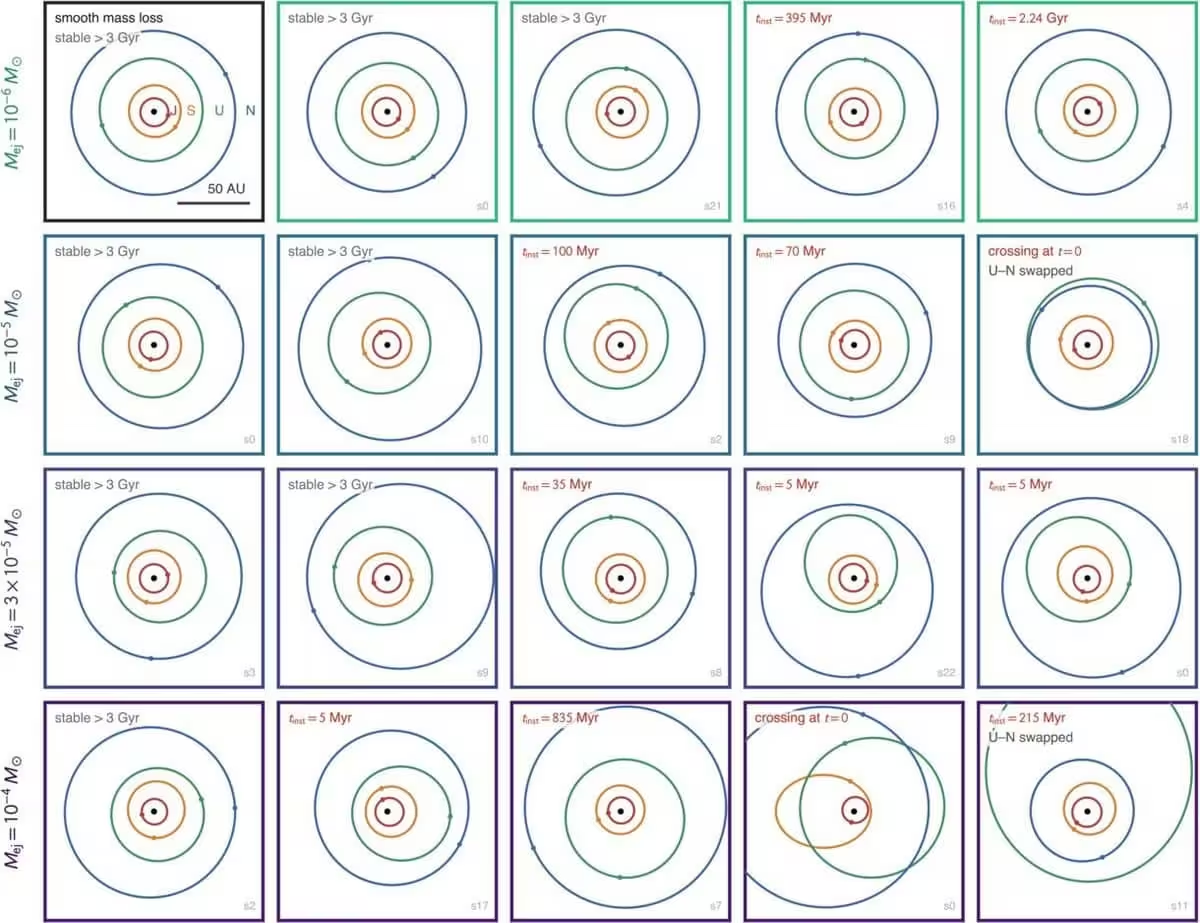
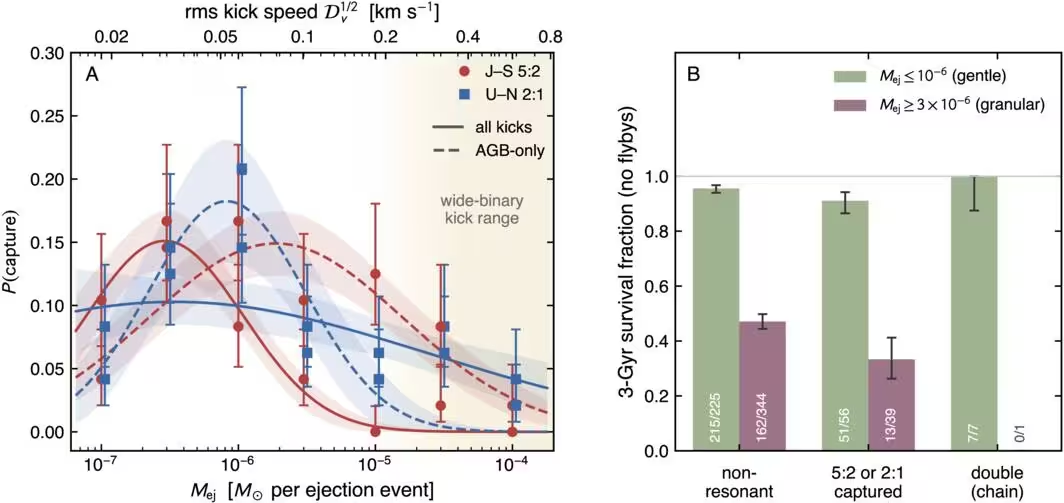
To test this hypothesis, a team at the California Institute of Technology employed high-performance supercomputers to conduct hundreds of complex N-body simulations. These models tracked the gravitational interplay between the outer planets while subjecting the Sun to erratic, non-uniform mass loss. While individual gravitational shifts appear negligible, the simulations demonstrated that these small, repeated perturbations compound over time, eventually driving the planetary system into a state of dynamical instability.
The study highlights that the long-term survival of a planetary system is not merely a product of its current orbital architecture, but is highly sensitive to the specific, violent history of its host star’s decline. As the Sun transitions through its red giant phase and finally becomes a white dwarf, the shifting gravitational landscape forces the giant planets to adjust, creating a window of vulnerability where orbital resonance can trigger chaotic scattering.
The Eventual Breakup of the Outer Solar System
This timeline remains far removed from the immediate future. The Sun is currently 4.57 billion years old and is projected to continue its stable main-sequence life for another five billion years. When the Sun eventually exhausts its nuclear fuel, it will expand, likely consuming Mercury, Venus, and Earth. The outer planets will persist, but they will be operating in a solar system fundamentally altered by the Sun’s reduced mass and volatile behavior.
Previous theories suggested that external cosmic events—such as the gravitational tug of passing stars—would serve as the primary catalyst for dismantling the outer solar system, but only after tens of billions of years. The latest findings suggest that the solar system may carry the seeds of its own destruction, with its internal architecture failing as a direct consequence of the Sun’s final evolution. This implies that the era of a recognizable, structured outer solar system is significantly more finite than once believed, ending with the chaotic scattering of the giant planets rather than a slow, indefinite fade.
This article has been fact checked for accuracy, with information verified against reputable sources. Learn more about us and our editorial process.
Last reviewed on .
Article history
- Latest version
Reference(s)
- Batygin, Konstantin., et al. “Terminal Instability of the Solar System Triggered by Stochastic Solar Mass Loss.” The Astrophysical Journal Letters, vol. 1009, no. 2, September 21, 2026, pp. L22 American Astronomical Society, doi: 10.3847/2041-8213/aea290. <https://iopscience.iop.org/article/10.3847/2041-8213/aea290>.
Cite this page:
- Posted by Farah Siddiqui