Mysterious Cosmic Bursts Vanish From View Leaving Astronomers Hunting For Early Universe Clues
Astronomers have detected a fleeting signal that traveled across an immense cosmic distance, offering new clues into the mysteries of deep space.
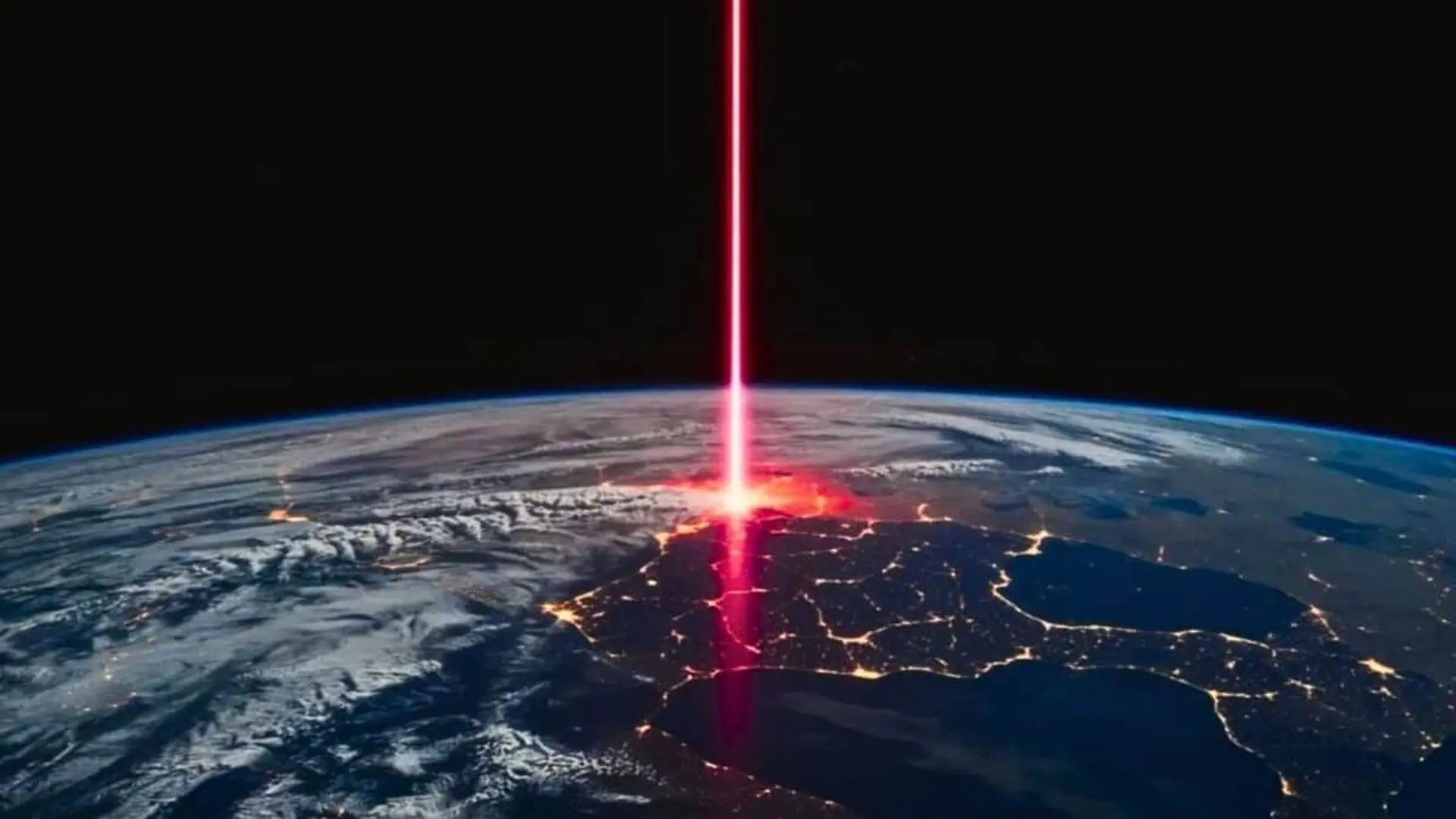
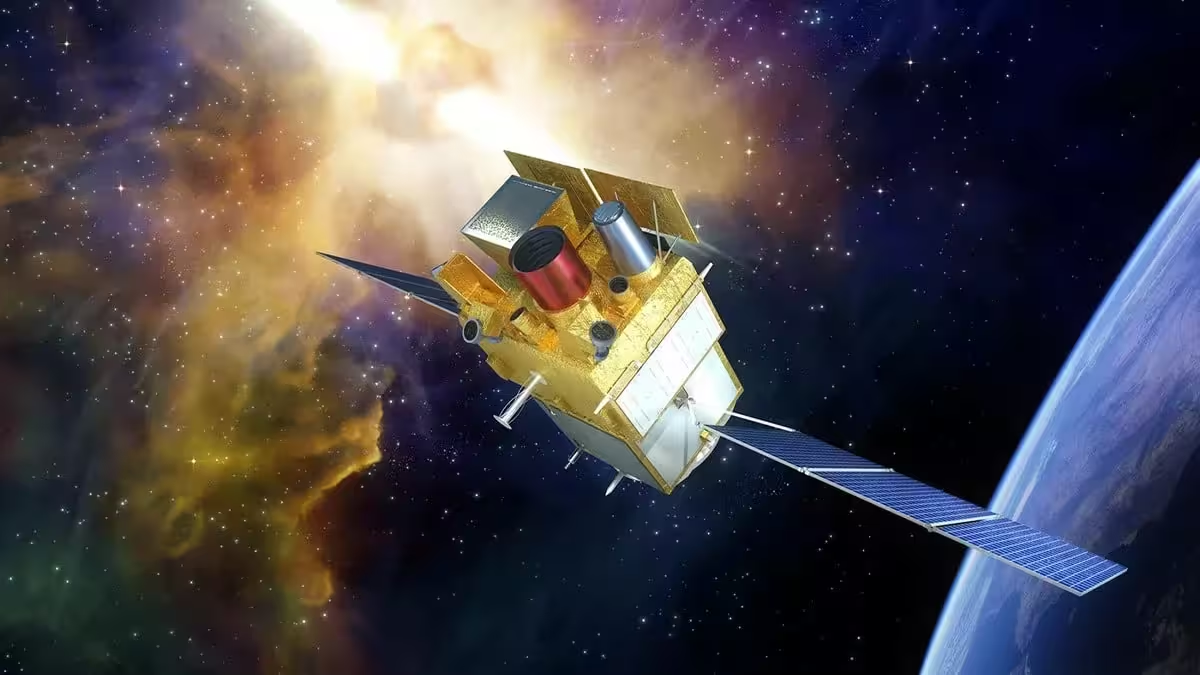
Astronomers tracking the French-Chinese SVOM satellite have identified a collection of eight mysterious gamma-ray bursts that are currently defying standard classification. While each event produced a distinct X-ray afterglow, the satellite’s visible-light telescope captured nothing at the source coordinates. Mission scientists suggest these elusive signals may represent some of the earliest stellar explosions to occur in the universe, dating back to its first billion years.
As of June 22, 2026, the SVOM mission has logged 318 gamma-ray bursts over two years of orbital operations. While the vast majority follow the expected patterns of high-energy cosmic flashes, these eight outliers present a significant observational gap. Because none of these candidates currently possess a precise redshift measurement, their true distance and physical origin remain open questions.
The Physics of Disappearing Light
The absence of visible light is a hallmark of extreme distance. As light travels from the far reaches of the cosmos, it must pass through vast clouds of neutral hydrogen, which effectively absorb ultraviolet and visible wavelengths. Simultaneously, the relentless expansion of space stretches these light waves toward the longer, near-infrared spectrum. This combination can render an otherwise violent explosion invisible to optical instruments while leaving it detectable in infrared bands, marking these objects as prime candidates for study in the early universe.
However, researchers caution that “dark” bursts do not automatically confirm ancient origins. Without definitive spectroscopic confirmation, these eight events remain intriguing possibilities rather than verified relics of the infant cosmos.
A Benchmark for Deep-Space Detection
The mission has already provided a masterclass in how to confirm such distant phenomena. On March 14, 2025, the satellite detected GRB 250314A, a 10-second blast characteristic of a massive star collapsing into a black hole. When these events produce relativistic jets aimed at our solar system, they can shine across the breadth of the universe, provided observers act quickly before the afterglow fades.
Following the X-ray detection by the Chinese-European Einstein Probe and NASA’s Swift observatory, the Nordic Optical Telescope identified the infrared signature. Subsequent analysis by the European Southern Observatory’s Very Large Telescope placed the event at a redshift of 7.3, indicating the explosion occurred when the universe was only 5 percent of its current age. According to findings published in Astronomy & Astrophysics, this ranks as the third most distant gamma-ray burst ever confirmed.
Expanding the Horizon of Cosmic Time
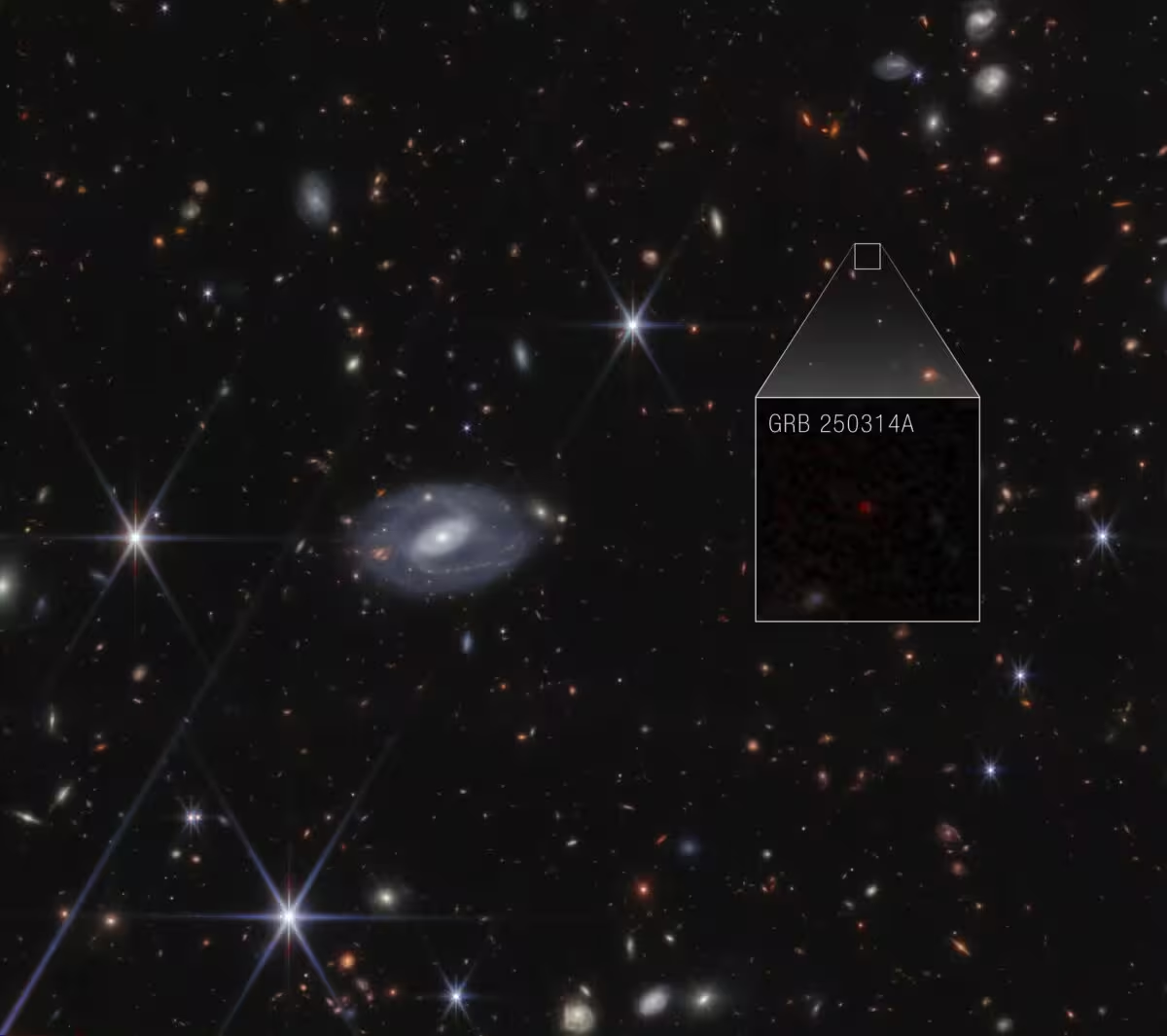
Cosmic expansion does more than shift colors; it warps time. Because of this, the light from these distant events appears to evolve in slow motion. When a team led by Andrew Levan at Radboud University turned the James Webb Space Telescope toward the location of GRB 250314A three and a half months later, they were able to catch the accompanying supernova at its peak brightness.
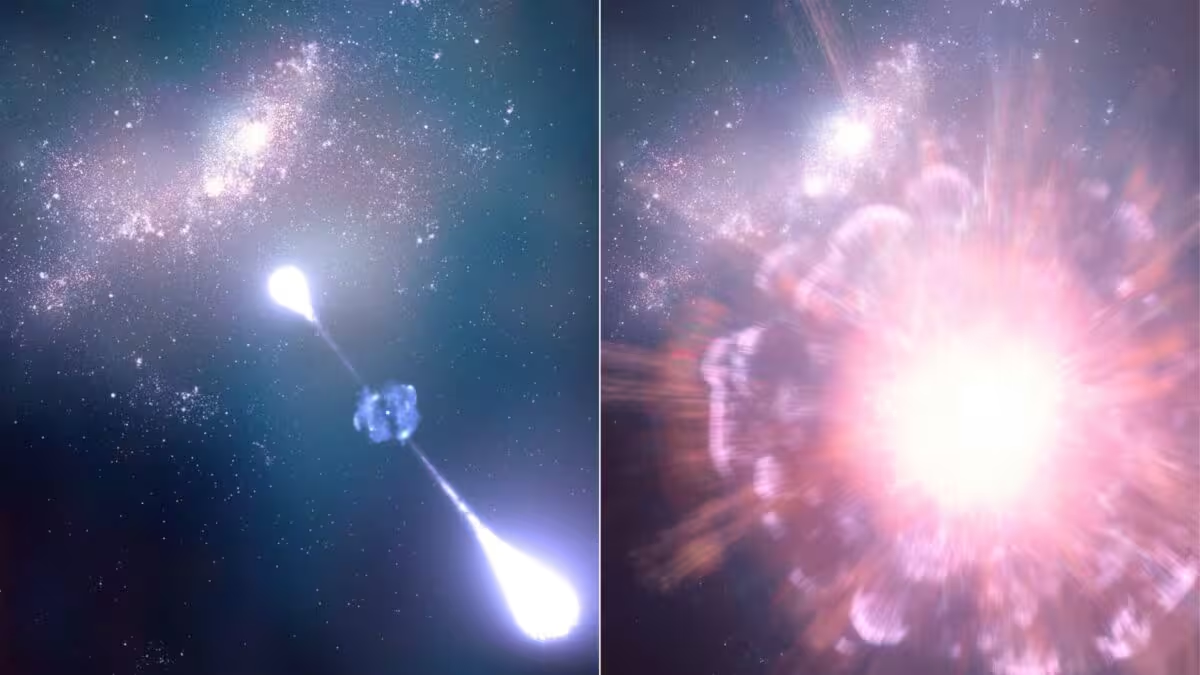
The resulting observations identified the earliest supernova ever detected, dating back to 730 million years after the Big Bang. Perhaps most surprising to researchers, such as University College Dublin’s Antonio Martin-Carrillo, was the striking similarity between this ancient cataclysm and modern stellar deaths. “Webb showed that this supernova looks exactly like modern supernovae,” noted Nial Tanvir of the University of Leicester, highlighting that the fundamental processes of star death appear to have remained consistent across cosmic history.
Racing Against the Fading Glow
The mission team is now focusing on optimizing rapid-response protocols. With the successful redshift measurement of GRB 250314A achieved within 17 hours, the goal is to drive that window even lower. Infrastructure upgrades, including the upcoming installation of the CAGIRE near-infrared camera on the Colibrí telescope, aim to bolster the global network’s ability to capture these fleeting signals.
While modeling studies from the Purple Mountain Observatory suggest that such high-redshift events are rare—potentially yielding fewer than six detections per year across current mission fleets—the eight mysterious bursts currently under investigation remain high-priority targets. Each one represents a potential window into the earliest chapter of the universe, waiting to be unlocked by the next generation of rapid-follow-up observations.
This article has been fact checked for accuracy, with information verified against reputable sources. Learn more about us and our editorial process.
Last reviewed on .
Article history
- Latest version
Reference(s)
- “Happy 2nd Anniversary, SVOM! – Svom.” <https://www.svom.eu/en/happy-2nd-anniversary-svom/>.
- Cordier, B.., et al. “SVOM GRB 250314A at z ≃ 7.3: An exploding star in the era of re-ionization.” Astronomy & Astrophysics, vol. 704, December 9, 2025, pp. L7 EDP Sciences, doi: 10.1051/0004-6361/202556580. <https://www.aanda.org/10.1051/0004-6361/202556580>.
Cite this page:
- Posted by Farah Siddiqui