Engineers Built a Tiny Jumping Robot That Could Change How We Explore the World
Engineers have developed DirectHop, a tiny, spring-less robot capable of precise, sequential jumps that could revolutionize low-cost, autonomous exploration.
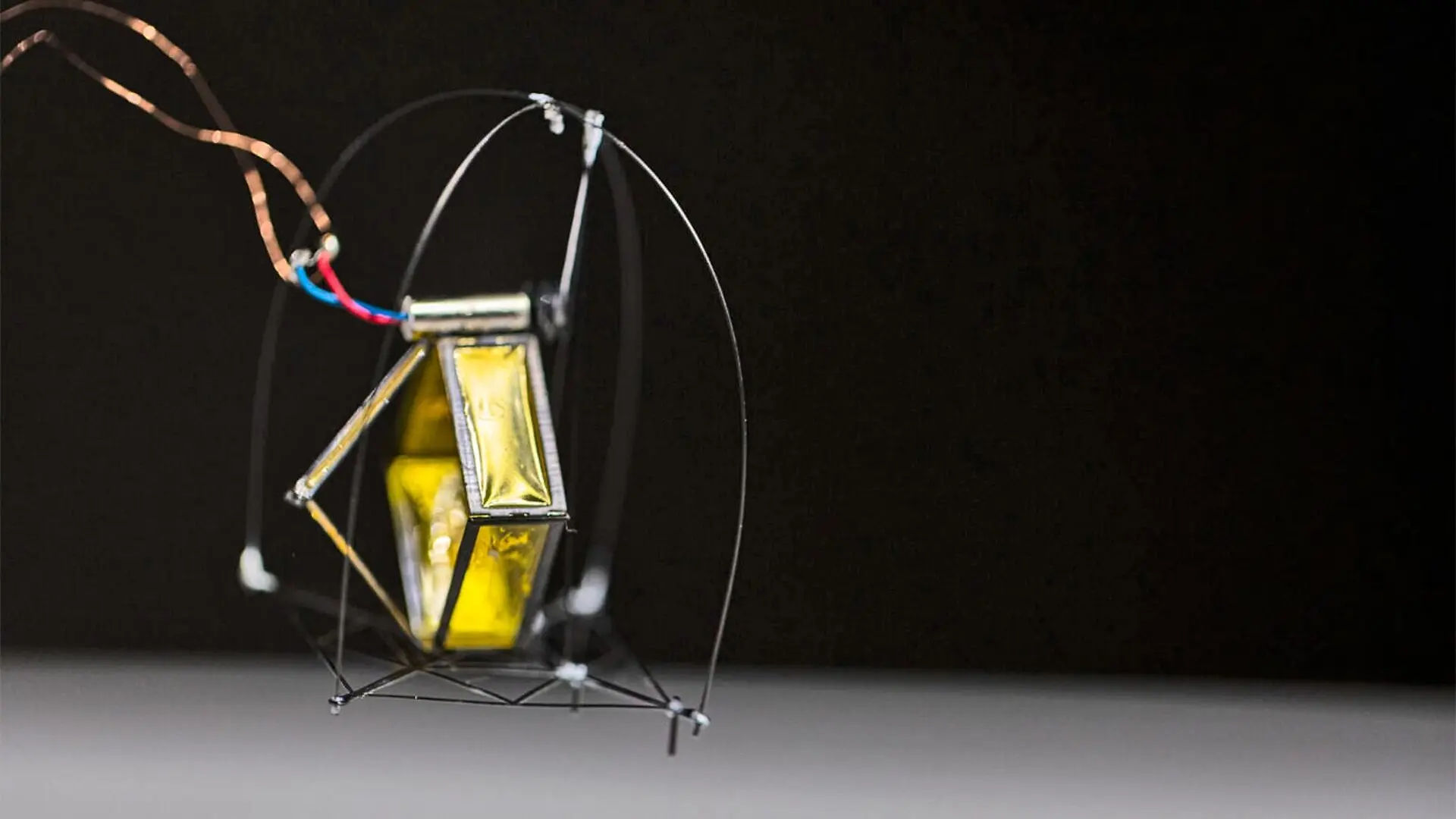
A new class of miniature robotics is aiming to outperform traditional flying drones in energy efficiency by mimicking the biological mechanics of jumping animals. Engineers at the University of Washington have unveiled DirectHop, a one-gram robot capable of precise, repeated jumps that allow it to scale obstacles like standard stair steps.
While aerial drones dominate the current market, they are forced to expend constant energy to remain airborne. In contrast, hopping locomotion—a method mastered by insects and amphibians—is significantly more efficient, as energy is only consumed during the active launch phase. This efficiency opens the door to cost-effective, large-scale deployments for tasks such as monitoring agricultural resources, detecting gas leaks in industrial infrastructure, or even performing extraterrestrial exploration.
Engineering a Jump Without Springs
Most existing hopping robots rely on spring-loaded mechanisms, a design inspired by the flea. While effective for distance, these systems typically function as binary, “all-or-nothing” devices that make it difficult to calibrate exact jump heights. They also involve complex, delicate parts that are challenging to manufacture at a sub-gram scale.
DirectHop bypasses these mechanical constraints by removing the spring entirely. Instead, the team utilized a small electric motor that drives the hop directly, functioning similarly to the muscle contractions of a frog. By modulating the electrical current supplied to the motor, researchers can control the force and, consequently, the height of each leap with centimeter-level precision.
The device operates by spooling a fishing line to pull itself up an integrated tower, extending three hinged legs to stabilize the movement. To address the challenge of landing, the designers incorporated a shell inspired by the box turtle. If the robot lands on its side, it can shift its center of gravity by reversing the motor, which allows it to right itself and reset for the next jump with a success rate of 90 percent.
Future Paths to Autonomy
The current prototype remains tethered for power and lacks independent navigation, but the research team is already working on the next generation of the platform. Plans for future iterations include the integration of onboard solar cells, batteries, and vibration motors to allow the robot to spin and steer. By incorporating miniature cameras and sensors, the engineers hope to enable fully autonomous stair climbing, where the robot analyzes an obstacle, calculates the required jump force, and executes the sequence without human intervention.
Beyond the technical capabilities, the researchers emphasize the potential for low-cost, high-volume production. Lead author Hanquan (John) Wang suggests that because the individual components are small and inexpensive, each robot could eventually be manufactured for approximately $10. This affordability could redefine how field missions are conducted.
“We could dispatch 100 or even 1,000 of these robots into the field,” Wang noted. “If some are lost or disabled, it’s not really a failure. The team of them can complete the task.”
The findings, which were supported by the National Science Foundation, were presented at the International Conference on Intelligent Robots and Systems. The full study can be accessed via the official conference paper.
This article has been fact checked for accuracy, with information verified against reputable sources. Learn more about us and our editorial process.
Last reviewed on .
Article history
- Latest version
Reference(s)
- “Wang Talwekar Fuller Directhop Iros2026.” <https://faculty.washington.edu/minster/files/wang_talwekar_fuller_directhop_iros2026.pdf?_gl=1*10ycnuw*_ga*MTA4NDc2NzMxMC4xNzg0MzAwMDg3*_ga_3T65WK0BM8*czE3OTA3OTUyNTIkbzkkZzEkdDE3OTA3OTUyNjEkajUxJGwwJGgw*_gcl_au*ODY3NTI1NTE1LjE3ODQzMDAwODYuLS4tLjE3ODQzMDAwODYuNjkzMzEzMTMyLjE3OTA3OTUyNTYuMTc5MDc5NTI2MQ..*_ga_JLHM9WH4JV*czE3OTA3OTUyNTIkbzI1NCRnMSR0MTc5MDc5NTI2MSRqNTEkbDAkaDA.>.
Cite this page:
- Posted by Asif Iqbal