Saturn’s Moon Enceladus May Be Doing The Hard Work In Our Search For Alien Life
Saturn’s moon Enceladus may hold the key to finding alien life, as its unique ocean chemistry could make biological signatures easier for probes to detect.
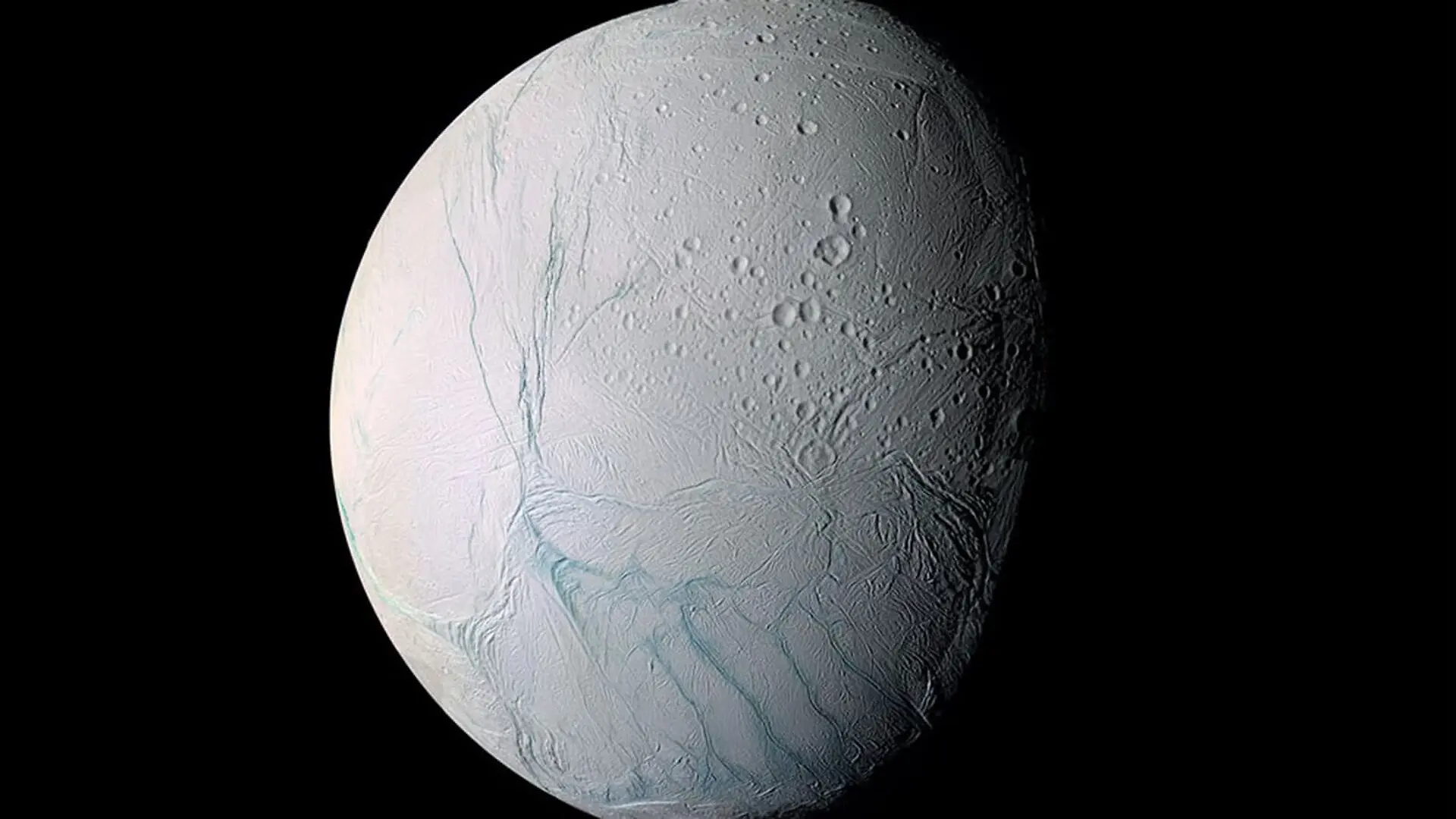
Saturn’s moon Enceladus has long been a primary target in the search for extraterrestrial life, thanks to the massive global ocean hidden beneath its icy shell. Now, new research suggests that this icy moon is not just a passive host for potential life, but an active participant in organizing the evidence scientists need to find it.
A study published in Science Advances reveals that the natural freezing process occurring within the moon’s vents acts as a sophisticated chemical separator. By concentrating various salts and organic compounds into individual ice grains, the moon effectively pre-packages samples that future spacecraft could analyze with unprecedented precision.
Natural Sample Preparation in Deep Space
The plumes erupting from the south pole of Enceladus have served as a natural laboratory for years, famously sampled by NASA’s Cassini spacecraft. As these plumes burst through cracks in the icy crust, they eject water vapor and frozen droplets into space, where they populate Saturn’s E ring. While Cassini provided a revolutionary look at these plumes, the new findings suggest the way we interpret those samples may need to shift.
By combining archival data from Cassini’s Cosmic Dust Analyzer with thermodynamic modeling and laboratory experiments, researchers discovered that ice grains are not necessarily uniform snapshots of the ocean. Instead, they are the products of a complex, multi-stage transition.
“We show that each grain is not necessarily a tiny scoop of the ocean,” explains Fabian Klenner, an assistant professor of planetary sciences at UC Riverside and coauthor of the study. “It is more of a fragment of a much larger ocean droplet in which freezing separated the salts before that droplet broke apart.”
How the Moon Processes Chemistry
The research team reconstructed this mechanism by simulating the journey of ocean spray as it rises through the moon’s icy vents. As droplets move upward, they undergo a slow cooling process that allows different salts—such as sodium chloride, potassium, and carbonates—to migrate and concentrate in specific regions within the droplet. As these droplets move through narrower passages at high speeds, collisions with the vent walls shatter them into smaller, compositionally distinct fragments.
This process is highly advantageous for future exploration. “Enceladus actually does a lot of the work for us in preparing samples for analysis that usually take a lot of effort in chemical labs on Earth,” says Frank Postberg of Freie Universität Berlin, who led the investigation. “The oceanic constituents are separated from each other and simultaneously concentrated into individual ice particles.”
Implications for Future Missions
The discovery that individual grains may be enriched with specific compounds means that future missions must prioritize high-resolution, individual particle analysis. If researchers aggregate too many grains into a single measurement, they risk washing out the subtle, concentrated chemical signatures that could indicate the presence of biological activity.
The researchers believe this same fractionation process might also explain why organic compounds appear to be elevated in only a small percentage of sampled ice grains. Because these molecules may be sequestered into specific, tiny fragments, the search for life becomes a game of precision targeting.
“Molecular signatures of life, if present, may be concentrated in only a few grains,” Klenner notes. “A future spacecraft has to find exactly those grains.”
As scientists look toward future missions, this study provides a new blueprint for how to hunt for biosignatures in the outer solar system. By focusing on the granular differences between ice particles rather than the average composition of the plumes, astronomers may be far more likely to identify the chemical fingerprints of life hidden in the frozen spray of Enceladus.
This article has been fact checked for accuracy, with information verified against reputable sources. Learn more about us and our editorial process.
Last reviewed on .
Article history
- Latest version
Reference(s)
- Postberg, Frank., et al. “Cassini CDA observes compositional segregation of Enceladus’ ice grains from slow freezing and fragmentation of oceanic spray.” Science Advances, vol. 12, no. 39, September 25, 2026 American Association for the Advancement of Science (AAAS), doi: 10.1126/sciadv.aee7256. <https://doi.org/10.1126/sciadv.aee7256>.
Cite this page:
- Posted by Karan Das