Scientists Use Quantum Computer to Simulate Matter Emerging From Pure Energy
Scientists have used a quantum computer to simulate a rare state of matter, unlocking new insights into physical processes once thought impossible to observe.

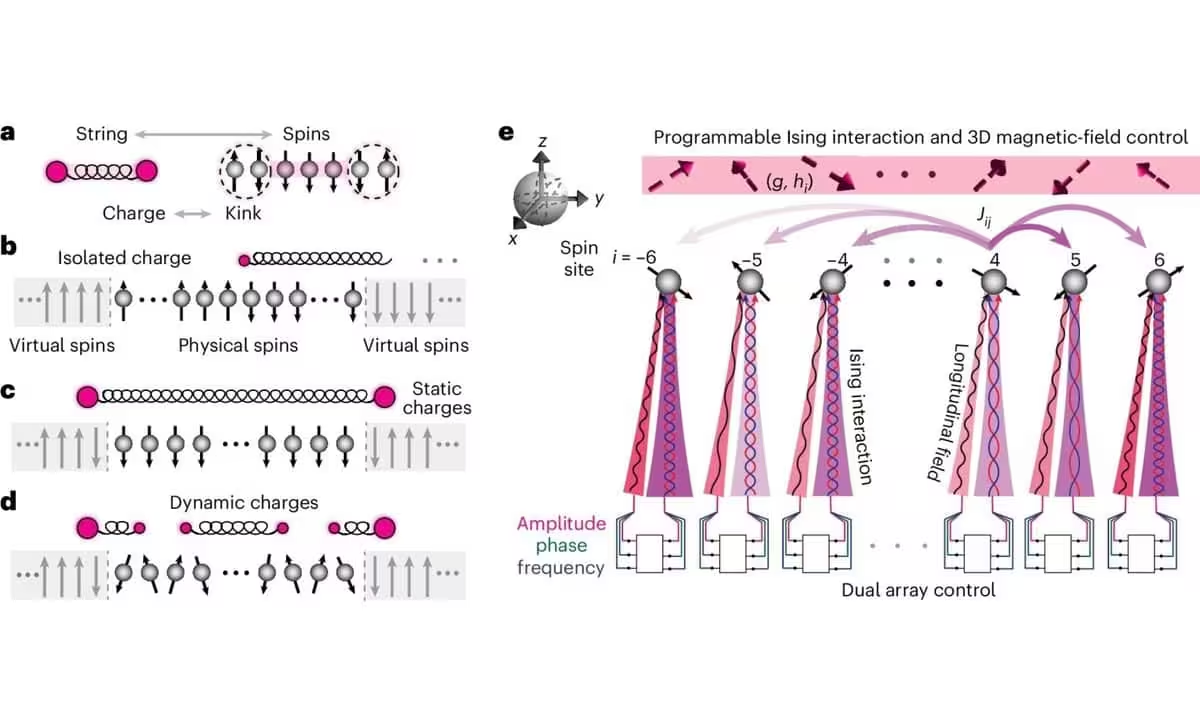
Researchers at the Duke Quantum Center have successfully utilized a trapped-ion quantum computer to model one of the most enigmatic processes in subatomic physics: the phenomenon of quark confinement and the subsequent “string-breaking” that occurs when these particles are pulled apart.
Quarks, which serve as the fundamental building blocks for protons and neutrons, occupy a unique position in the standard model of physics. Because they are never found in isolation, they are effectively “confined” within composite particles, existing only in groups such as triplets or pairs. Attempting to pull two quarks apart requires such immense energy that the system instead creates two new quarks, a process dictated by the strong nuclear force, which behaves much like an elastic string stretched to its breaking point.
Simulating Subatomic Dynamics in a Controlled Environment
Directly observing the behavior of quarks has historically been impossible, as scientists are typically limited to indirect measurements provided by high-energy particle accelerators. To overcome these limitations, the Duke team constructed a quantum simulator using a chain of 13 trapped ions—atoms stripped or augmented with electrons to possess an electric charge—which could be precisely manipulated via laser technology.
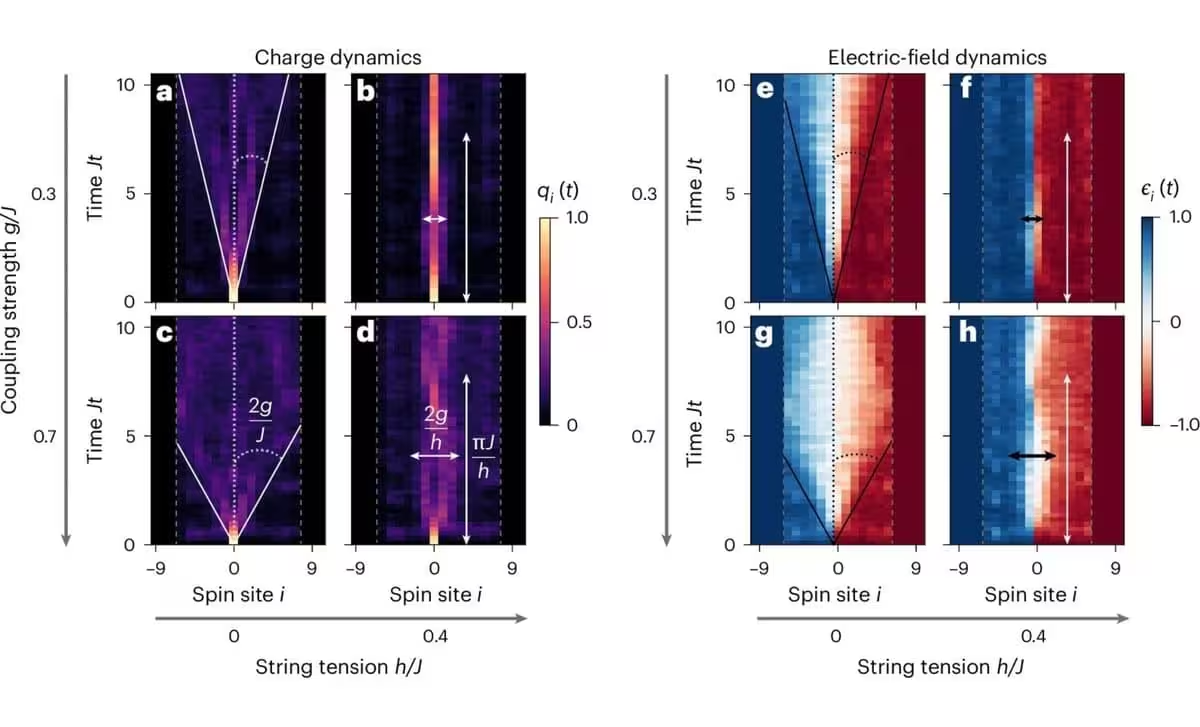
By encoding the properties of string-breaking into this quantum system, the team created a laboratory-scale model of how matter emerges from pure energy. The accuracy of this quantum simulation was subsequently verified against calculations from a classical supercomputer, confirming that the trapped-ion platform correctly replicated the physical dynamics of the strong nuclear force.
New Frontiers for Fundamental Physics
The experiment highlights the transition of quantum computing from theoretical curiosity to a practical tool for high-energy research. As the distance between quarks—and the tension within their strong nuclear bond—reaches a specific threshold, the energy is converted into mass, generating new particles. This experiment represents a milestone in observing these transitions in a non-equilibrium state.
Arinjoy De, the study’s lead author and a former researcher at the Duke Quantum Center, emphasized the potential of this approach. “Working at the intersection of quantum simulation and high-energy physics is incredibly exciting,” De stated in a press release. “By simulating quark confinement and string-breaking phenomena in a controlled lab environment, we’re opening up new pathways for experimental investigations into the behavior of matter at its most fundamental level.”
Beyond Classical Computational Limits
This work serves as a proof-of-concept for future simulations that could eventually surpass the capabilities of even the most powerful classical supercomputers. Because these quantum systems map directly onto the quantum nature of subatomic particles, they offer a unique window into the early universe.
Professor Christopher Monroe of Duke University noted the broader significance of the platform: “Quantum computer simulations provide the best platform to investigate complex questions like matter formation, short of having witnessed the Big Bang itself.” The successful modeling of these dynamics suggests that quantum simulators will play an increasingly vital role in mapping the complex, often counterintuitive interactions that govern the building blocks of reality.
This article has been fact checked for accuracy, with information verified against reputable sources. Learn more about us and our editorial process.
Last reviewed on .
Article history
- Latest version
Reference(s)
- Tie, Andrew. “Quantum Device Simulates Matter Popping into Existence.”, September 23, 2026 Duke University Pratt School of Engineering <https://pratt.duke.edu/news/quantum-simulation-string-breaking/>.
Cite this page:
- Posted by Farah Siddiqui