Citizen Scientist Finds Supersonic Bow‑And‑Arrow Galaxy Shaped by Shock Wave
International team discovers a rare, bow‑shaped galaxy spanning ~2 million light‑years, a radio source that challenges galaxy‑environment models.

Astronomers have identified a striking new radio source, dubbed RAD-BAARG (Bow‑And‑Arrow Radio Galaxy), in data from LOFAR, one of the most sensitive low‑frequency radio arrays on the planet. The object’s bizarre outline appears to capture, in real time, a galaxy racing supersonically through the scorching plasma that fills a neighboring galaxy cluster, leaving a massive shock front in its wake.
An Unprecedented Radio Structure
On one flank the galaxy emits a slender plasma jet that expands into a sector‑shaped cone before bending back into a sweeping arc that stretches roughly 560 kiloparsecs—about 1.8 million light‑years. The opposite side shows a jet that twists into an S‑shaped curve, ending in a faint, displaced tail that reaches nearly 600 kiloparsecs.
Lead author Dr. Ananda Hota of the RAD@home Astronomy Collaboratory in India says the source bears no resemblance to any radio galaxy encountered in his 25 years of professional work. The pronounced asymmetry—a compact, bright side versus a diffuse, extended counterpart—suggests that the surrounding environment, rather than internal galactic mechanics, dominates the observed shape.
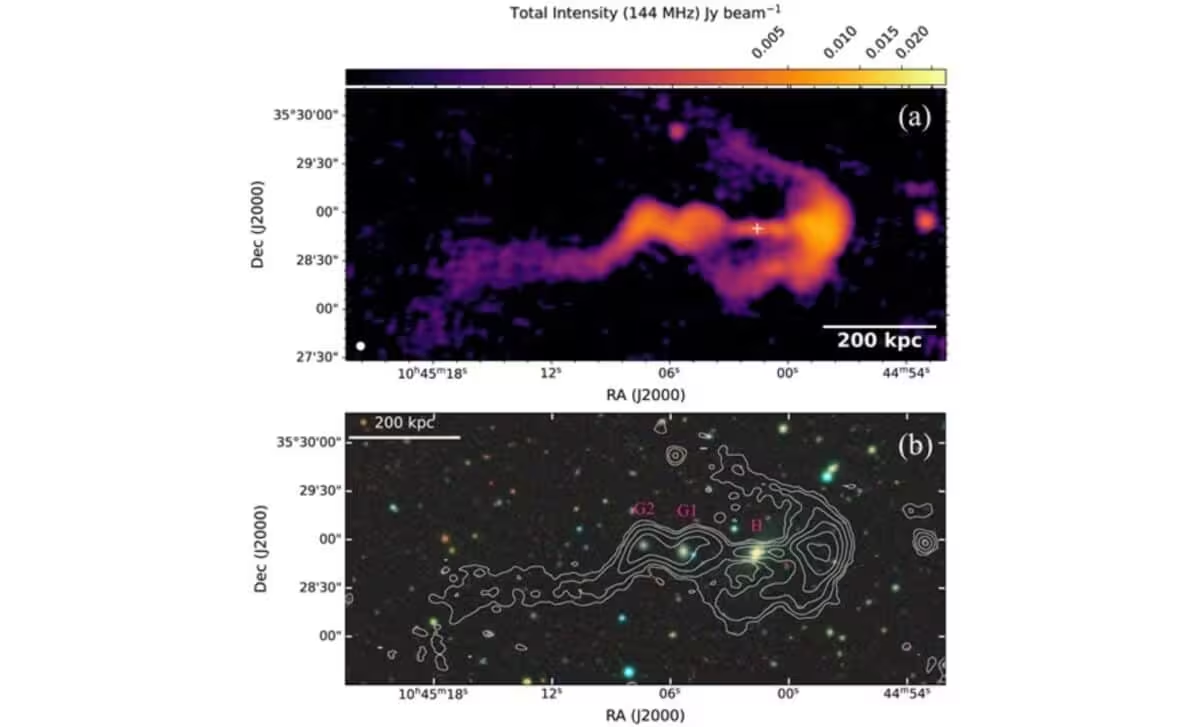
The western arc is the centerpiece of the discovery. Its sheer size far surpasses what the galaxy’s own jets could generate, leading researchers to interpret it as a bow shock—a compression wave that forms ahead of any object moving faster than the local sound speed. Here, the “medium” is the searing hot gas that permeates the intra‑cluster space.
By measuring the curvature of the arc (the Mach angle), the team inferred an infall velocity between 1,130 and 3,580 km s⁻¹, a range that aligns with known supersonic entry speeds for galaxies falling into clusters.
A Himalayan Volunteer Drives the Breakthrough
The object was first flagged by Pranim Limbo, a citizen scientist with RAD@home, while sifting through LOFAR survey images during an online weekend workshop in May 2025. Limbo, who works from an isolated Himalayan valley, has no formal ties to a major observatory.
Founded in 2013, the RAD@home collaboratory functions as a zero‑budget network that equips volunteers across India to examine data from professional telescopes. As detailed in the peer‑reviewed paper, participants are trained to blend radio, optical, ultraviolet and infrared observations to spot rare phenomena that automated pipelines often miss. The bow‑and‑arrow configuration, visible only in LOFAR’s ultra‑deep survey, exemplifies the power of human‑led inspection.
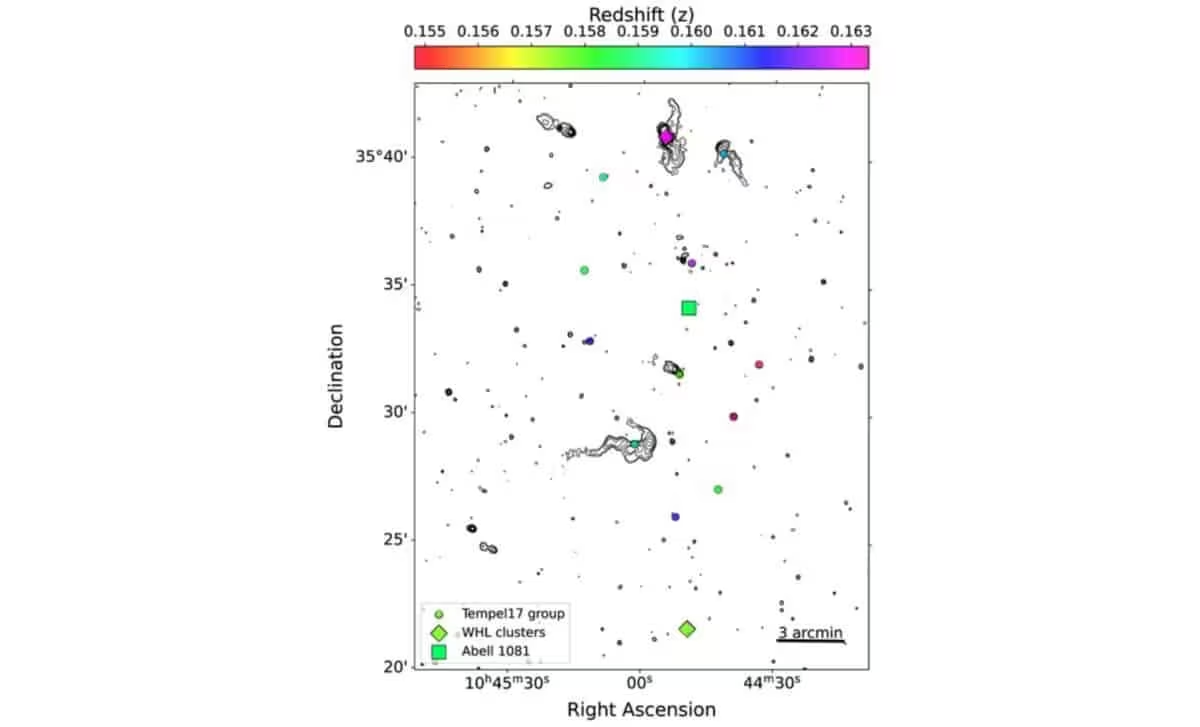
The host galaxy occupies a densely populated region of the sky, with three neighboring clusters lying within about twelve arcminutes and sharing comparable distances. Researchers describe this as a dynamically intricate, multihalo environment, a setting conducive to large‑scale gas inflows that can propel a galaxy into a supersonic plunge and generate the observed shock front.
Co‑lead author Dr. Pratik Dabhade of the National Centre for Nuclear Research in Poland emphasized that LOFAR’s capability to capture faint, diffuse emission at low frequencies was crucial for revealing the bow‑shaped structure. He added that upcoming instruments such as the Square Kilometre Array Observatory will likely uncover many similar systems, providing a new means to map the invisible boundaries and shock waves that steer galaxy evolution within the cosmic web.
This article has been fact checked for accuracy, with information verified against reputable sources. Learn more about us and our editorial process.
Last reviewed on .
Article history
- Latest version
Reference(s)
- “Dr Ananda Hota.” RAD@home India <https://radathomeindia.org/anandahota>.
- <https://academic.oup.com/mnras/article/549/4/stag1033/8711583?login=false>.
- <https://www.researchgate.net/profile/Pratik-Dabhade>.
Cite this page:
- Posted by Farah Siddiqui