New Radio Telescope Array Could Spot a Cellphone Signal From the Sun
A new Nevada telescope will image the cosmos faster and deeper than ever, set record‑breaking observations on day one and reshape our view of the universe.
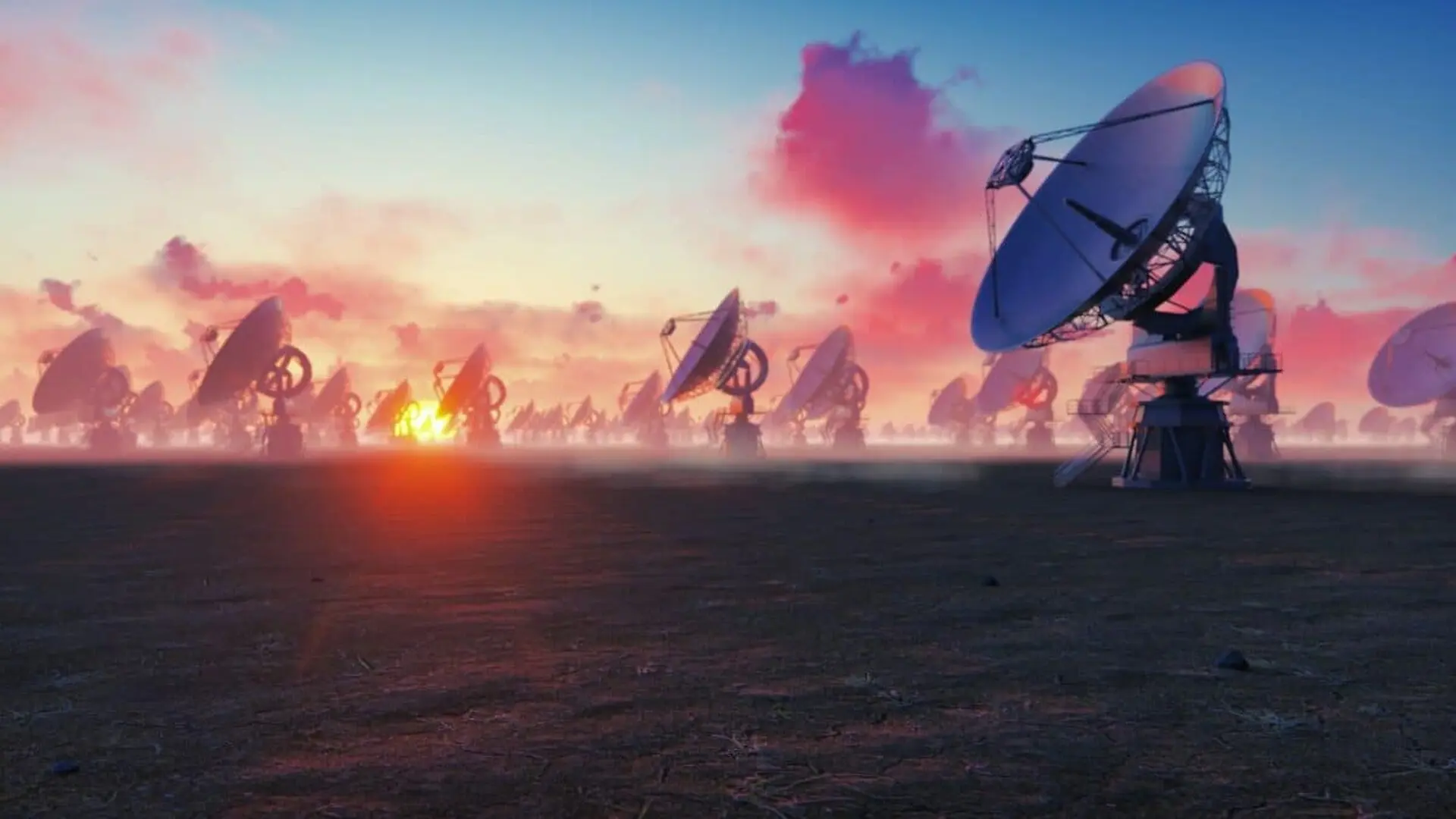
A consortium led by the California Institute of Technology, with backing from Schmidt Sciences, is set to install the Deep Synoptic Array in a remote valley of Nevada’s White Pine County. The initiative will deploy 1,650 radio dishes across more than 123 square miles of Great Basin desert, creating one of the largest radio‑telescope networks ever planned.
When completed, the array is expected to scan the heavens up to 100 times faster than any current radio instrument and to deliver images far sharper than those produced by existing facilities. Groundwork is slated to begin in 2027, and scientific operations should commence after the 2029 completion date.
A New Kind of Radio Observatory
What distinguishes the Deep Synoptic Array is the unprecedented scale of its antenna collection. Conventional radio astronomy relies either on a few massive dishes that capture faint signals from distant space or on modest arrays that achieve high resolution. The DSA is engineered to combine both strengths, delivering deep‑space sensitivity together with fine imaging capability.
Each 20‑foot reflector will transmit raw observations to an off‑site supercomputer built around the latest Nvidia GPU technology. This “radio camera” system, described by Caltech, is essential because the combined data flow from 1,650 dishes rivals the total internet traffic across the United States. Real‑time processing avoids the need to store an unwieldy 100 exabytes of raw data per survey.
“Without the radio camera, we would have to store 100 exabytes of data [100 billion gigabytes] to complete our survey,” explained Gregg Hallinan, Caltech astronomy professor and principal investigator. “This would require five million hard drives in a multi‑billion‑dollar facility the size of multiple football fields.” All resulting images will be released to the public without a proprietary waiting period.
Potential to Double Known Radio Sources in a Single Day
Historically, every radio telescope built over the past century has catalogued roughly 20 million radio emitters. Caltech estimates that the Deep Synoptic Array could reach that total within its first 24 hours of operation and aim for one billion new detections by the end of a five‑year survey.
The instrument will hunt for fast radio bursts—brief, intense flashes of radio energy whose origins remain elusive—and is expected to uncover more than 20,000 previously unknown pulsars, the rapidly rotating neutron stars that emit sweeping radio beams. It will also pinpoint radio signatures that accompany gravitational‑wave events such as neutron‑star mergers, which forge heavy elements like gold and platinum.

“Radio astronomy is about to go from sketch to photograph,” said Vikram Ravi, co‑principal investigator and Caltech astronomy professor. “The DSA will survey a vastly larger volume of the universe far more frequently than any previous telescope.”
Beyond exotic transients, the array will produce high‑resolution maps of gas and star‑formation activity across millions of galaxies. Researchers anticipate using these data to probe dark‑matter physics, constrain neutrino masses, and refine measurements of the universe’s expansion rate.
The White Pine County site was chosen after an extensive survey of locations in four western states. Its sparse population and natural topography provide strong protection against radio‑frequency interference that hampers observatories near urban centers. Hallinan notes that the system is so sensitive it could pick up a cellphone signal reflected from the Sun. Two prototype dishes have already been erected near Bishop, California, serving as a technology demonstrator ahead of full‑scale construction.
This article has been fact checked for accuracy, with information verified against reputable sources. Learn more about us and our editorial process.
Last reviewed on .
Article history
- Latest version
Reference(s)
- “Caltech Readies to Build World's Most Sensitive Radio Telescope.”, June 11, 2026 California Institute of Technology <https://www.caltech.edu/about/news/caltech-readies-to-build-worlds-most-sensitive-radio-telescope>.
- “Gregg W. Hallinan | The Division of Physics, Mathematics and Astronomy.” <https://www.pma.caltech.edu/people/gregg-w-hallinan>.
- “Vikram Ravi - homepage.” <https://sites.astro.caltech.edu/~vikram/>.
Cite this page:
- Posted by Farah Siddiqui