Fermi Reveals First Binary Supernova Pair Hidden Near the Jellyfish Nebula
NASA’s Fermi mission discovers a rare binary supernova remnant pair, shedding new light on massive star explosions and cosmic particle acceleration.
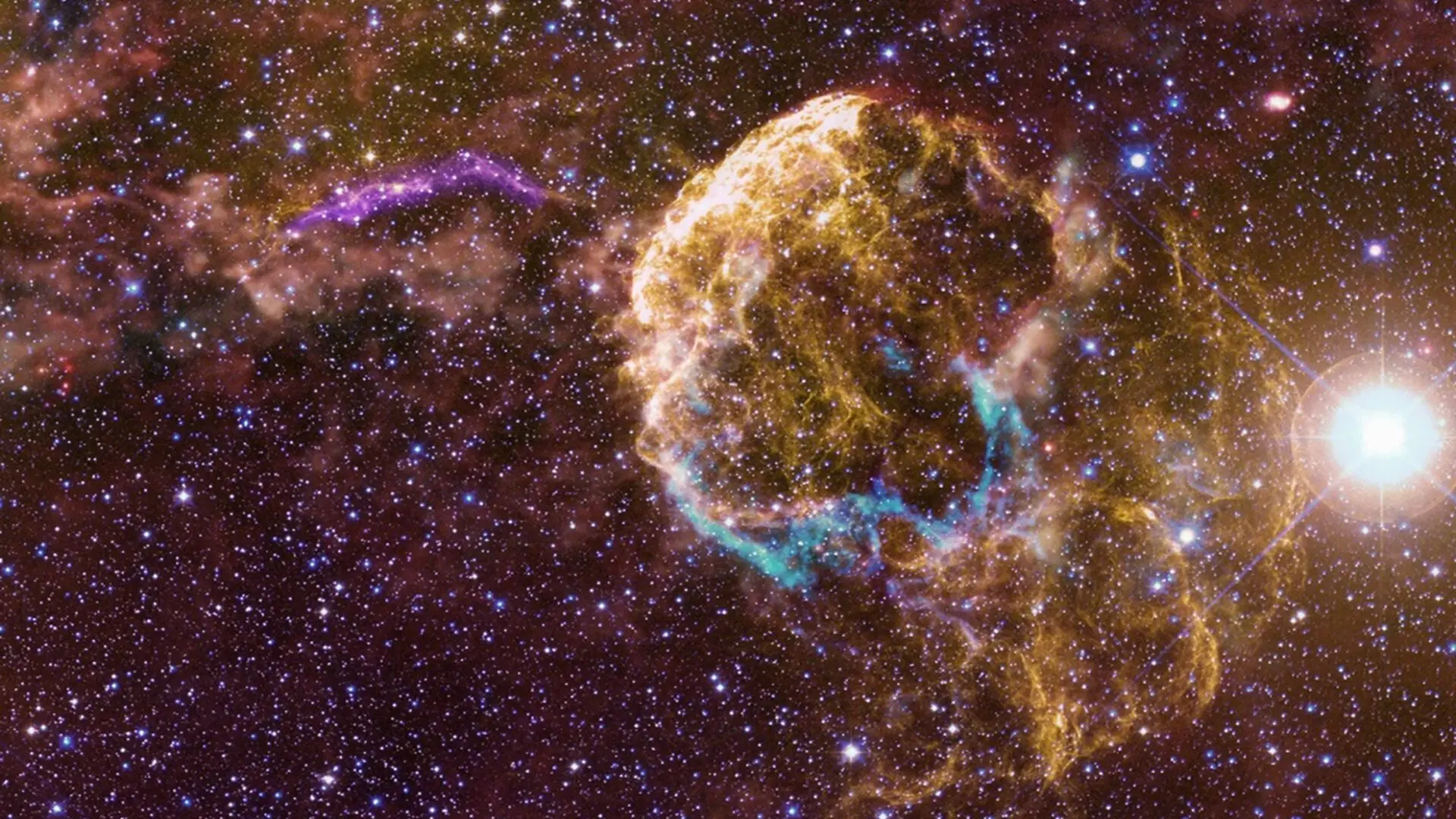
A pair of supernova remnants hidden in the Gemini constellation have been uncovered, offering the first glimpse of a binary star system where both members exploded. The brighter object, known as the Jellyfish Nebula (IC 443), has long been recognized for its intense gamma‑ray emission. New analysis of data from NASA’s Fermi Gamma‑ray Space Telescope has now revealed a fainter neighbor, G189.6+3.3, that was previously masked by the Nebula’s glow.
Fermi Data Exposes a Concealed Companion
Astronomers have studied the Jellyfish Nebula for decades, yet the adjacent remnant G189.6+3.3 remained undetected in most wavebands. By stacking 16 years of gamma‑ray observations, researchers identified a distinct signal emanating from the hidden source, confirming its status as a supernova remnant.
“Using 16 years of data from NASA’s Fermi Gamma-ray Space Telescope, our analysis uncovered gamma rays associated with a supernova remnant that was hidden in the glare of its neighbor, the Jellyfish Nebula, one of the brightest gamma-ray-emitting supernova remnants known,” said Miltiadis Michailidis, a postdoctoral fellow at Stanford University. “There are so many striking connections between the two remnants that we conclude they’re likely related, giving us the first known example of a binary system where both stars have undergone supernova explosions.”
The finding underscores how long‑term gamma‑ray monitoring can reveal structures that are invisible in optical or X‑ray images, especially when multiple remnants overlap in a crowded region of the sky.
High‑Energy Particles Trace the Explosions
Supernova remnants act as natural accelerators, propelling protons to relativistic speeds. The Fermi Large Area Telescope (LAT) has been instrumental in mapping these processes, linking shock‑driven particle acceleration to the gamma‑ray glow observed from both remnants.
“The overlapping remnants, a connecting gas filament, and the availability of data from Fermi and other facilities motivated us to delve into this complex but little-studied region,” said Marianne Lemoine-Goumard, an astrophysicist at CNRS, University of Bordeaux. “With Fermi’s LAT instrument, we found gamma-ray emission associated with accelerated protons in the northern part of the fainter remnant. If both remnants are interacting with the same structure, then they must share a common distance from us.”
These observations confirm that cosmic rays—dominant energetic particles in the Milky Way—originate from the shock fronts of supernovae. When the accelerated particles collide with surrounding interstellar gas, they generate gamma rays that map the flow of energy through the remnants.
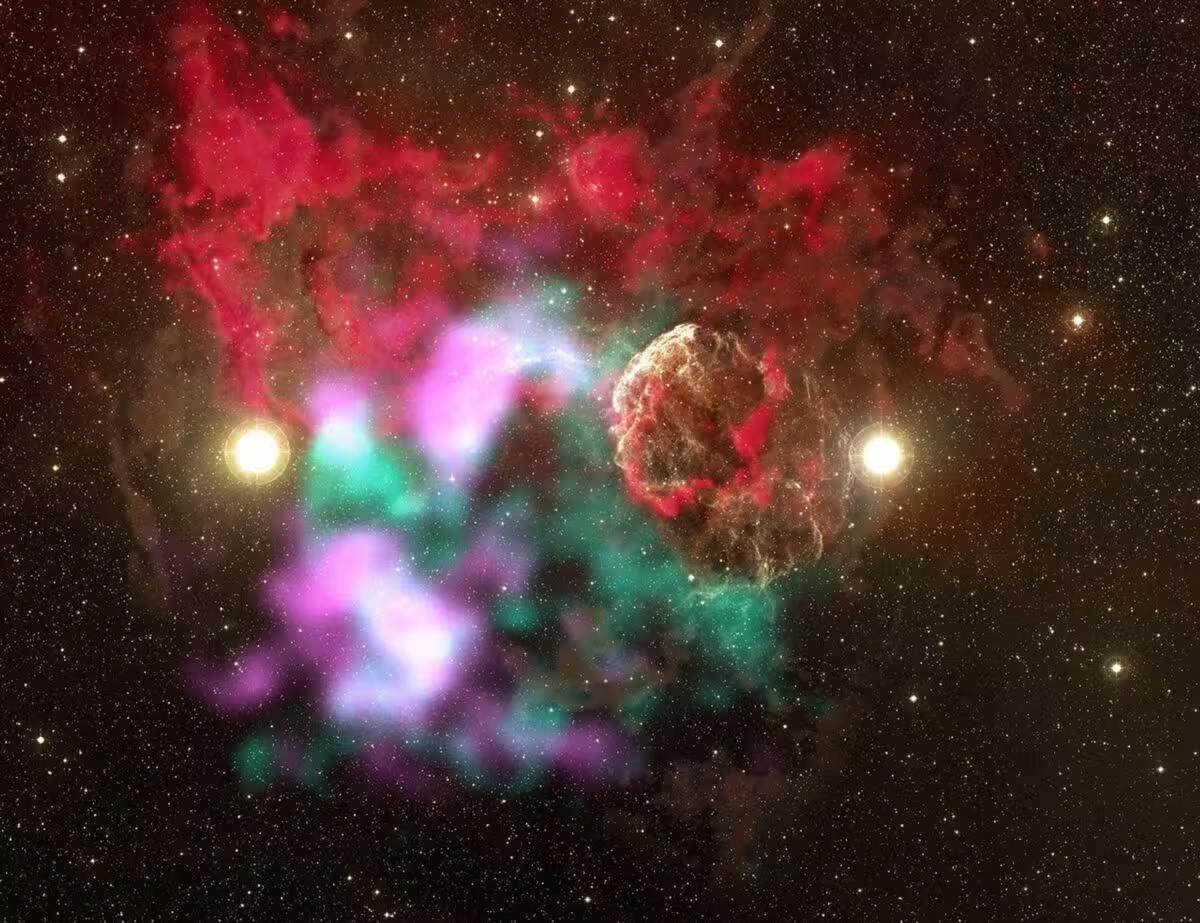
NASA Goddard Space Flight Center and M. Michailidis et al. 2026; radio, MWISP and ESA/Planck; infrared: NASA/WISE/JPL-Caltech/UCLA; optical: DSS; ultraviolet: NASA/Swift; X-ray: SRG/eROSITA; gamma ray: NASA/DOE/Fermi LAT Collaboration
Binary Star Evolution and Separate Explosions
Massive stars frequently form in pairs, sharing material and influencing each other’s life cycles. Combining Fermi’s gamma‑ray data with X‑ray imaging and simulations of millions of massive binaries, the research team concluded that the progenitors of IC 443 and G189.6+3.3 once orbited closely, transferred mass, and exploded at different epochs. Age estimates place the Jellyfish Nebula at roughly 8,000–9,000 years old, while its quieter companion may be between 20,000 and 110,000 years old, implying a separation of up to 100,000 years between the two supernovae.
“The evidence we’ve compiled — including observations across the spectrum, the chemical and physical properties of the remnants, simulations, and more — paints a compelling picture of a dual supernova event,” said Michailidis.
These results demonstrate that binary massive stars can leave behind distinct, interacting remnants, offering a rare laboratory to probe stellar death, explosion dynamics, and the impact on surrounding interstellar material.
Broader Impact on Galactic Ecology
By dissecting the gamma‑ray and particle‑acceleration signatures of both remnants, scientists can better understand how supernovae inject energy into their environments, potentially triggering new rounds of star formation and enriching the galaxy with cosmic rays. “Fermi’s gamma-ray observations of supernova remnants continue to reveal the dynamic lives of stars,” said Elizabeth Hays, Fermi project scientist at NASA’s Goddard Space Flight Center. “We can now connect the glowing remains of two massive stars to a powerful pair that evolved together over thousands of years.”
Continued monitoring by NASA’s high‑energy observatories promises to uncover additional concealed sources, deepening our knowledge of the complex interplay that governs stellar evolution throughout the Milky Way.
This article has been fact checked for accuracy, with information verified against reputable sources. Learn more about us and our editorial process.
Last reviewed on .
Article history
- Latest version
Cite this page:
- Posted by Farah Siddiqui