Third Dark‑Matter‑Free Galaxy Found in a Cosmic Line, Upending Formation Theories
Newly discovered galaxy with two odd companions could upend theories on dark matter and galaxy formation.
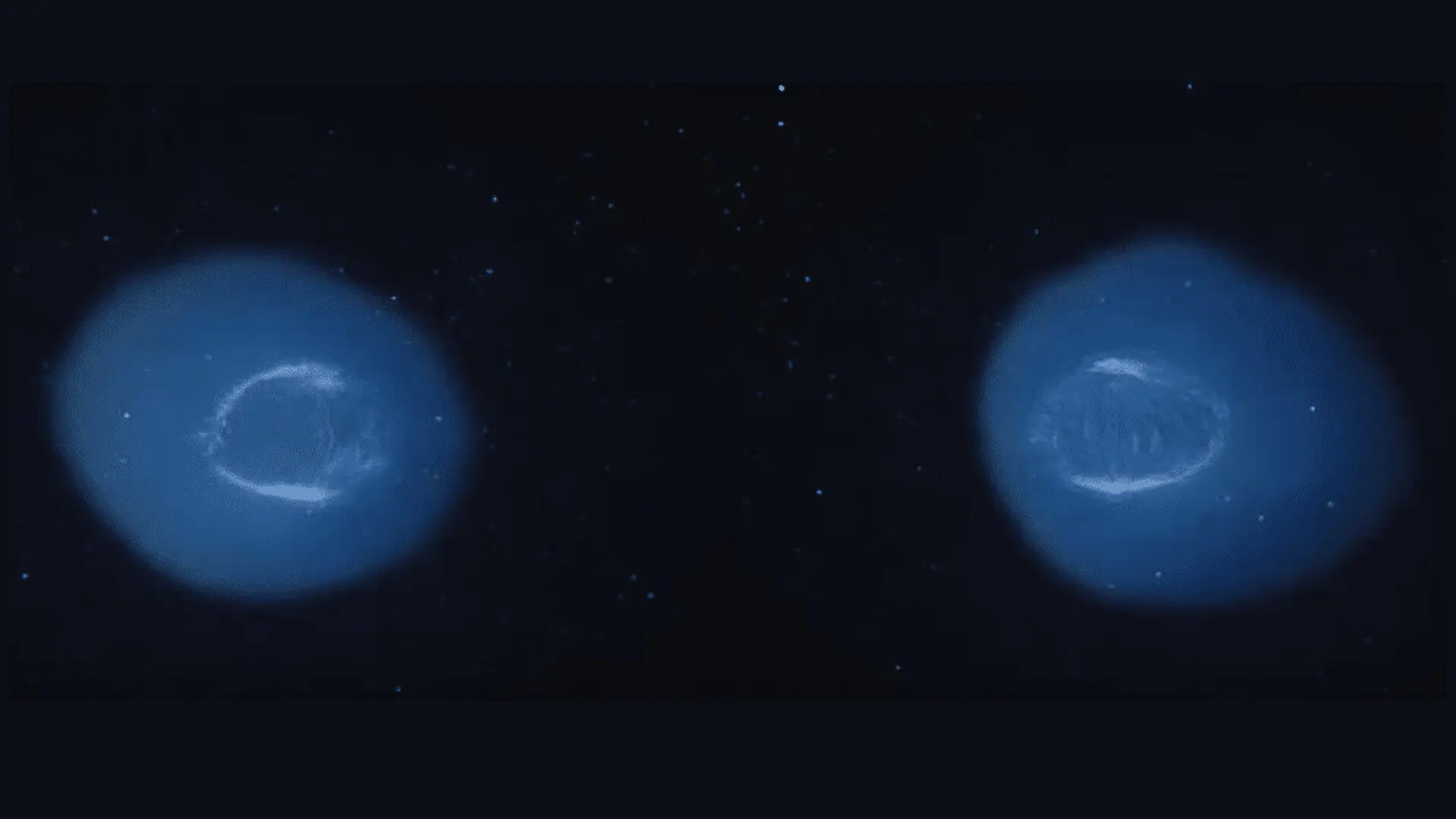
Astronomers have identified a dim galaxy about 45 million light‑years away that appears to be devoid of dark matter, adding a third member to an unusual chain of such objects documented in The Astrophysical Journal. This discovery not only questions long‑standing ideas about galaxy formation but also highlights a striking linear arrangement of three dark‑matter‑free galaxies, hinting at a common, violent origin.
Uncommon Linear Structure of Dark‑Matter‑Free Galaxies
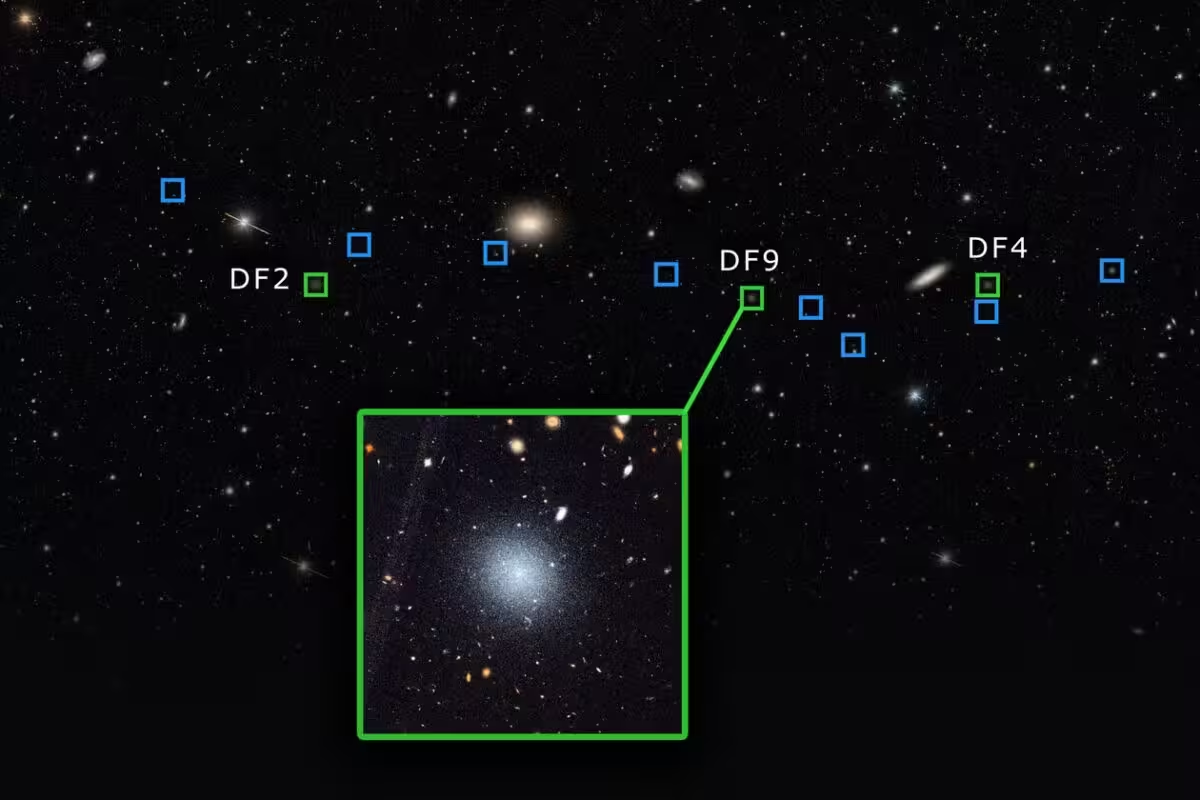
The faint dwarf galaxy NGC 1052‑DF9 has been confirmed as the latest addition to a rare alignment that also includes the previously reported DF2 and DF4 galaxies. All three reside within a narrow filament that has no analogue in existing sky surveys, challenging conventional models of how galaxies are distributed across the cosmos.
Deep imaging revealed that DF9 is not an isolated case; it shares both physical traits and motion patterns with its neighbors, suggesting a linked formation history rather than independent evolution. The detection relied on instruments capable of tracing extremely faint stellar light, allowing researchers to map the galaxies’ kinematics and confirm their shared characteristics.
“A line of galaxies lacking dark matter has never been seen before,” said Michael Keim, a Ph.D. student in astrophysics at Yale and lead author of the study. “The discovery provides some of the strongest evidence yet that these galaxies formed through an extreme and previously unseen process and offers a rare new window into the nature of dark matter itself.”
The alignment is therefore interpreted as the lingering imprint of a large‑scale event that simultaneously shaped multiple galaxies under atypical conditions.
NGC 1052‑DF9’s Place in the Emerging Pattern
Initially flagged as a possible supermassive‑black‑hole candidate, NGC 1052‑DF9 was later recognized as an ultra‑diffuse dwarf galaxy. Its inclusion in the dark‑matter‑free cohort strengthens the argument that DF2 and DF4 are not isolated anomalies but part of a broader phenomenon. Consistent measurements of stellar velocities across all three objects point to a common formation mechanism.
By tracking the motions of its constituent stars, researchers estimated DF9’s total mass at roughly 100 million solar masses—essentially the amount expected from its visible matter alone. A typical galaxy of similar size would normally contain a dark‑matter component an order of magnitude larger, underscoring the puzzle of whether dark matter behaves as a distinct substance or requires alternative explanations.
Keck Observatory Data Bolsters the Dark‑Matter‑Free Claim
Observations with the W. M. Keck Observatory’s Cosmic Web Imager in Hawaii captured faint light from DF9, enabling precise mapping of stellar velocities. The resulting mass profile aligns closely with the visible matter estimate, reinforcing the conclusion that dark matter contributes negligibly to the galaxy’s gravitational field.
The full study, available in The Astrophysical Journal, situates DF9 within a growing effort to understand galaxies that appear to defy standard cosmology. Earlier work on DF2 and DF4 already challenged the notion that galaxies must form within dark‑matter halos; the addition of a third case suggests a repeatable, albeit rare, astrophysical process.
High‑Speed Collisions as a Possible Formation Mechanism
One leading hypothesis proposes that a violent, high‑velocity encounter between galaxies in the distant past stripped dark matter from the colliding systems. The remaining gas could then collapse into new, baryon‑dominated galaxies arranged along a narrow track, leaving a faint filament that persists over billions of years.
“Up until now, it was assumed galaxies formed within pools of dark matter called ‘halos,’” Keim explained. “This system shows that stars and galaxies can form outside of dark matter ‘halos’ in extreme events and indicates that dark matter is a physical substance that can act independently of normal matter or gas, challenging alternative theories that dark matter is gravity.” This perspective directly confronts models that seek to explain cosmic structure without invoking a separate dark‑matter component.
Future Searches for Hidden Remnants
Researchers are now extending their hunt for additional traces of the proposed collision, such as faint gas filaments that may linger along the same line. Upcoming observations with next‑generation telescopes aim to detect ultra‑low surface‑brightness features, potentially unveiling the full extent of the galactic chain.
The DF2‑DF4‑DF9 system continues to serve as a natural laboratory for testing competing theories of dark matter and galaxy formation. As observational capabilities advance, this rare alignment could become a benchmark for determining whether dark matter invariably governs structure formation or whether extraordinary events occasionally carve an alternative path.
This article has been fact checked for accuracy, with information verified against reputable sources. Learn more about us and our editorial process.
Last reviewed on .
Article history
- Latest version
Reference(s)
- Keim, Michael A.., et al. “A Third Galaxy Missing Dark Matter along a Trail of Galaxies in the NGC 1052 Field.” The Astrophysical Journal, vol. 1004, no. 2, June 16, 2026, pp. 210 American Astronomical Society, doi: 10.3847/1538-4357/ae6b8d. <https://iopscience.iop.org/article/10.3847/1538-4357/ae6b8d>.
Cite this page:
- Posted by Farah Siddiqui