Hidden Demon Cavefish Unveils New Genus After Decades In Alabama Military Cave
New blind cavefish genus Demogorgonichthys arcanus discovered under Redstone Arsenal in Huntsville, Alabama, known only from Bobcat Cave and its aquifer.
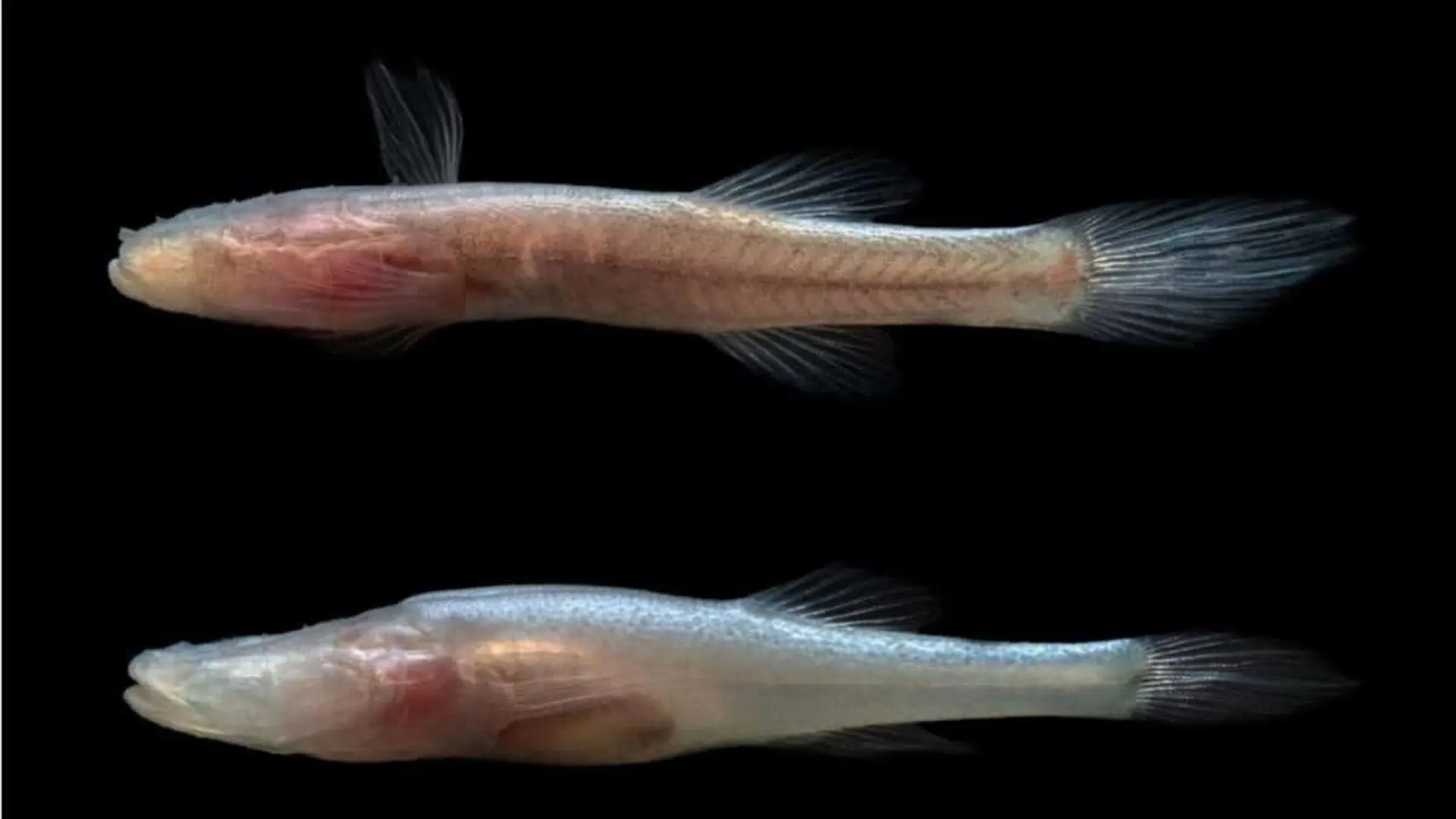
Bobcat Cave, a karst system beneath Redstone Arsenal in northern Alabama, has been the focus of regular biological surveys for more than three decades. Despite this extensive monitoring, scientists have now identified a previously unknown fish that represents an entirely new genus of blind cavefish.
Underground Discovery Reveals a New Fish Genus
The newly described species, informally called the “demon cavefish,” measures under two inches, lacks pigmentation, and exhibits a faint electric‑blue sheen when alive. Its diminutive size and translucent appearance initially suggested a possible affiliation with known blind fish from the region.
Detailed anatomical studies, high‑resolution CT scans, and comprehensive genetic sequencing conducted by researchers at the University of Alabama in Huntsville demonstrated that the organism differs enough to merit placement in its own genus.
Matthew Niemiller, associate professor of biological sciences at UAH and lead author of the study, emphasized the surprise of the find given the cave’s long‑standing monitoring program.
“This is one of the last places we’d have bet on it,” Niemiller said, likening the discovery to stumbling upon a new big‑cat species in a group thought to be fully cataloged.
Auburn University’s Jonathan Armbruster, curator of fishes at the Auburn University Museum of Natural History, noted distinct differences in snout morphology, body shape, and coloration when specimens collected after a February 2025 sighting were examined.
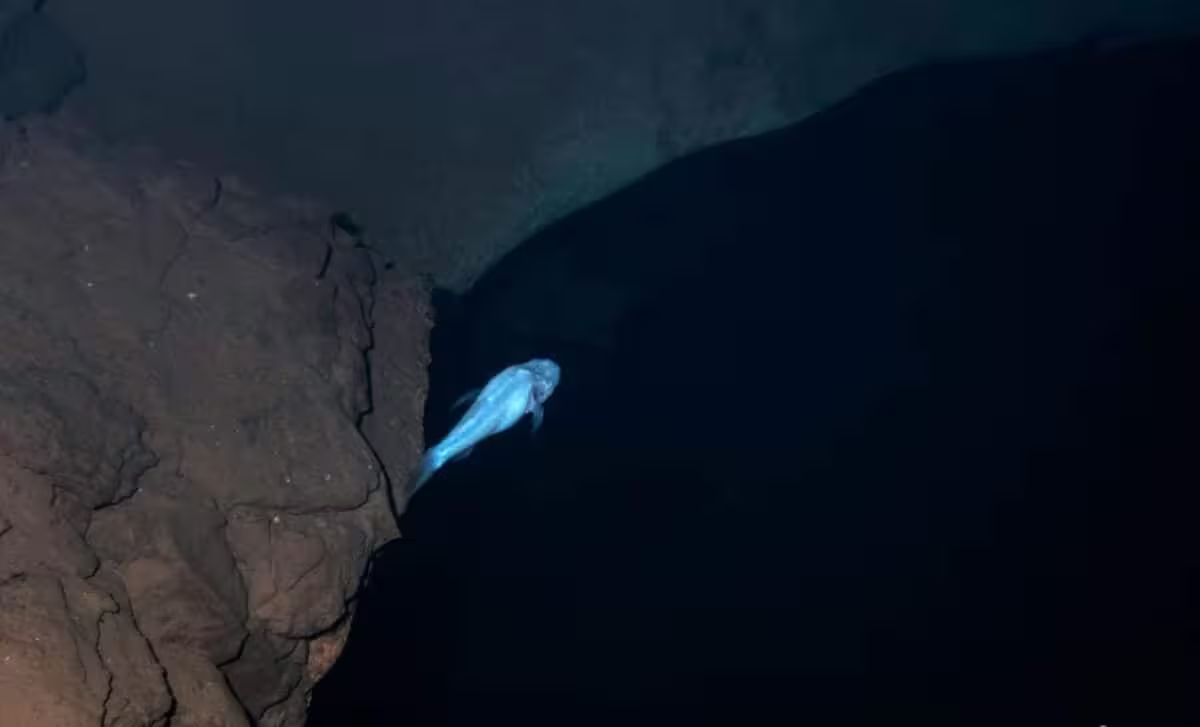
Genetic analysis revealed that a segment of the rhodopsin gene—critical for light detection—is absent and non‑functional in the demon cavefish, whereas the sympatric Southern Cavefish (Typhlichthys subterraneus) retains a functional version and shows limited light response.
Field observations suggest that no more than roughly 20 individuals occupy the visible pools at any given time. Armbruster speculated that the majority of the population may reside deeper within the aquifer, beyond the reach of conventional sampling methods.
The scientific name, Demogorgonichthys arcanus, draws on the mythological Demogorgon and the Latin term “arcanus,” highlighting both its subterranean lifestyle and the prolonged period it remained hidden.
Convergent Evolution Shapes Two Unrelated Cavefish
Although the demon cavefish and the Southern Cavefish coexist in the same underground pools and share classic troglomorphic traits—loss of pigmentation and eye reduction—their evolutionary histories diverged millions of years apart. The researchers describe this as a classic case of convergent evolution, where unrelated lineages independently acquire similar adaptations to comparable environments.
Molecular dating places the split of the demon cavefish lineage from its nearest North American relatives at roughly 11.6 million years ago. Combined with distinct skeletal features, this temporal separation justified the establishment of a new genus.
#NewSpeciesAlert – 𝐷𝑒𝑚𝑜𝑔𝑜𝑟𝑔𝑜𝑛𝑖𝑐ℎ𝑡ℎ𝑦𝑠 𝑎𝑟𝑐𝑎𝑛𝑢𝑠, a new species (and genus) of amblyopsid cavefish, is described from Bobcat Cave, a long-monitored karst system on Redstone Arsenal in northern Alabama, USA. Notably, 𝐷. 𝑎𝑟𝑐𝑎𝑛𝑢𝑠 occurs in syntopy with… pic.twitter.com/6fw1U1o1Ss
— Fish in the News (@FishInTheNews) July 21, 2026
The species is currently known only from Bobcat Cave and its associated aquifer, making its survival tightly linked to groundwater quality in the surrounding recharge zone. Water samples collected over the past twenty years have shown elevated levels of cadmium, chromium, and lead, pollutants traced to historic munitions handling and disposal activities on the military installation.
Restricted access to the Redstone Arsenal has limited surface development around the cave, providing some protection against direct habitat disturbance. Nonetheless, contaminants can still infiltrate the subterranean ecosystem, underscoring the fish’s vulnerability.
“Being known from a single cave and its aquifer makes it inherently vulnerable,” Niemiller warned, noting that the discovery illustrates how even thoroughly studied systems can harbor undiscovered biodiversity.
This article has been fact checked for accuracy, with information verified against reputable sources. Learn more about us and our editorial process.
Last reviewed on .
Article history
- Latest version
Reference(s)
- “UAH | College of Science | Faculty & Staff | The University of Alabama in Huntsville.” <https://www.uah.edu/science/faculty-staff/matthew-niemiller>.
- “https://twitter.com/FishInTheNews/status/2079624800071200786/photo/1.” <https://t.co/6fw1U1o1Ss>.
Cite this page:
- Posted by Hassan Raza