New AI Framework Identifies Rice Leaf Diseases and Rejects Noise
A knowledge-guided neural network combines symptom attribute checks with an environmental noise filter to improve agricultural diagnostics.
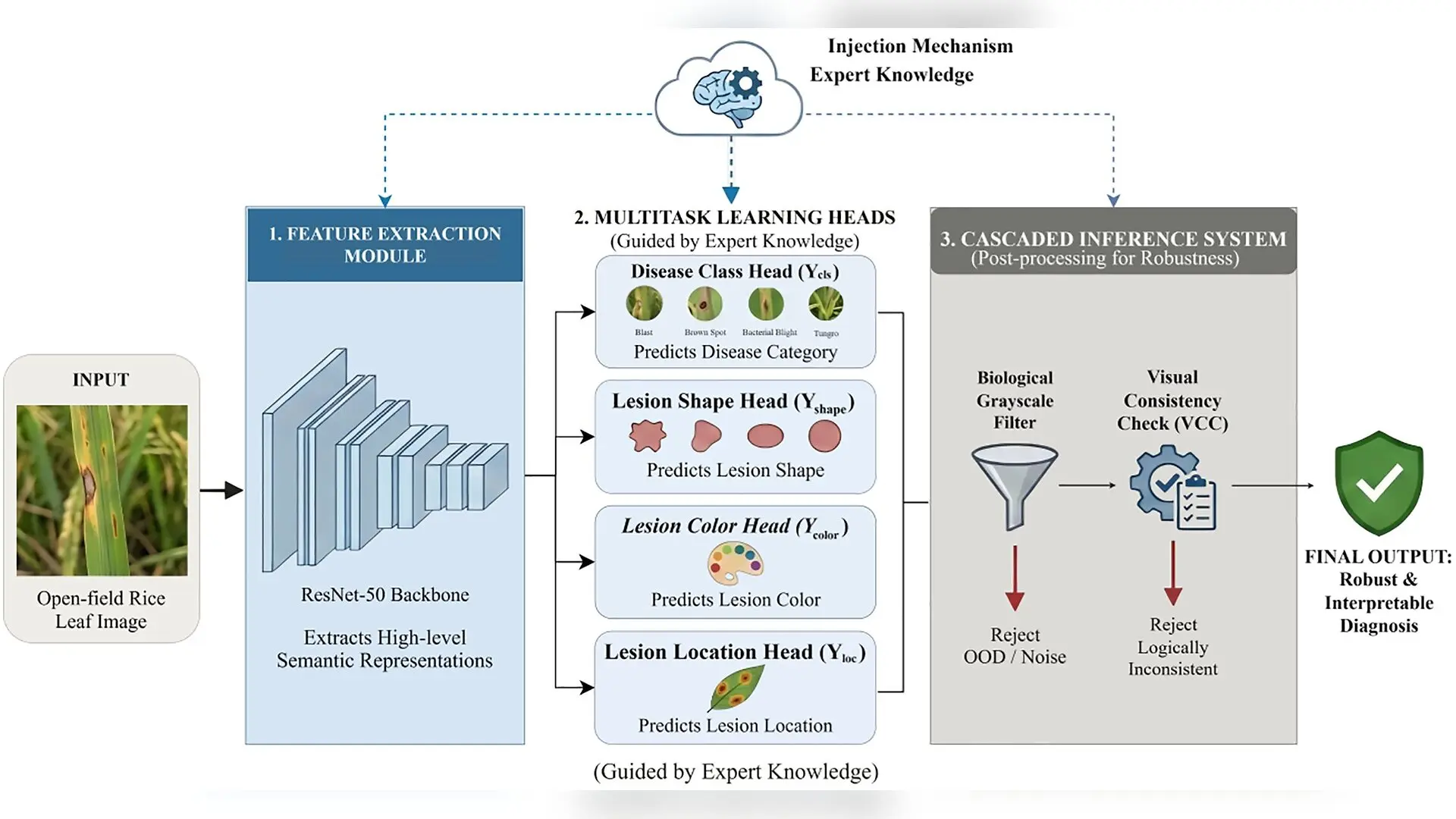
Rice plants infected with destructive pathogens can now be identified by a new deep-learning framework that also filters out non-plant images and detects inconsistent disease predictions. The system, detailed in a study published in PLOS One, addresses two major shortcomings of standard artificial intelligence tools in agriculture, namely their tendency to act as black boxes and their vulnerability to misclassifying random objects as crop diseases.
How Expert Knowledge Guides Modern Crop Diagnostics
Staple crops like rice feed more than half of the global population, making early disease detection a vital component of food security. However, conventional convolutional neural networks often struggle in real-world agricultural settings. When presented with background interference such as soil, flowerpots, or animals, standard classifiers typically force these out-of-distribution inputs into one of the trained disease categories with high confidence. To combat this issue, researchers Xiang Lyu, Lan Bai, Yue Yu, and LuMin Liu developed the Knowledge-Guided Multitask Rice Network, or MTRNet.
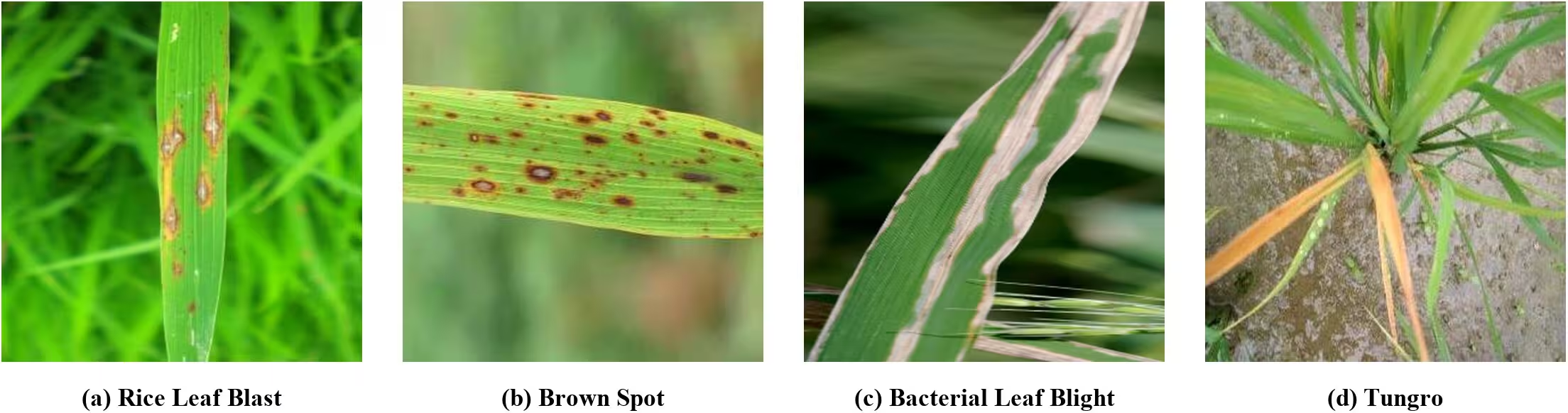
The research team built their model around a shared ResNet-50 feature extraction backbone, attaching four parallel prediction heads to handle different aspects of plant pathology. While the primary classification head determines the disease type among Rice Leaf Blast, Brown Spot, Bacterial Leaf Blight, and Tungro, three auxiliary heads evaluate specific morphological attributes including lesion shape, color, and onset location. Ground-truth labels for these auxiliary tasks are automatically generated through an Expert Knowledge Injection mechanism that maps each disease category to its canonical phytopathological symptoms.
Testing Diagnostic Accuracy and Noise Rejection
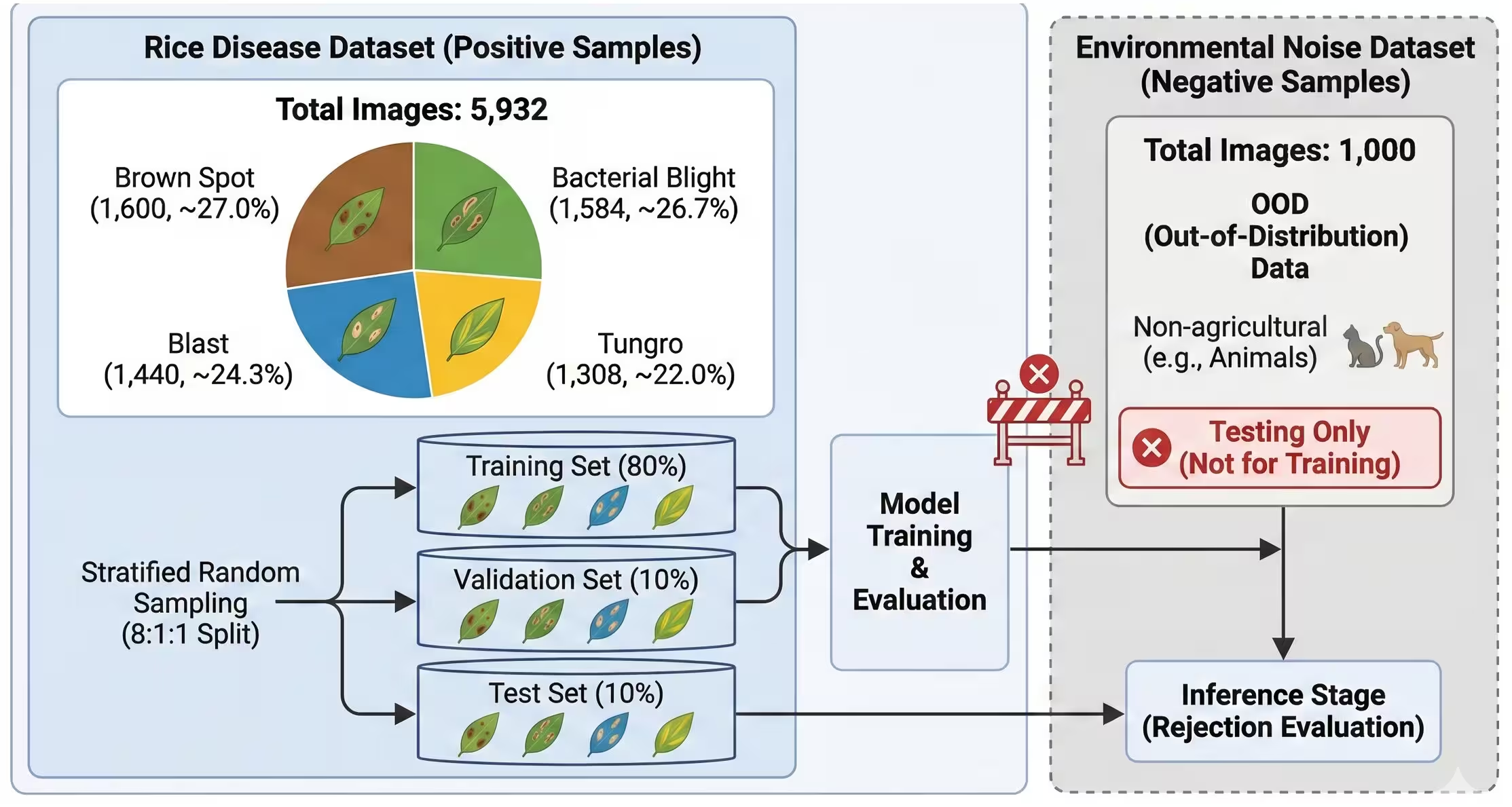
The investigators evaluated their framework using two distinct collections, consisting of a public agricultural dataset containing 5,932 rice leaf images and an environmental noise dataset comprising 1,000 images of cats and dogs. Because standard image splitting protocols on the rice dataset often lead to data leakage through flipped and rotated near-duplicates, the authors implemented a source-aware five-fold cross-validation protocol where near-duplicate clusters were strictly partitioned.
Under this rigorous evaluation, the model achieved a mean classification accuracy of 96.32 percent. To handle unwanted environmental interference, the authors incorporated a Cascade Inference System operating in two stages. Stage I acts as a biological grayscale filter, evaluating pixel color distribution in the hue, saturation, and value color space to screen out inputs with insufficient vegetation ratios. Stage II performs a visual consistency check, comparing the predicted disease against its morphological attributes to ensure logical alignment with the expert rules matrix.
Performance Metrics and Practical Limitations
The cascade system yielded an out-of-distribution rejection rate of 77.78 percent on the animal noise dataset, successfully intercepting non-target images before they could be misdiagnosed. The ablation experiments revealed that the model-independent color filter of Stage I drove the vast majority of the rejections, while the consistency check added a minor supplementary benefit. The false rejection rate on genuine diseased leaves remained at 8.29 percent, largely driven by the conservative color filter discarding close-up images with sparse background foliage.
Despite these promising outcomes, the authors noted several limitations in their approach. The auxiliary attribute heads primarily re-encode the main disease classification rather than demonstrating independent pathological feature disentanglement, and the static expert matrix cannot easily account for complex co-infections or chronological symptom transitions. Furthermore, relying solely on RGB imagery cannot reliably differentiate viral infections like Tungro from abiotic nutrient deficiencies. Future research directions include expanding the framework with multispectral data, conducting external field validations, and optimizing lightweight backbones for deployment on edge-computing devices.
The research was published in PLOS One on November 12, 2026.
This article has been fact checked for accuracy, with information verified against reputable sources. Learn more about us and our editorial process.
Last reviewed on .
Article history
- Latest version
Reference(s)
- Lyu, Xiang., et al. “Knowledge-guided multi-task learning with cascade out-of-distribution rejection for rice leaf disease diagnosis.” PLOS One, vol. 21, no. 11, November 12, 2026, pp. e0362080 Public Library of Science (PLoS), doi: 10.1371/journal.pone.0362080. <https://doi.org/10.1371/journal.pone.0362080>.
Cite this page:
- Posted by Priya Sharma