70-Million-Year-Old Carnivore Egg Unveiled in Patagonia: Could It Still Hold a Baby
Rare 70-million-year-old underground egg captured on live camera; scientists say it could be the continent’s sole example.
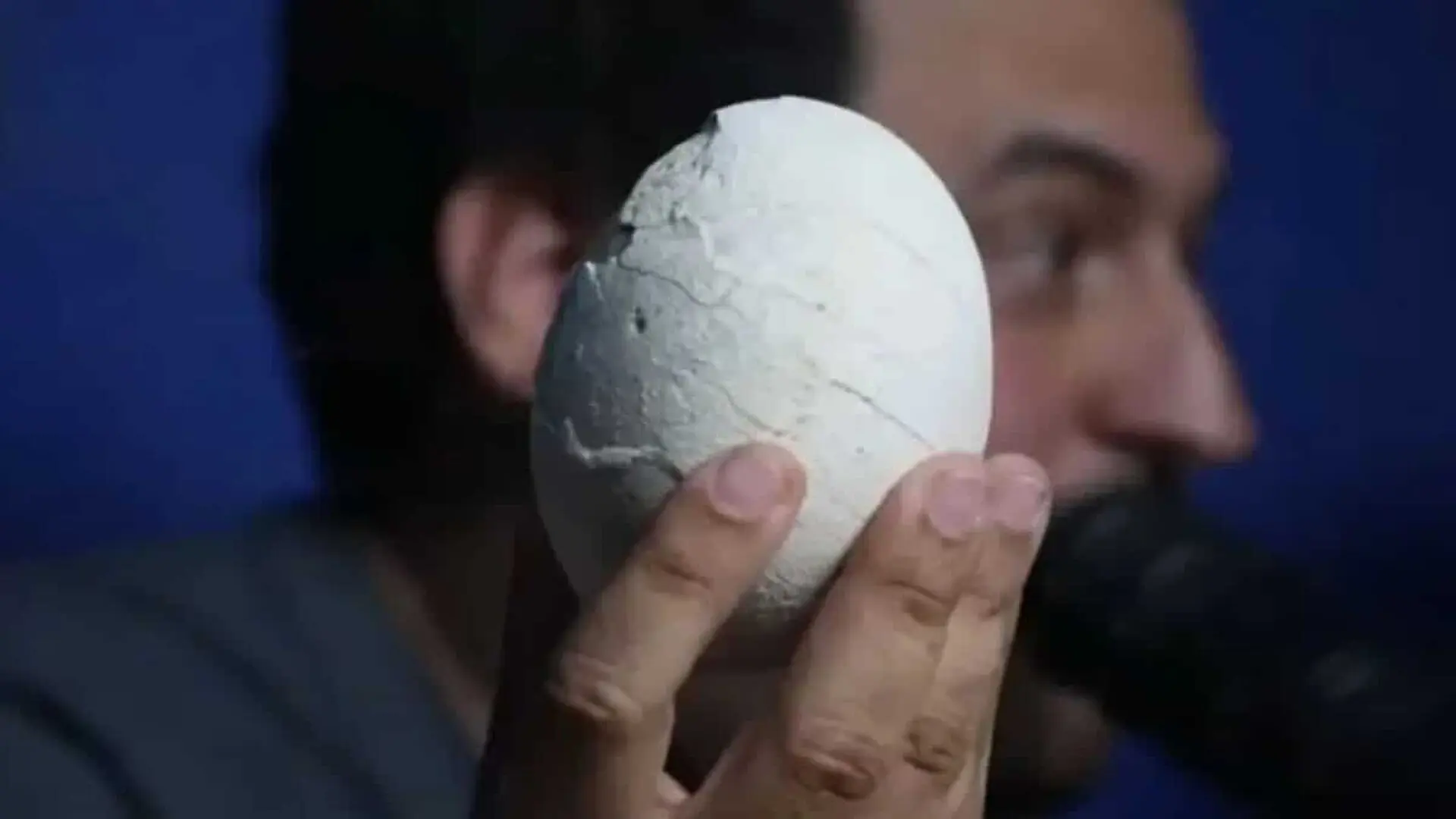
A team of Argentine paleontologists has announced the recovery of a nearly complete fossil egg dating back roughly 70 million years, recovered from Patagonia’s Allen Formation. If an embryonic remain is confirmed inside, the specimen could become the first complete carnivorous‑dinosaur egg from South America to retain its developing offspring.
The egg emerged during the first field campaign of the Cretaceous Expedition, a live‑streamed research effort conducted in Río Negro Province. The dig was directed by paleontologists Federico Agnolín and Matías Motta, who kept the find under wraps until the moment it was broadcast, allowing viewers worldwide to share the surprise.
Beyond the rarity of the egg itself, such specimens can illuminate aspects of dinosaur biology that skeletal remains cannot, including nesting strategies, reproductive cycles, and parental care. The expedition, organized by the Laboratory of Comparative Anatomy and Evolution of Vertebrates (LACEV) at the Argentine Museum of Natural Sciences, had already reported a suite of significant discoveries, ranging from hadrosaur‑like dinosaurs to a long‑necked sauropod and several tiny mammals.
An Egg in Unusual Condition
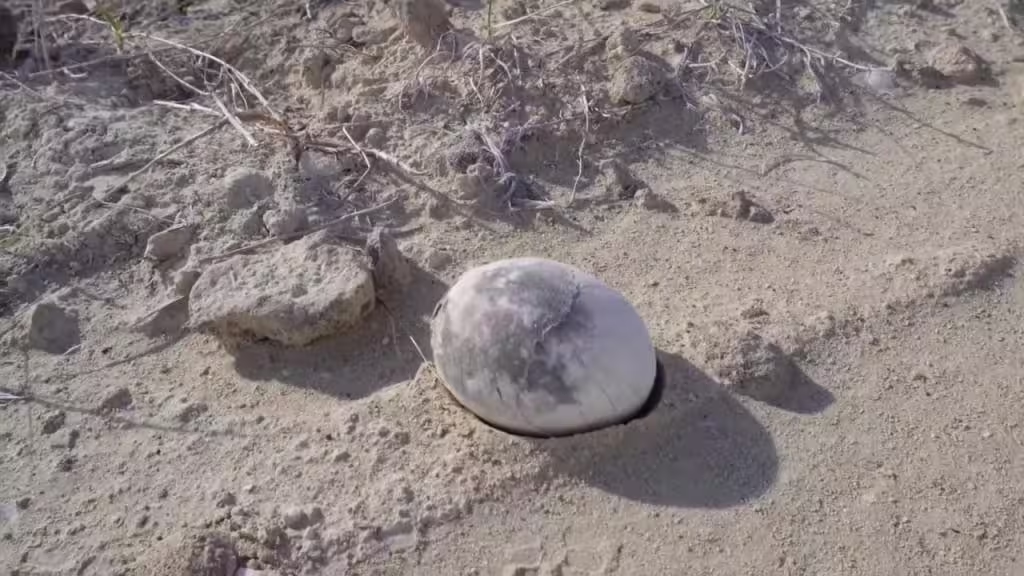
The specimen stood out immediately because its shell, bleached white after millions of years of exposure, retained an astonishing level of integrity. Federico Agnolín recalled being initially skeptical that the object was indeed fossilized.
Researchers propose that the egg may represent the most complete and best‑preserved carnivorous‑dinosaur egg yet documented, possibly belonging to a yet‑unknown species. Its oval contour, more reminiscent of avian eggs than the rounder, thicker shells typical of sauropods, points toward a theropod origin.
Prior to unveiling the egg, the field party had already recovered fossils interpreted as two distinct duck‑bill dinosaurs, a long‑necked sauropod, and a collection of diminutive mammals, underscoring the productivity of the season.
Who Laid This Egg?
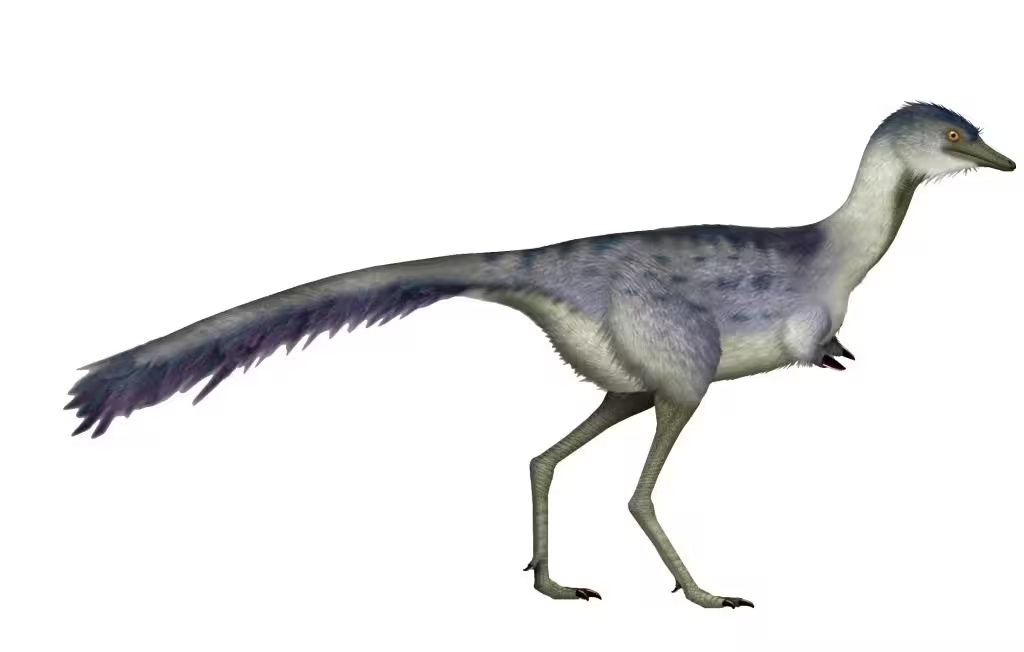
Pinpointing the parent species remains a central challenge. Early hypotheses focused on Bonapartenykus, a small theropod known from the Late Cretaceous of the same region, but comparative analysis of shell microstructure dismissed that match.
The ornamentation on the shell surface differed from known fragments, suggesting the egg originated from a different carnivorous dinosaur, perhaps one whose adult form has yet to be discovered.
“We believe we’re looking at another kind of carnivorous dinosaur — perhaps one whose adult form is not yet known,” he added, confirming its identity will require a detailed study of the shell’s microscopic structure.
The team plans to subject the egg to micro‑CT scanning, a non‑destructive method capable of revealing internal anatomy and any potential embryonic remains.
A confirmed embryo would be an exceptional find. While dinosaur embryos have been documented worldwide, Argentine records to date involve only sauropods; a carnivorous theropod embryo would fill a notable gap. Agnolín expressed cautious optimism, noting that preservation odds are slim but the scientific payoff would be substantial.
Nest Evidence Could Redefine Behavior
The egg was not isolated. Adjacent fragments of shell and eroded material appear to form part of a larger nest structure. The same stratigraphic horizon also yielded remains of Rocasaurus muniozi, a titanosaur noted for bird‑like respiratory adaptations.
If the assemblage proves to be a genuine nesting site, it would mark the first documented carnivorous‑dinosaur nest from South America, offering rare insight into reproductive habits near the close of the Cretaceous.
“A skeleton doesn’t tell you any of that,” he adds. “It doesn’t reveal whether the animal cared for its offspring, or whether it was social or solitary. A nest, on the other hand, does. And that’s what’s fascinating. It lets us glimpse the behavior of animals that lived 70 million years ago. That’s the true value of this discovery,” stated Agnolín.
Theropods occupy a pivotal position in the dinosaur‑bird transition. Modern birds, their descendants, construct nests, incubate eggs, and nurture hatchlings. Examining ancient theropod eggs and nesting contexts may illuminate the evolutionary steps that gave rise to these complex behaviors.
This article has been fact checked for accuracy, with information verified against reputable sources. Learn more about us and our editorial process.
Last reviewed on .
Article history
- Latest version
Reference(s)
- “Paleontólogos del CONICET participan de la primera campaña transmitida en vivo para buscar dinosaurios en la estepa patagónica.”, October 7, 2025 Museo de Ciencias Naturales <https://www.macnconicet.gob.ar/paleontologos-del-conicet-participan-de-la-primera-campana-transmitida-en-vivo-para-buscar-dinosaurios-en-la-estepa-patagonica/>.
- <https://www.researchgate.net/profile/Federico-Agnolin-2>.
Cite this page:
- Posted by Hassan Raza